Arrival of Ferdinand Magellan at Homonhon
1521 · Homonhon, Philippines
Ferdinand Magellan arrived at the island of Homonhon in the Philippines, marking the first recorded visit by Europeans to the archipelago.
March 16, 1521
Ferdinand Magellan reaches the Philippines during his expedition to circumnavigate the globe, marking the first European contact with the islands.
, Philippines | Spanish Empire
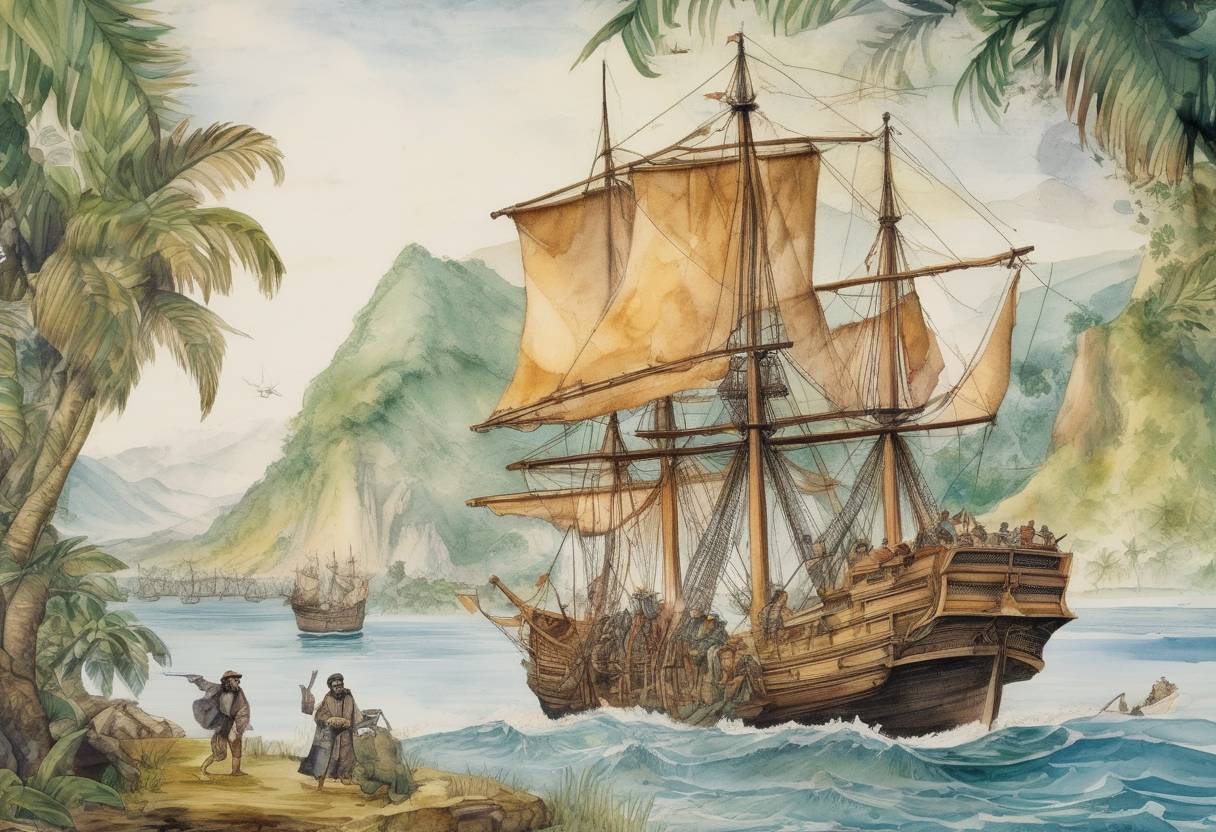
On March 16, 1521, the Portuguese explorer Ferdinand Magellan, leading a Spanish expedition, reached the Philippine archipelago, marking the first recorded European contact with the islands. This event was a significant milestone in the Age of Exploration and had profound implications for global navigation and European colonial expansion.
Ferdinand Magellan: Born in Portugal around 1480, Magellan became a skilled sailor and navigator. Despite his Portuguese origins, he secured the backing of the Spanish crown for his ambitious expedition to find a westward route to the Spice Islands (the Moluccas).
The Expedition: Magellan set sail from Spain on September 20, 1519, with a fleet of five ships and about 270 men. The expedition aimed to find a new route to Asia by sailing westward, thus avoiding the Portuguese-controlled eastern routes.
Journey Across the Pacific: After navigating the treacherous strait at the southern tip of South America, now known as the Strait of Magellan, the fleet entered the Pacific Ocean. The crossing was arduous, with the crew suffering from scurvy and starvation due to the lack of fresh provisions.
First Contact: On March 16, 1521, Magellan’s fleet sighted the island of Samar in the Philippines. This marked the first European contact with the archipelago. The fleet anchored at the island of Homonhon, where they were met by local inhabitants.
Interactions with Locals: Magellan and his crew were initially received with hospitality. They established friendly relations with some local leaders, notably Rajah Humabon of Cebu, who converted to Christianity along with many of his subjects.
Cultural Exchange: The arrival of Magellan in the Philippines initiated a period of cultural exchange and laid the groundwork for future Spanish colonization. The introduction of Christianity had a lasting impact on the cultural and religious landscape of the islands.
Magellan’s Demise: Despite initial successes, Magellan’s expedition faced challenges. On April 27, 1521, Magellan was killed in the Battle of Mactan, led by the local chieftain Lapu-Lapu, who resisted Spanish influence.
Circumnavigation Completion: Although Magellan did not survive the journey, his expedition eventually succeeded in circumnavigating the globe. Under the command of Juan Sebastián Elcano, the remaining crew completed the voyage, returning to Spain in 1522. This achievement proved the feasibility of global circumnavigation and the vastness of the Earth.
Colonial Expansion: The contact initiated by Magellan paved the way for Spanish colonization of the Philippines, which lasted for over three centuries. The Philippines became a crucial part of Spain’s global empire.
Navigation and Exploration: The expedition demonstrated the potential of global maritime exploration and contributed to the mapping of the world, influencing future voyages and the expansion of European influence across the globe.
Magellan’s arrival in the Philippines remains a pivotal moment in history, symbolizing the interconnectedness of different cultures and the beginning of a new era of global exploration and exchange.
Source: en.wikipedia.org