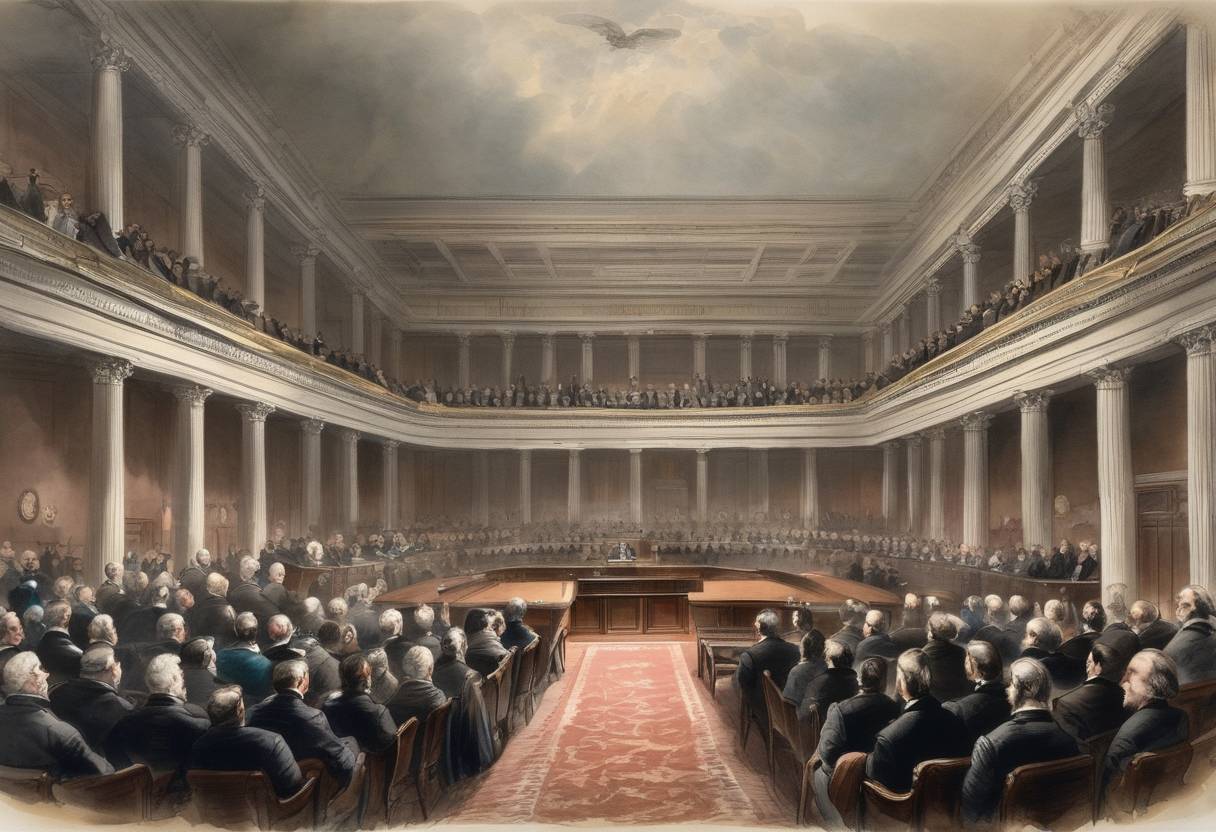
Impeachment Trial of President Andrew Johnson
On March 5, 1868, the impeachment trial of President Andrew Johnson commenced in the United States Senate. This marked the first time in American history that a sitting president was put on trial for impeachment, a significant event in the nation’s legislative history.
Background
President Andrew Johnson, who assumed office following the assassination of Abraham Lincoln in 1865, faced growing discontent from the Radical Republicans in Congress. His lenient approach to Reconstruction and frequent vetoes of legislation intended to protect the rights of freed slaves put him at odds with many lawmakers.
The political tension escalated with Johnson’s violation of the Tenure of Office Act, a controversial law passed in March 1867. The Act restricted the president’s power to remove certain officeholders without Senate approval. Johnson challenged this by dismissing Edwin M. Stanton, the Secretary of War, and a staunch Radical Republican ally.
Articles of Impeachment
In response to Johnson’s actions, the House of Representatives adopted eleven articles of impeachment against him on February 24, 1868. The most significant charge was the violation of the Tenure of Office Act, but the articles also accused him of bringing disgrace to the presidency through inflammatory speeches and resisting the authority of Congress.
The Trial
The Senate trial opened on March 5, 1868, with Chief Justice Salmon P. Chase presiding. The prosecution was led by representatives known as the House Managers. Johnson did not personally attend the trial but was represented by his legal defense team.
The trial proceedings were a major event, drawing attention from across the nation. Discussions and debates revolved around constitutional interpretations of presidential powers and the legality of the Tenure of Office Act.
Outcome
After nearly three months of legal arguments, debates, and testimonies, the Senate fell short of convicting Andrew Johnson. On May 16 and May 26, 1868, three critical votes were held, with each resulting in a 35-19 outcome — one vote shy of the two-thirds majority required for conviction.
Historical Significance
The impeachment trial of Andrew Johnson was a pivotal moment in U.S. history. It tested the balance of power between the presidency and Congress and set precedents regarding the limits of executive power. The Tenure of Office Act was later found to be unconstitutional, reinforcing the argument that Johnson’s dismissal of Stanton should not have led to impeachment.
This trial highlighted the complexities of Reconstruction era politics and left lasting impacts on subsequent interpretations of presidential authority and the impeachment process.