California's Admission as the 31st State: September 9, 1850
1850 · Washington D.C., United States
California was admitted as the 31st state of the United States as part of the Compromise of 1850.
January 29, 1850
Henry Clay introduced the Compromise of 1850 to the U.S. Congress, a series of measures intended to ease tensions between slave and free states.
Washington D.C., United States | United States Congress
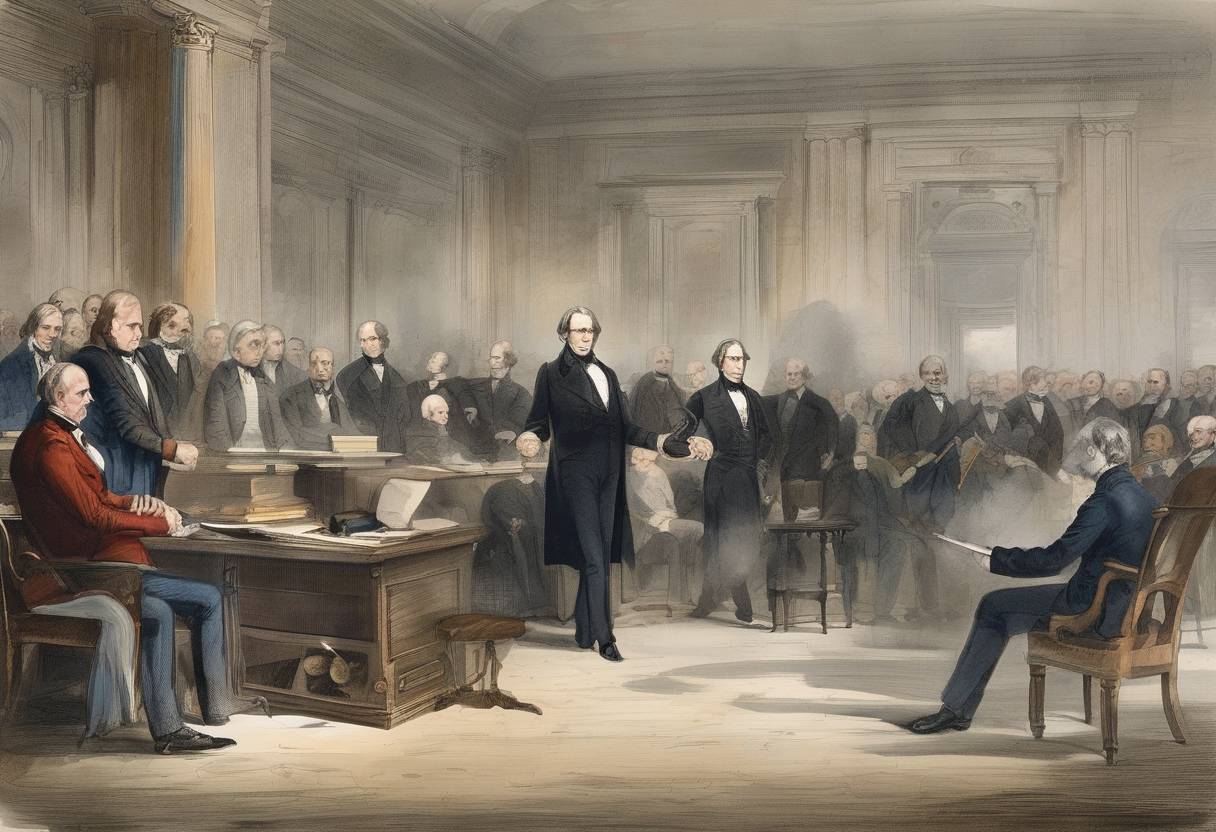
On January 29, 1850, Henry Clay, a prominent American statesman and senator from Kentucky, introduced a series of legislative measures to the United States Congress known as the Compromise of 1850. This set of proposals aimed to address and mitigate the escalating tensions between slave and free states following the territorial gains from the Mexican-American War (1846-1848).
The acquisition of vast territories from Mexico, including present-day California, Arizona, New Mexico, and Utah, reignited the contentious debate over the expansion of slavery into new states and territories. The Missouri Compromise of 1820 had previously attempted to balance the interests of slave and free states, but the new territories threatened to upset this delicate balance.
Henry Clay’s Compromise of 1850 consisted of five main components designed to appease both Northern and Southern interests:
California Admission: California was to be admitted to the Union as a free state, tipping the balance in favor of free states in the Senate.
Territorial Status and Popular Sovereignty: The territories of New Mexico and Utah were to be organized without any immediate decision on the status of slavery. Instead, the question of whether to permit slavery would be determined by popular sovereignty, allowing settlers in those territories to decide.
Texas Boundary and Debt: Texas, a slave state, agreed to relinquish claims to parts of New Mexico in exchange for federal assumption of its public debt.
Slave Trade in Washington, D.C.: The compromise abolished the slave trade (but not slavery itself) in the nation’s capital, Washington, D.C., addressing a significant moral concern for abolitionists.
Fugitive Slave Act: A new, stricter Fugitive Slave Law was enacted, requiring citizens to assist in the capture of runaway slaves and imposing penalties on those who aided their escape. This provision was particularly controversial and inflamed Northern opposition.
The Compromise of 1850 temporarily eased sectional tensions and postponed the outbreak of the Civil War. It was a testament to Henry Clay’s skill as a negotiator, earning him the nickname “The Great Compromiser.” However, the measures, particularly the Fugitive Slave Act, intensified Northern resistance to slavery and contributed to the rise of the abolitionist movement.
The Compromise highlighted the deep divisions within the United States over the issue of slavery and underscored the challenges of maintaining a union of states with fundamentally opposing economic and moral views. While it delayed conflict, it ultimately set the stage for the more profound national crisis that would erupt a decade later with the onset of the Civil War.
In summary, the Compromise of 1850 was a critical moment in American history, reflecting the complexities and contradictions of a nation grappling with the moral and political challenges of slavery.
Source: www.senate.gov