California's Admission as the 31st State: September 9, 1850
1850 · Washington D.C., United States
California was admitted as the 31st state of the United States as part of the Compromise of 1850.
December 5, 1848
In his State of the Union address to Congress, President James K. Polk reaffirms the validity of U.S. territorial claims after the Mexican-American War and urges the admission of California and New Mexico as states.
Washington D.C., United States | United States Congress
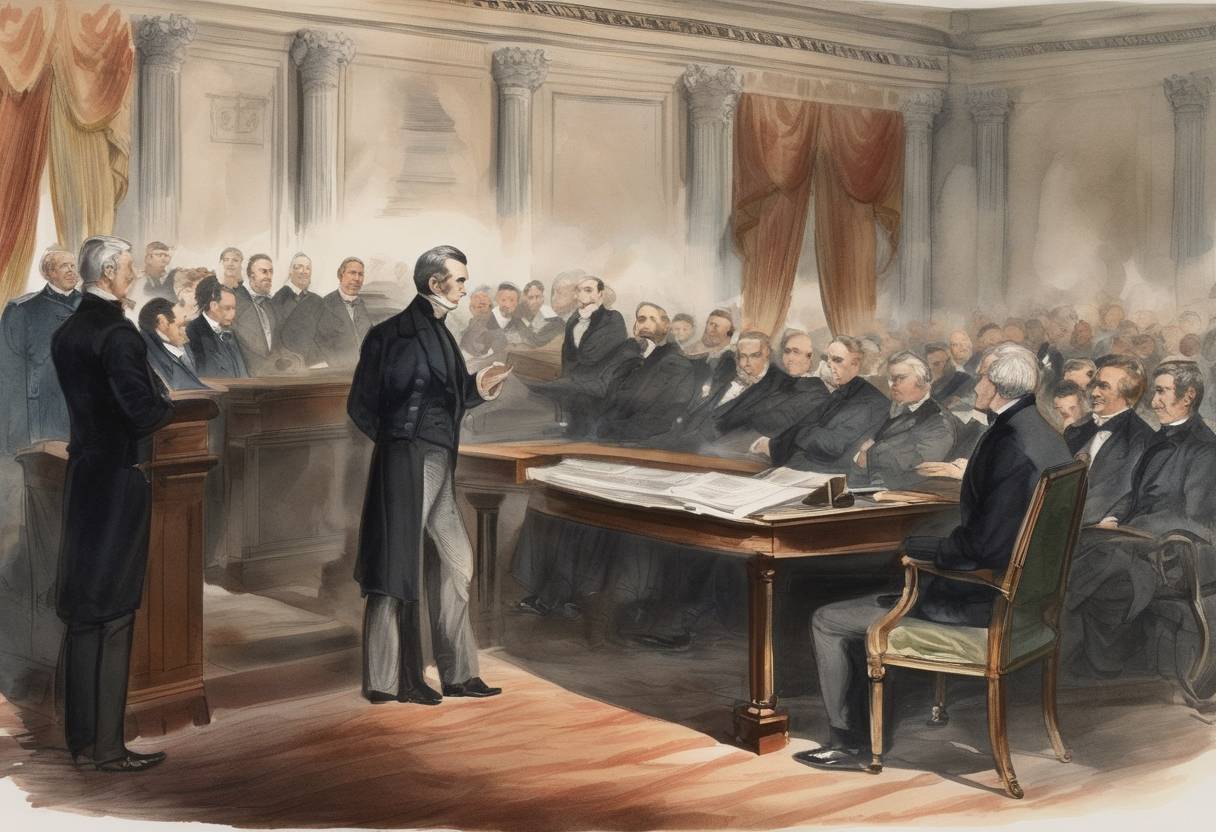
On December 5, 1848, President James K. Polk delivered his annual State of the Union address to Congress, focusing on the outcomes and implications of the recently concluded Mexican-American War. In this pivotal speech, Polk reaffirmed the United States’ territorial claims arising from the war and discussed the potential statehood of newly acquired territories, particularly California and New Mexico.
The Mexican-American War, fought from 1846 to 1848, was primarily ignited by territorial disputes following the United States’ annexation of Texas in 1845. Tensions escalated as both nations laid conflicting claims to lands between the Rio Grande and the Nueces River. President Polk, an advocate of Manifest Destiny, aimed to expand U.S. territory further, which led to the war declaration after an armed conflict near the disputed boundary.
The war concluded with the signing of the Treaty of Guadalupe Hidalgo on February 2, 1848. Under the treaty’s terms, Mexico ceded vast tracts of land to the United States, including present-day California, Nevada, Utah, and portions of Arizona, New Mexico, Colorado, and Wyoming.
Validation of Territorial Claims: President Polk used his address to solidify the legitimacy of the newly acquired territories, underscoring the Treaty of Guadalupe Hidalgo as a legal foundation reinforcing U.S. sovereignty over these lands.
Statehood Proposals: Polk advocated for the admission of California and New Mexico into the Union as states. The speech highlighted their economic and strategic importance, especially California’s burgeoning population due to the Gold Rush, which began in early 1848.
National Growth and Prosperity: The address reflected on the potential for economic expansion and national stature from these additions, with Polk emphasizing the benefits of integrating these territories into the Union to support overall national growth.
Slavery and Expansion: Although not directly addressed in this speech, the underlying tension over the extension of slavery into new territories was a significant national concern. Polk’s proposals were set against the contentious backdrop of free vs. slave state debates, which would continue to shape American politics leading up to the Civil War.
The proposals from Polk’s address marked the beginning of a complex process as Congress debated the issues of governance and admission of new states. The question of whether slavery would be allowed in these new territories would dominate American politics, leading to the Compromise of 1850.
California was admitted to the Union as a free state in 1850, following intense political negotiation. Meanwhile, New Mexico and Utah were organized as territories without a direct decision on slavery, subject to popular sovereignty.
Polk’s presidency and his territorial expansions left a lasting impact on the United States, embodying the notion of Manifest Destiny and setting the stage for transformative changes in the nation’s political landscape.
Source: millercenter.org