Election of Franklin Pierce as the 14th President of the United States
1852 · Washington D.C., United States
Franklin Pierce was elected the 14th President of the United States.
November 6, 1820
The U.S. presidential election of 1820, marking James Monroe's second term, took place. Monroe ran effectively unopposed in this election, leading to one of the least contested presidential elections in American history.
Washington D.C., United States | United States Government
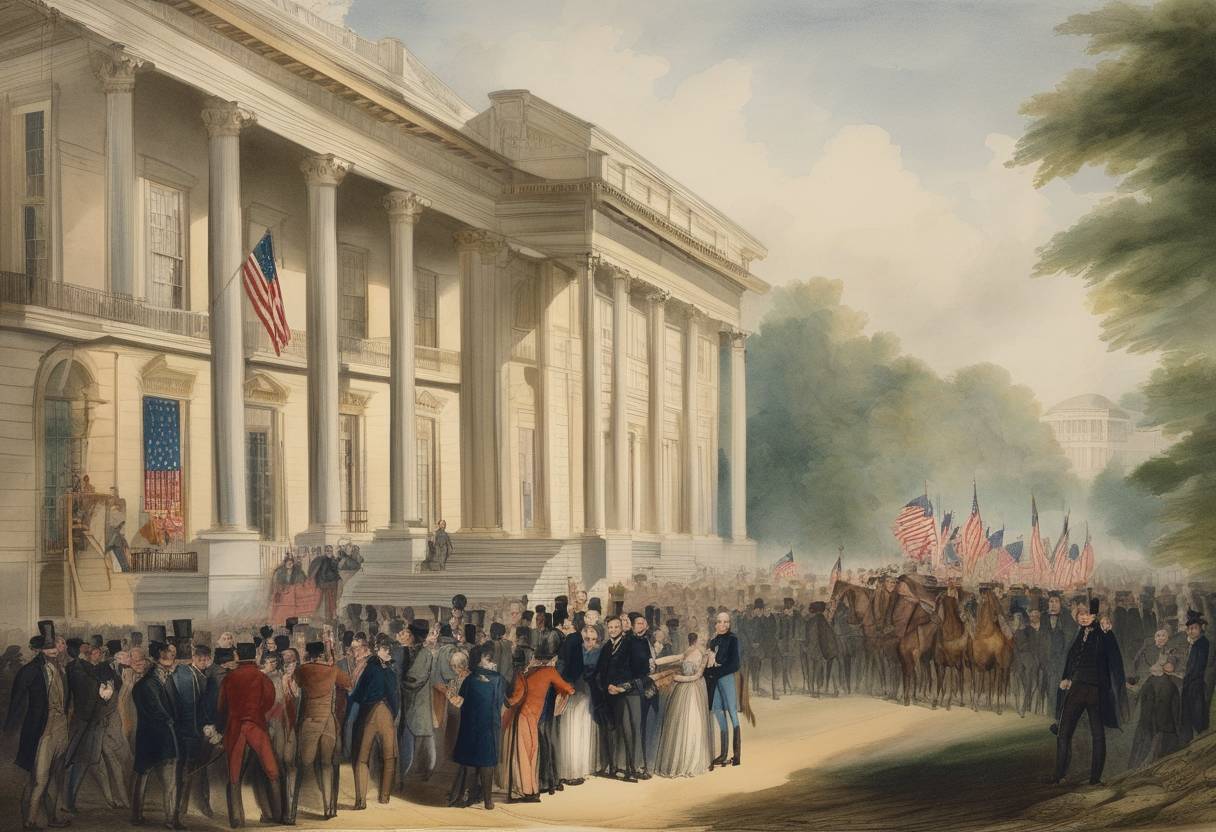
On November 6, 1820, the United States held its presidential election, a significant event marking the re-election of James Monroe, cementing one of the least contested elections in American history. This election is noteworthy for Monroe’s effective unopposed run, reflecting a period known as the “Era of Good Feelings,” characterized by the dominance of the Democratic-Republican Party and a decline in partisan conflict.
James Monroe, the incumbent president, was first elected in 1816, succeeding James Madison. His presidency came at a time when the Federalist Party, which had been a dominant force in earlier elections, was waning in influence and effectively dissolved after the War of 1812. The war had severely damaged the Federalists’ reputation, especially with the Hartford Convention’s opposition stance, which appeared unpatriotic.
Monroe’s first term was marked by national unity and the absence of viable political opposition, allowing Monroe to govern without significant political strife. His administration focused on national unity, westward expansion, and fostering economic growth. The Missouri Compromise of 1820 was one of the notable legislative achievements during his first term, addressing the contentious issue of slavery’s expansion into new territories.
During the 1820 election, Monroe faced minimal opposition. He was the candidate for the Democratic-Republican Party, the sole surviving national party after the Federalist Party’s collapse. The absence of a strong opposing party or candidate led to an almost unanimous election result.
The formal opposition was so weak that no other candidates declared their intent to run against Monroe. In fact, the electoral vote results show that only one elector cast a vote against Monroe, voting for John Quincy Adams instead. The elector’s motivation was reportedly to ensure that George Washington remained the only president unanimously elected by the Electoral College.
James Monroe won re-election with 231 out of 232 electoral votes, which was unprecedented in its near unanimity. This victory underscored the lack of political rivalry and public contention during his presidency.
Monroe’s second term continued to emphasize national consolidation and prosperity. He sought to maintain the country’s momentum in expanding westward and integrating the new territories into the union while maintaining peace with European powers.
The election of 1820 demonstrated the ephemeral nature of political opposition in the United States. Still, it also set the stage for future political realignments, particularly the emergence of new political parties that would eventually challenge the dominant Democratic-Republicans, leading to the two-party system that defines American politics today.
Source: en.wikipedia.org