The Siege of Masada and its Conclusion on April 14, 73 CE
73 · Masada, Roman Empire (modern-day Israel)
The Siege of Masada culminated in a mass suicide, ending the First Jewish–Roman War.
April 8, 0070
The Siege of Jerusalem by Roman forces commenced as part of the First Jewish-Roman War.
Jerusalem, Judea (modern-day Israel) | Roman Empire
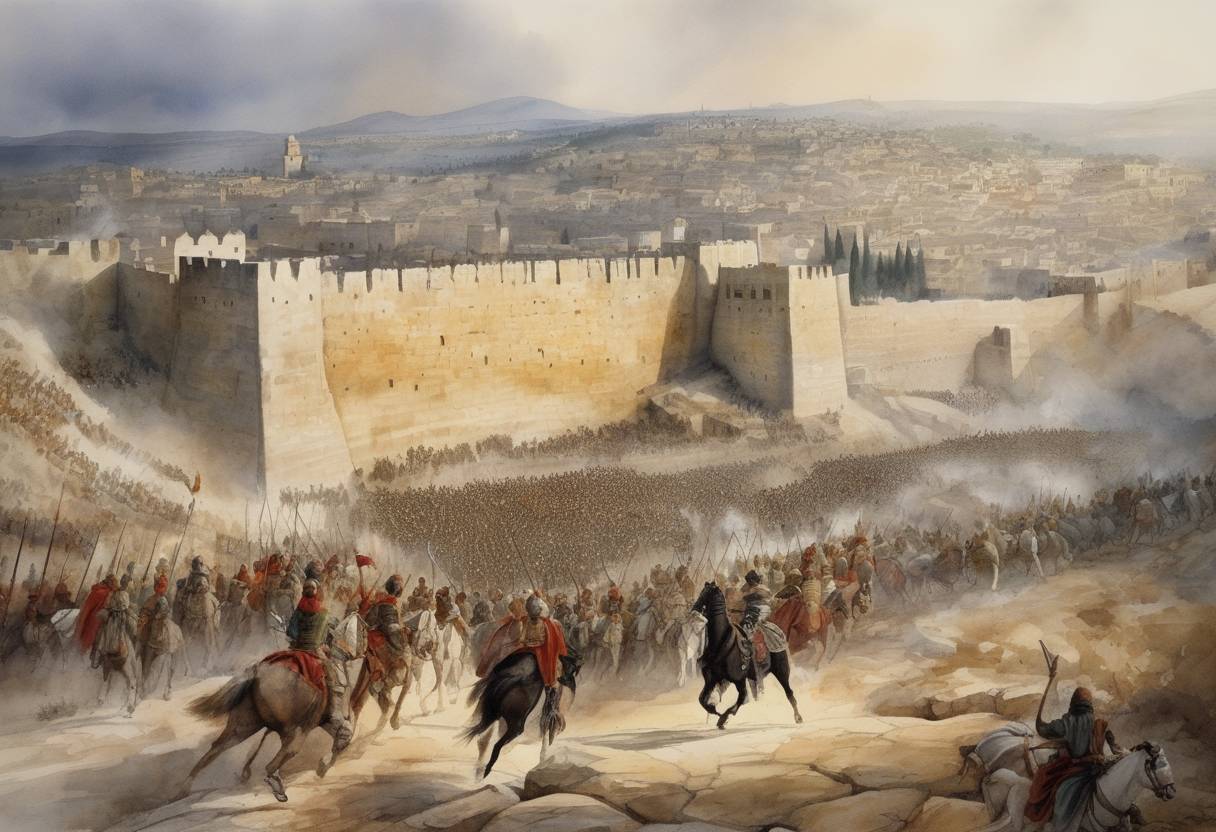
The Siege of Jerusalem began on April 8, 70 CE, as part of the First Jewish-Roman War, also known as the Great Jewish Revolt. This pivotal conflict occurred when Roman legions, commanded by the future Emperor Titus, besieged the city of Jerusalem. The event was marked by significant battles and severe consequences for the Jewish population and their polities.
The First Jewish-Roman War erupted in 66 CE due to long-standing tensions between Jewish communities in the Roman province of Judea and the Roman authorities. These tensions were fueled by heavy taxation, religious persecution, and administrative corruption. The immediate cause of the war was a revolt against Roman rule, which quickly escalated into a full-scale rebellion.
In the preceding months leading into April 70 CE, the Roman legions, under General Vespasian and later his son Titus, systematically subdued other rebellious territories in Galilee and Judea, isolating Jerusalem for a decisive strike.
Jerusalem was not only the spiritual and cultural center of Jewish life but also a strategically defensible location with its robust fortifications. The city was heavily fortified with complex wall systems surrounding it, including parts built by King Herod and earlier Jewish kings.
Titus began the siege by first cutting off supplies to the city. The Roman forces constructed a circumvallation, a massive wall meant to prevent the besieged from escaping, stretching about 4.5 miles and completed in three days. The Roman army consisted of four legions along with additional support troops, bringing a formidable force to the siege.
The defenders of Jerusalem were composed of various Jewish factions, which often clashed with each other, complicating the defensive efforts. Tensions among different Jewish groups, including the Zealots and their sectarian rivals, weakened the city’s internal cohesion.
As the siege wore on, the inhabitants of Jerusalem faced severe food shortages, leading to starvation and plague. The psychological warfare used by Romans and dire conditions heightened the desperation among the defenders.
The siege culminated in the eventual breach of the city’s defenses after months of intense fighting, leading to the fall of Jerusalem. The Romans captured the city in September 70 CE, ending in widespread destruction. The Temple, a symbol of Jewish identity and faith, was destroyed, marking a significant event in Jewish history.
The Siege of Jerusalem is considered a crucial event that shaped Jewish history and Roman imperial policies, highlighting the tensions between religious faith and imperial aspirations. The consequences of this siege were profound, influencing the architectural, religious, and cultural landscapes of the time.
Source: www.britannica.com