Indira Gandhi Elected as Prime Minister of India
1966 · New Delhi, India
Indira Gandhi was elected as the first female Prime Minister of India.
October 31, 1984
Indian Prime Minister Indira Gandhi is assassinated by her bodyguards in New Delhi.
New Delhi, India | Indian Government
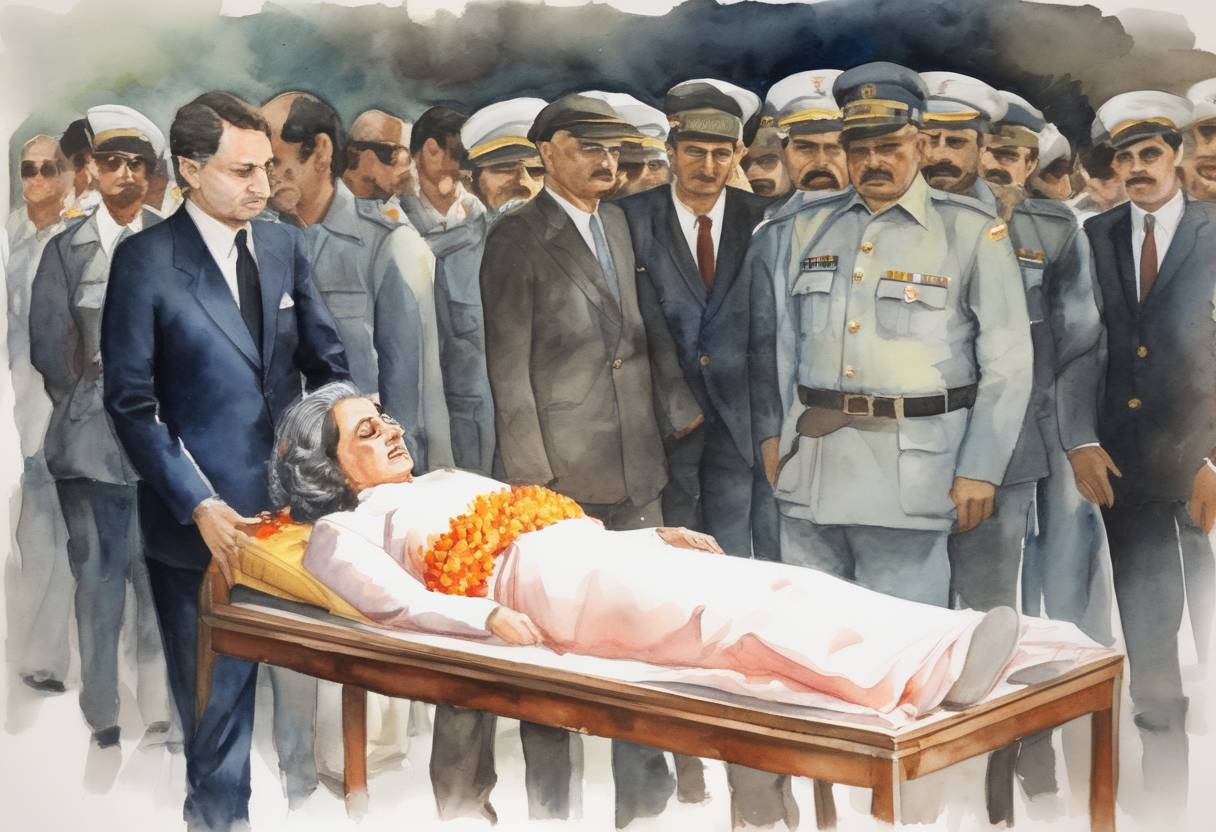
On October 31, 1984, Indira Gandhi, the Prime Minister of India, was assassinated by her own bodyguards at her residence in New Delhi. This tragic event marked a significant turning point in Indian history, with profound political and social repercussions.
Indira Gandhi, the daughter of Jawaharlal Nehru, India’s first Prime Minister, was a central figure in Indian politics. She served as Prime Minister from 1966 to 1977 and again from 1980 until her assassination in 1984. Her tenure was marked by significant events, including the Green Revolution, the Emergency period (1975-1977), and efforts to centralize power.
A key event leading up to her assassination was Operation Blue Star, a military operation ordered by Indira Gandhi in June 1984. The operation aimed to remove Sikh militants, led by Jarnail Singh Bhindranwale, from the Golden Temple in Amritsar, Punjab. The operation resulted in significant casualties and damage to the holy Sikh shrine, causing widespread anger and resentment among the Sikh community.
On the morning of October 31, 1984, Indira Gandhi was on her way to be interviewed by British actor and author Peter Ustinov for a documentary. As she walked through the garden of her residence at 1 Safdarjung Road, she was shot by two of her Sikh bodyguards, Satwant Singh and Beant Singh. Beant Singh fired three rounds into her abdomen, followed by Satwant Singh, who emptied his Sten gun into her body. She was rushed to the All India Institute of Medical Sciences (AIIMS), where she was declared dead.
The assassination led to a series of violent anti-Sikh riots across India, particularly in Delhi, resulting in the deaths of thousands of Sikhs. These riots were marked by widespread arson, looting, and murder, with allegations of political complicity and inaction by the authorities.
Indira Gandhi’s death led to a swift political transition. Her son, Rajiv Gandhi, was sworn in as Prime Minister on the evening of her assassination. The Congress Party, leveraging the sympathy wave, won a landslide victory in the subsequent general elections held in December 1984.
Both assassins were apprehended immediately after the attack. Beant Singh was killed in custody, while Satwant Singh, along with co-conspirator Kehar Singh, was tried and executed in 1989.
Indira Gandhi’s assassination highlighted the deep-seated tensions between the Indian government and the Sikh community, exacerbated by Operation Blue Star. It also underscored the volatile nature of Indian politics during the period and had lasting impacts on the country’s socio-political landscape.
The event remains a poignant reminder of the challenges of maintaining national unity in a diverse and multi-ethnic society like India.
Source: en.wikipedia.org