NASA Launches Mariner 10: A Historic Mission
1973 · Cape Canaveral, United States
NASA launches Mariner 10, the first spacecraft to fly by two planets, Venus and Mercury.
June 14, 1967
Mariner 5, a NASA spacecraft, is launched towards Venus to conduct atmospheric experiments.
Cape Canaveral, USA | NASA
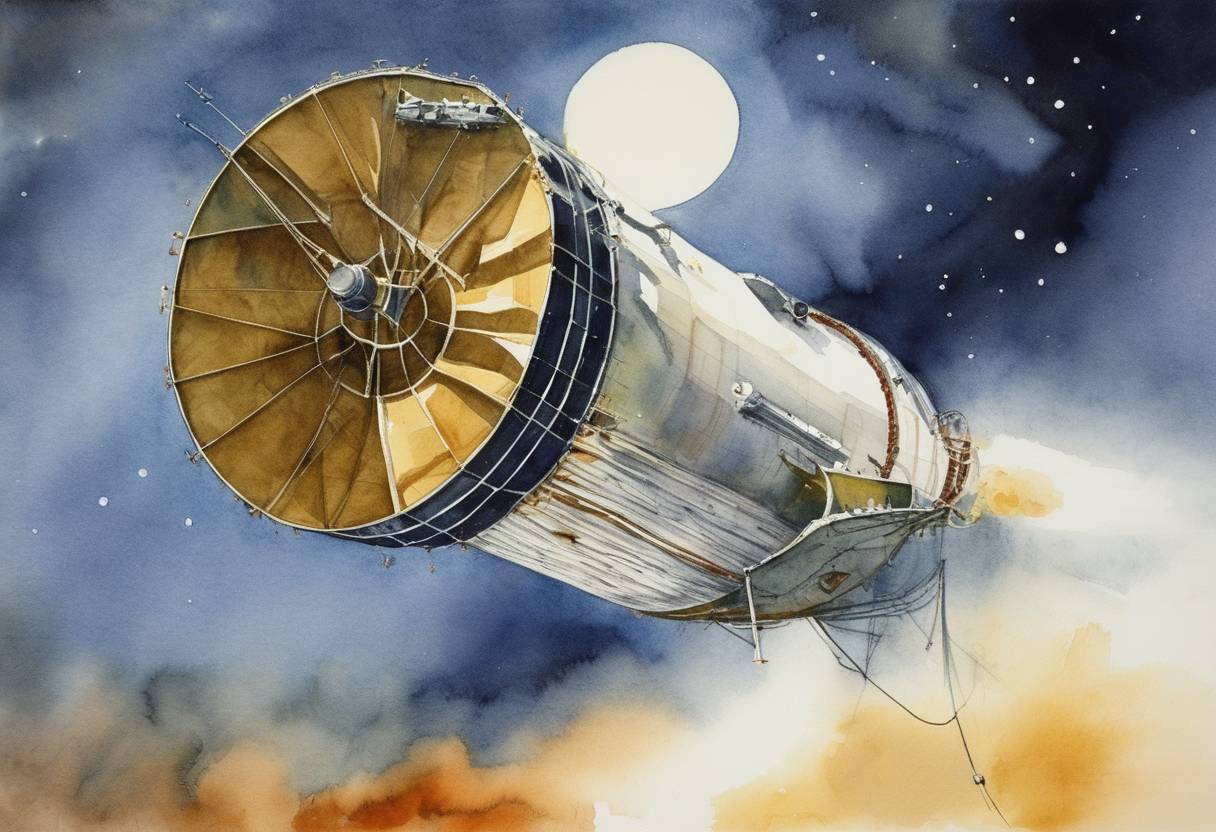
On June 14, 1967, NASA successfully launched the Mariner 5 spacecraft, part of the Mariner program aimed at exploring the planetary bodies of the solar system. Mariner 5 was specifically designed to conduct scientific experiments to study the atmosphere of Venus, following in the footsteps of its predecessor, Mariner 2, which had conducted the first successful flyby of Venus in 1962.
Mariner 5 was initially constructed as a backup for the Mariner 4 mission, which was targeted towards Mars. However, after the successful flyby of Mars by Mariner 4, the decision was made to repurpose the backup spacecraft for a mission to Venus. The spacecraft was modified to optimize its scientific payload for Venusian atmosphere studies.
The primary objectives of Mariner 5 included:
The scientific instruments on board included a cosmic dust detector, a solar plasma probe, a magnetometer, and radio equipment capable of receiving signals reflected from the atmosphere of Venus.
Mariner 5 was launched at 06:01:00 UTC from Cape Kennedy Air Force Station (now Cape Canaveral), Florida, aboard an Atlas-Agena D rocket. The launch vehicle successfully placed the spacecraft on a trajectory towards Venus.
After a journey of approximately 4 months, Mariner 5 made its closest approach to Venus on October 19, 1967, flying within 3,990 kilometers (2,480 miles) of the planet’s surface.
Key achievements of the mission included:
The mission significantly enhanced scientific understanding of Venus, offering a clearer picture of the conditions on the planet. Many of the findings from Mariner 5 paved the way for future explorations of Venus, including the Soviet Venera series and subsequent NASA missions.
Mariner 5’s successful execution represented a critical milestone in the exploration of Venus and contributed to the growing body of knowledge regarding Earth’s closest planetary neighbor. The mission’s data challenged preconceived notions about the planet, illustrating the complexity of planetary atmospheres and influencing the design of future interplanetary missions.
Source: en.wikipedia.org