Albert Einstein Publishes Special Theory of Relativity
1905 · Bern, Switzerland
Albert Einstein publishes his paper on the special theory of relativity in the journal Annalen der Physik.
June 30, 1905
Albert Einstein submitted his paper 'On the Electrodynamics of Moving Bodies' to the Annalen der Physik, introducing the theory of special relativity.
Bern, Switzerland | Annalen der Physik
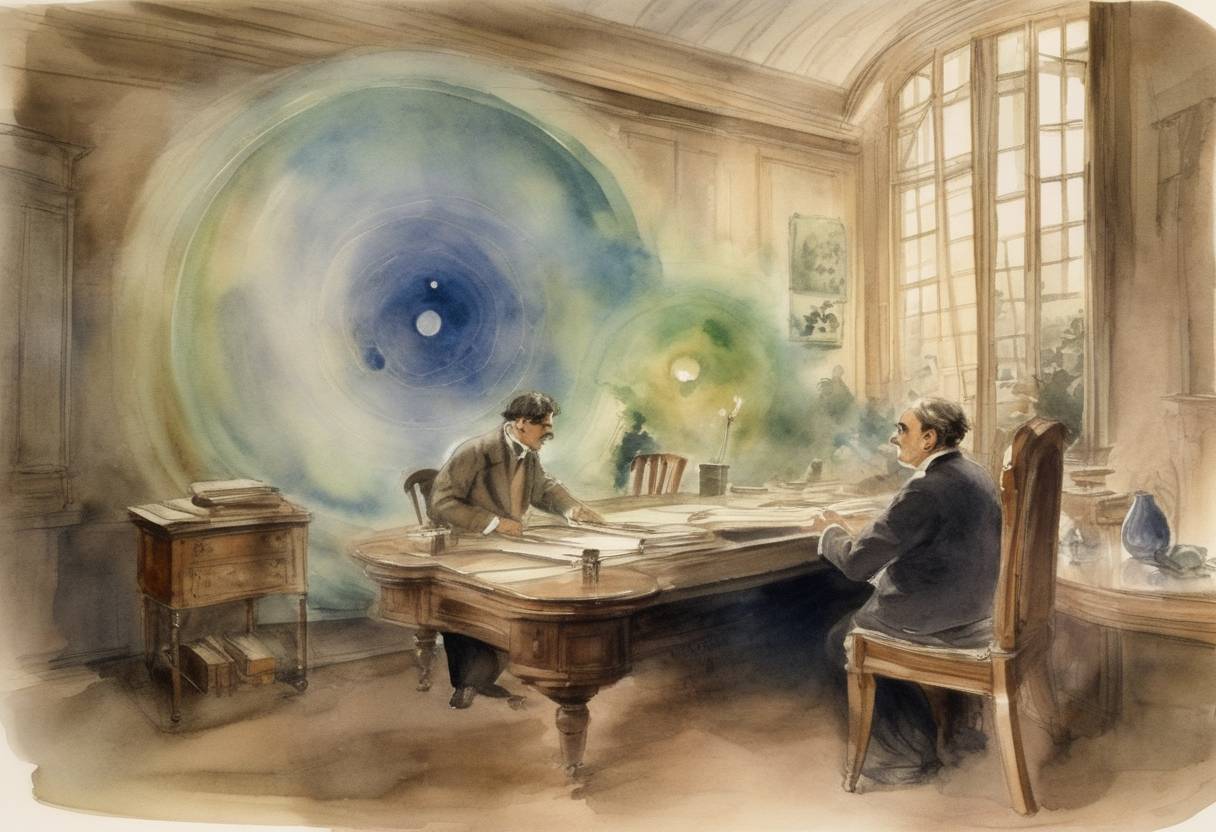
On June 30, 1905, Albert Einstein submitted his groundbreaking paper titled “On the Electrodynamics of Moving Bodies” to the renowned German scientific journal, Annalen der Physik. This paper introduced the theory of special relativity, fundamentally altering the understanding of space, time, and energy.
At the time, physicists were grappling with inconsistencies between the laws of mechanics and Maxwell’s equations of electromagnetism. The prevailing theories could not adequately explain phenomena observed at high velocities, particularly those approaching the speed of light. Einstein’s insights were partly inspired by the works of Hendrik Lorentz and Henri Poincaré, who had explored the mathematics underlying these problems, but had not connected them into a coherent framework as Einstein would.
Einstein’s paper proposed two postulates at the heart of special relativity:
The Principle of Relativity: The laws of physics are invariant (identical) in all inertial frames of reference. This means no physical experiment can distinguish one inertial frame from another.
The Constancy of the Speed of Light: The speed of light in a vacuum is the same for all observers, regardless of their relative motion or the motion of the light source.
These concepts led to the conclusion that time and space are not absolute but relative and interwoven into a single continuum known as spacetime. This was a profound departure from the Newtonian understanding of a static, absolute time and space.
Einstein’s theory introduced the concept of time dilation, where time is observed to be moving slower for a moving clock from the standpoint of a stationary observer, and length contraction, where objects are shortened in the direction of their motion relative to an observer.
Furthermore, the paper laid down the basis for the mass-energy equivalence formula (E=mc^2), which was expanded in a follow-up paper submitted to Annalen der Physik later in 1905. This formula established the interrelationship between mass and energy, leading to revolutionary advancements in physics and technology.
The publication of this paper was a pivotal moment in the history of science, marking the beginning of modern theoretical physics. The concepts established by special relativity have been experimentally validated repeatedly and are critical to the operation of technologies such as GPS. Einstein’s work also paved the way for the development of the general theory of relativity, which further expanded these concepts to include gravity.
The publication on June 30, 1905, thus stands as a cornerstone of contemporary physics, transforming humanity’s understanding of the universe.
Source: www.history.com