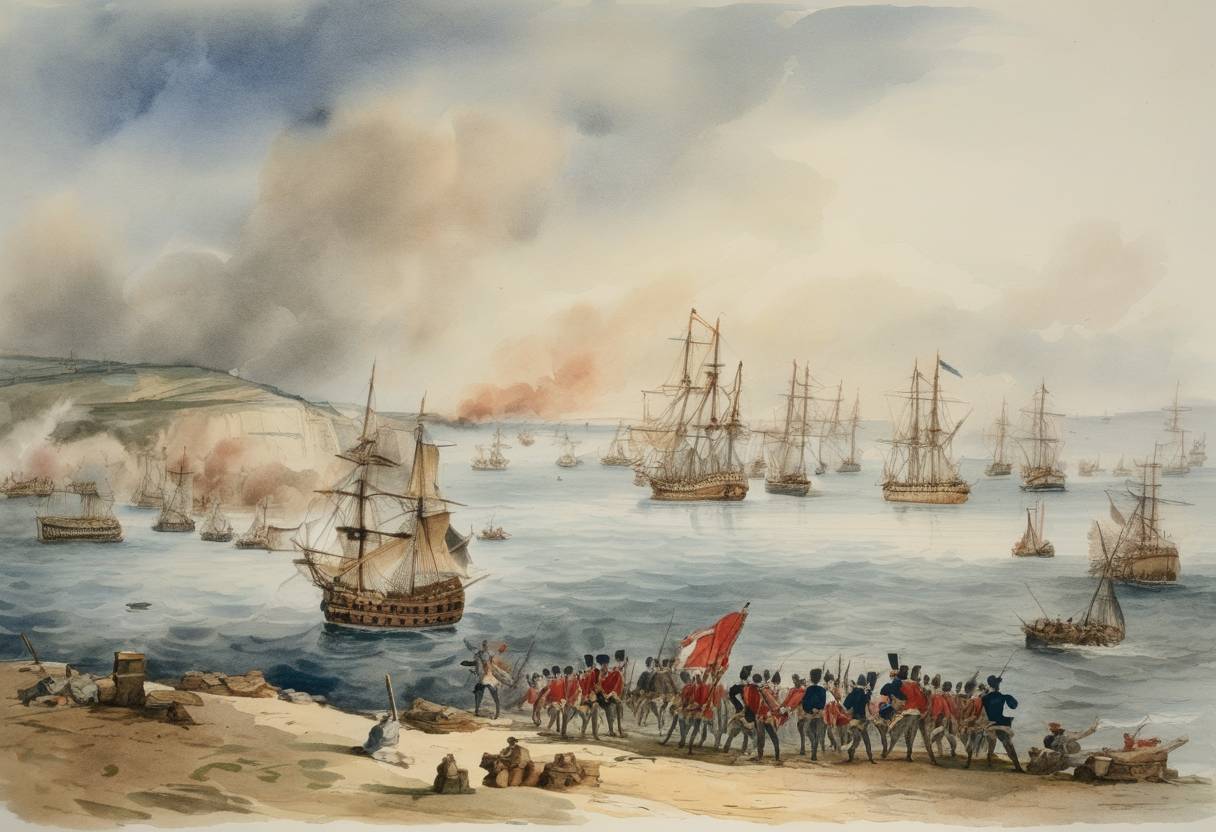
The Second Battle of Quiberon Bay - November 20, 1759
The Second Battle of Quiberon Bay was a critical naval engagement in the Seven Years’ War, occurring on November 20, 1759. This clash between France and Britain is noted for its decisive outcome, where the British fleet thwarted a French attempt to mount an invasion of Britain.
Context
The Seven Years’ War (1756-1763) was a global conflict, often regarded as the first “world war” due to its theatres spanning Europe, the Americas, West Africa, India, and the Philippines. One of Britain’s objectives was to eliminate French naval capabilities to secure naval supremacy and protect their territories.
Lead-Up to the Battle
Leading up to the engagement, the French navy, under Marshal de Conflans, sought to break a British blockade and possibly support a planned invasion of Britain. France had suffered several setbacks during the war, and securing control of the seas was crucial for shifting momentum.
The French fleet aimed to rendezvous in Quiberon Bay in Brittany, France. However, British intelligence, under the command of Admiral Sir Edward Hawke, anticipated French movements and prepared for an encounter.
The Battle
On November 20, 1759, amid a violent storm, Hawke intercepted the French fleet near Quiberon Bay. Utilizing his 23 ships of the line against the 21 ships of de Conflans, Hawke launched a daring attack despite the treacherous weather and the dangerous shoals in the bay.
Key Events
- The British fleet adopted an aggressive approach, with Hawke famously disregarding the risk of navigational hazards to close in on the French.
- Several French ships were destroyed, including the flagship “Soleil Royal.”
- The engagement resulted in substantial French losses, with many ships sunk or grounded and substantial casualties.
Outcome and Aftermath
The Battle of Quiberon Bay was a decisive victory for Britain:
- It cemented British command of the sea, significantly diminishing the threat of a French invasion.
- The defeat weakened French naval power, limiting their ability to resupply distant colonies or effectively challenge British forces elsewhere.
- Britain’s success at Quiberon Bay complemented other victorious campaigns of 1759, marking a pivotal year often referred to as the “Annus Mirabilis.”
The battle’s impact extended beyond military consequences, contributing significantly to Britain’s growing imperial dominance in the latter half of the 18th century.