1487 · Stoke, England
The Second Battle of Stoke Field, which effectively ended the Wars of the Roses, took place between supporters of Henry VII and Yorkist forces.
May 4, 1471
The Battle of Tewkesbury took place during the Wars of the Roses, resulting in a decisive victory for the Yorkists led by King Edward IV over the Lancastrians.
Tewkesbury, England | Yorkist forces
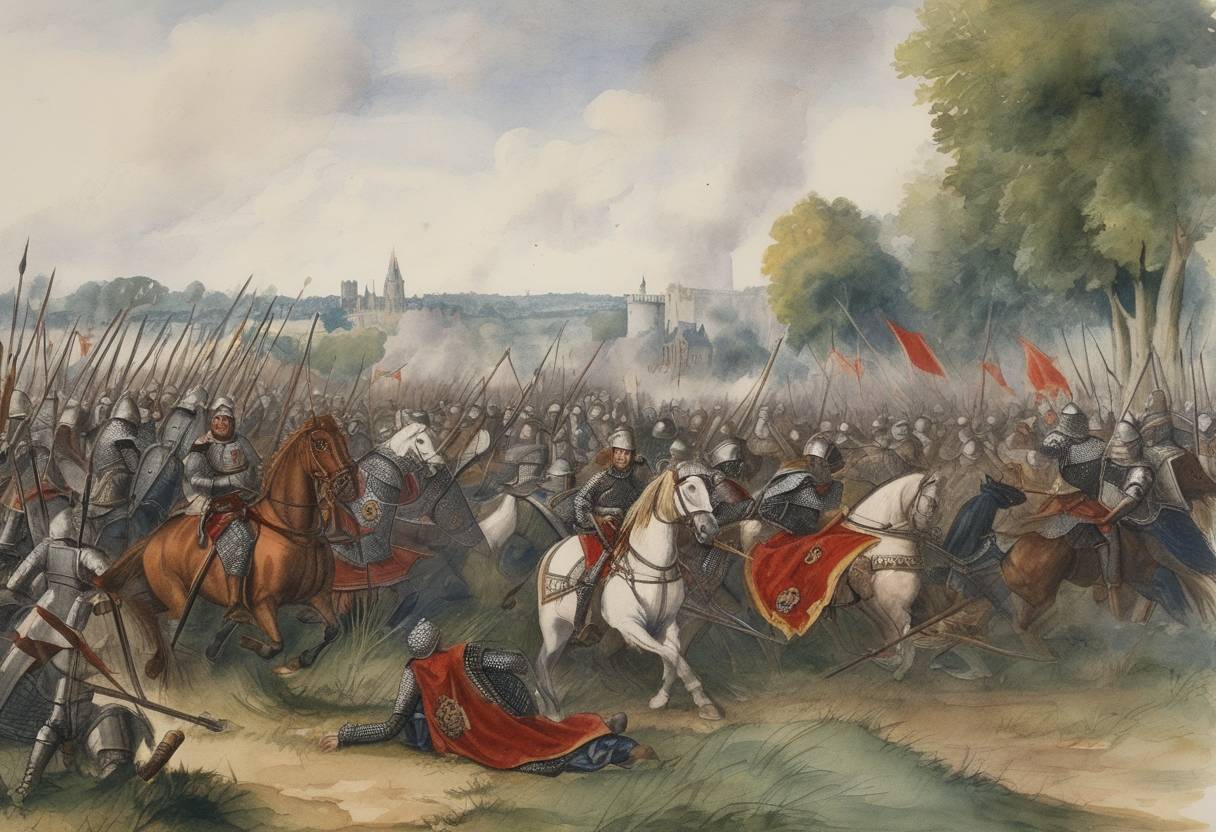
The Battle of Tewkesbury, fought on May 4, 1471, was a pivotal engagement during the Wars of the Roses, a series of civil wars for control of the throne of England. It marked a decisive victory for the Yorkist forces led by King Edward IV over the Lancastrians, further solidifying Edward’s hold on the English crown.
The Wars of the Roses were characterized by a fierce rivalry between two branches of the royal Plantagenet family: the House of Lancaster, represented by the red rose, and the House of York, symbolized by the white rose. Tensions and conflicts had been brewing since the mid-15th century due to competing claims to the throne, and by 1471, England had been embroiled in intermittent warfare for nearly two decades.
Edward IV, the Yorkist king, had initially secured the throne in 1461 but faced significant opposition from the Lancastrians, who sought to restore Henry VI. The year 1470 saw a temporary Lancastrian resurgence when Richard Neville, the Earl of Warwick, known as “the Kingmaker,” switched allegiance from York to Lancaster, briefly restoring Henry VI to power. Edward IV was forced into exile but returned to England in 1471, gathering support and reclaiming the throne after his victory at the Battle of Barnet.
Following Barnet, Edward’s forces pursued the Lancastrian army south. Margaret of Anjou, the queen consort of Henry VI, was leading the Lancastrian forces in an attempt to unite with allies in Wales. King Edward IV intercepted the Lancastrians at Tewkesbury, strategically preventing their escape.
On the morning of May 4, the two armies engaged on fields near Tewkesbury Abbey. The Yorkists, better positioned with a well-coordinated battle strategy, took advantage of the terrain and superior numbers. The battle was intense but relatively short, characterized by brutal hand-to-hand combat. Despite initial resistance, the Lancastrian ranks broke under the relentless Yorkist attack.
The Yorkist victory at Tewkesbury was decisive. Many prominent Lancastrian leaders were killed in battle or executed shortly afterward, including Prince Edward, the only son of Henry VI and Margaret of Anjou. Queen Margaret was captured, and the remnants of the Lancastrian forces were decimated.
With the Lancastrian leadership effectively obliterated, Edward IV’s power was unchallenged. The death of Prince Edward extinguished the direct Lancastrian line of succession. Shortly after the battle, Henry VI died under mysterious circumstances in the Tower of London, likely murdered to eliminate any remaining Lancastrian threat.
The Battle of Tewkesbury was one of the last significant battles in the Wars of the Roses, leading to a period of relative stability under Edward IV and paving the way for the eventual rise of the Tudor dynasty. The consolidation of Edward’s power helped usher in a new phase in English history, with the Wars of the Roses serving as a cautionary tale of dynastic conflict and its impacts.
Source: en.wikipedia.org