The Ratification of the Thirteenth Amendment
1865 · Washington, D.C., United States
The Thirteenth Amendment to the United States Constitution was ratified, abolishing slavery in the United States.
December 1, 1862
President Abraham Lincoln gives State of the Union address, during which he called for the abolition of slavery and emphasized the preservation of the Union.
Washington, D.C., United States | United States Congress
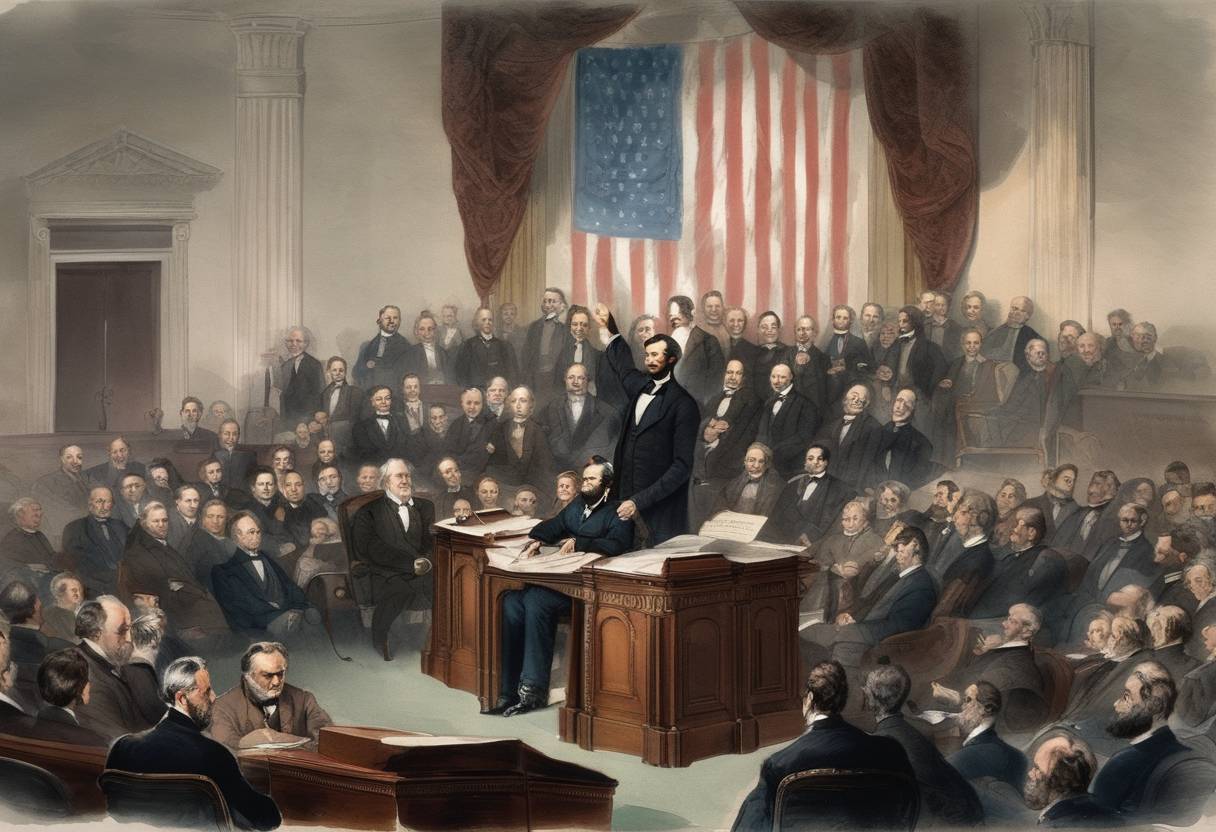
On December 1, 1862, President Abraham Lincoln delivered a momentous State of the Union address to Congress during a critical period in American history. This address was pivotal as it outlined Lincoln’s legislative priorities amid the ongoing Civil War and underscored his commitment to the principles of liberty and the preservation of the Union.
The United States was in the midst of the Civil War, a conflict principally triggered by issues surrounding slavery and states’ rights. The Union was battling the Confederate states, which had seceded from the Union following the election of Lincoln in 1860. By late 1862, the war had seen significant battles, including Antietam in September, and was increasingly fraught with high casualties and deep national division.
Lincoln used the address as an opportunity to reiterate his commitment to the abolition of slavery. He pointed to the Emancipation Proclamation, which he had announced earlier in September 1862 and was set to take effect on January 1, 1863. Lincoln framed the elimination of slavery not only as a moral imperative but as a necessary step for the survival of the Union.
Central to Lincoln’s address was the notion that the Union must be preserved at all costs. He argued that the Civil War was fought to protect democratic ideals and the nation’s founding principles. Lincoln emphasized that a house divided against itself could not stand, appealing to the collective responsibility of the legislature and the American people to uphold the Union.
In his address, Lincoln also discussed the need for continued support for the war effort, both financially and militarily. He underscored the importance of infrastructure, such as railroads, and the mobilization of resources and manpower to ensure victory over the Confederacy.
Lincoln’s December 1, 1862, State of the Union address demonstrated his unwavering resolve to end slavery and preserve the Union. It laid the groundwork for the final issuance of the Emancipation Proclamation, marking a definitive shift towards the abolitionist cause in the war effort. This address is remembered as a crucial articulation of his vision for the nation, highlighting the intertwined fates of freedom and unity.
The 1862 address served as a reflection of Lincoln’s strategic and moral leadership, reinforcing his position that the Civil War was a struggle not only for the nation’s survival but also for the fundamental transformation of American society.
Source: www.loc.gov