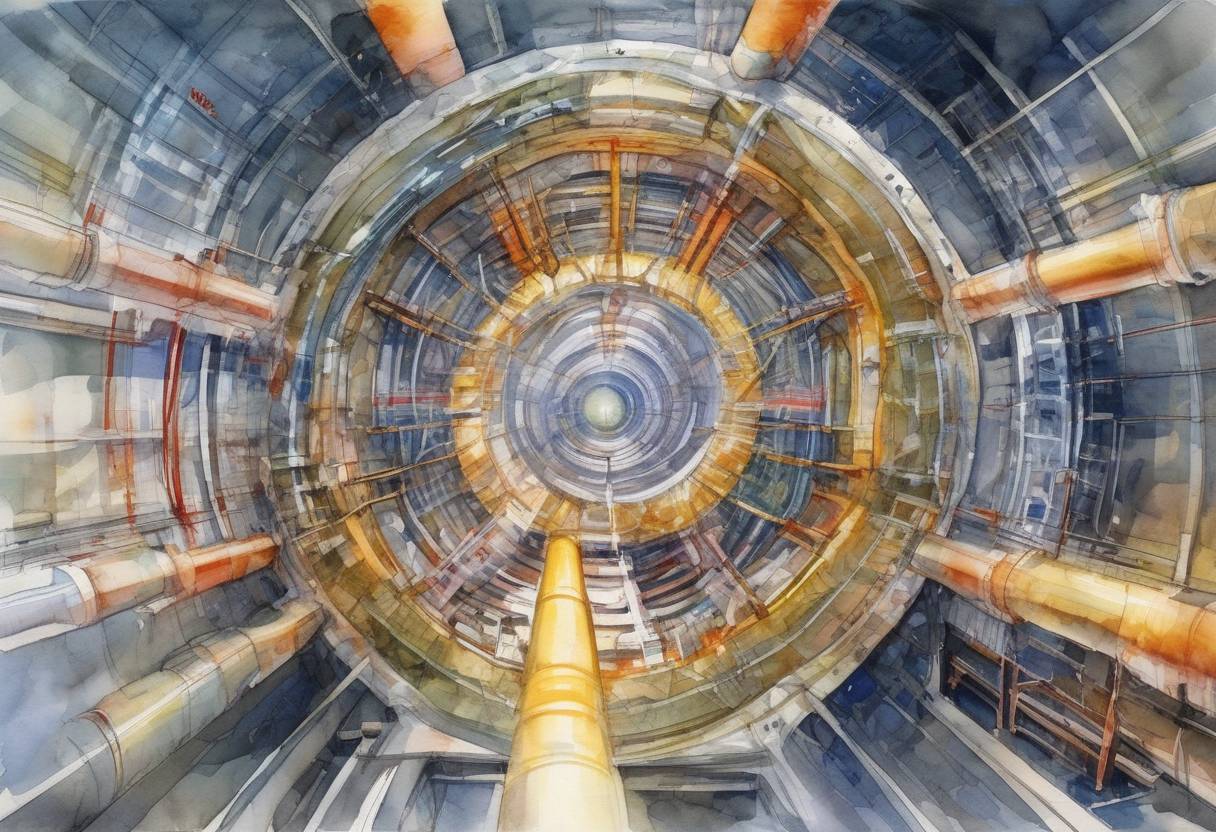
Inauguration of the Large Hadron Collider (LHC) at CERN
On September 23, 2008, the Large Hadron Collider (LHC) at CERN (the European Organization for Nuclear Research) was officially inaugurated, marking a pivotal moment in the field of particle physics. The LHC is the world’s largest and most powerful particle accelerator, designed to explore some of the most fundamental questions about the universe.
Background
- CERN: Established in 1954, CERN is one of the world’s largest and most respected centers for scientific research in the field of particle physics. It is located near Geneva, on the Franco-Swiss border.
- Purpose of the LHC: The LHC was constructed to test various predictions of high-energy physics, including the existence of the Higgs boson, the nature of dark matter, and the conditions of the early universe shortly after the Big Bang.
Key Features of the LHC
- Structure: The LHC consists of a 27-kilometer ring of superconducting magnets with a number of accelerating structures to boost the energy of the particles along the way.
- Functionality: It accelerates two high-energy particle beams in opposite directions, which are made to collide at four different points around the ring. These collisions allow physicists to study the resulting particle interactions.
Inauguration Ceremony
- The inauguration event was attended by dignitaries, scientists, and representatives from CERN’s member states.
- The ceremony celebrated the collaborative international effort that brought the LHC to fruition, involving thousands of scientists, engineers, and technicians from over 100 countries.
Scientific Significance
- Higgs Boson: One of the primary goals of the LHC was to confirm the existence of the Higgs boson, a fundamental particle associated with the Higgs field, which gives mass to other particles. This discovery was later announced in 2012.
- Beyond the Standard Model: The LHC provides insights into physics beyond the Standard Model, potentially offering clues about supersymmetry, extra dimensions, and other theoretical frameworks.
Aftermath and Impact
- Discoveries: Since its inauguration, the LHC has been instrumental in numerous discoveries and has significantly advanced our understanding of particle physics.
- Upgrades and Future: The LHC has undergone several upgrades to increase its collision energy and luminosity, ensuring it remains at the forefront of scientific research.
The inauguration of the LHC was not just a milestone for CERN but for the global scientific community, representing a leap forward in our quest to understand the fundamental building blocks of the universe.