The Siege of Masada: April 15, 73 CE
73 · Masada, Judea
The Siege of Masada ends with the fall of the Jewish fortress to the Roman Empire, marking the end of the First Jewish-Roman War.
September 7, 0070
The Romans, led by the future Emperor Titus, captured and destroyed Jerusalem during the First Jewish–Roman War. This significant event resulted in the destruction of the Second Temple and marked a pivotal shift in Jewish history.
Jerusalem, Judea (now Israel) | Roman Empire
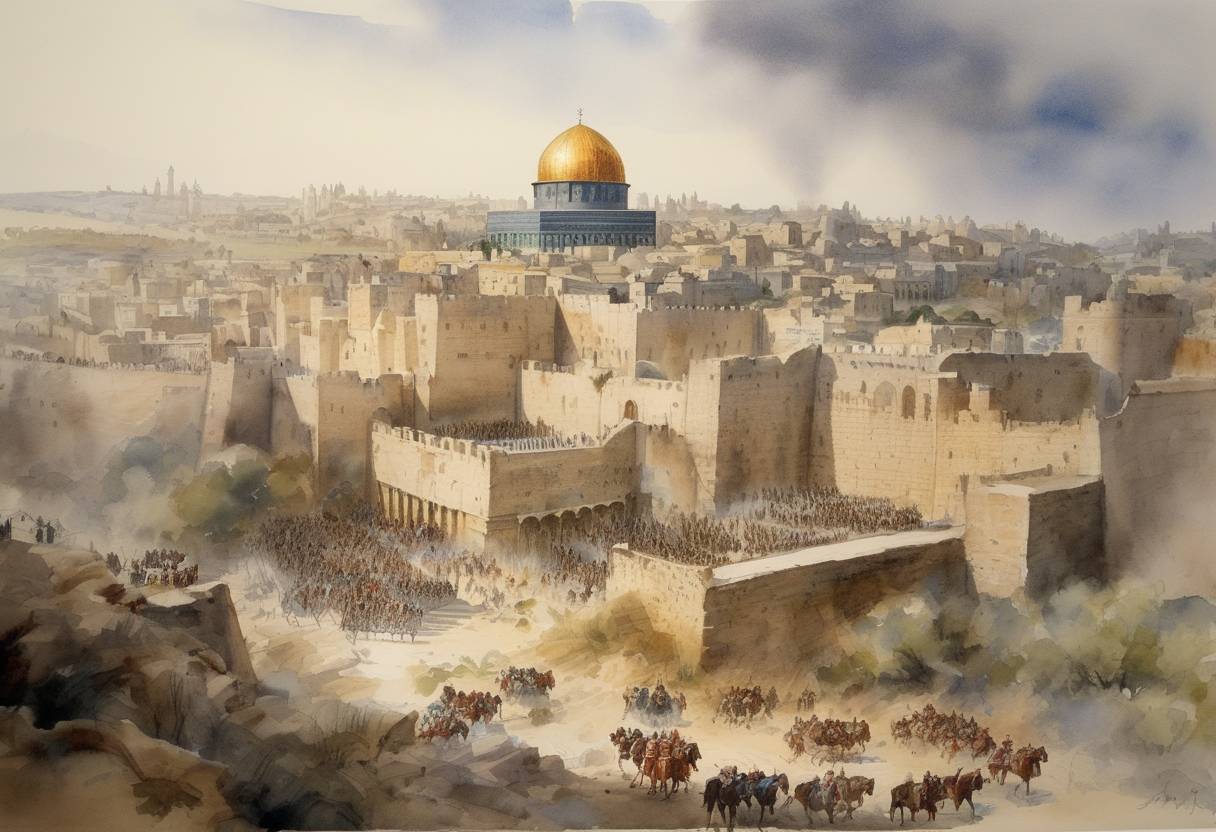
The final capture and destruction of Jerusalem by the Roman forces led by the future Emperor Titus occurred on September 7, 70 CE, as part of the concluding phase of the First Jewish–Roman War, also known as the Great Revolt. This critical event marked the end of a protracted siege of the city, which had been subjected to intense military pressure and deprivation.
The First Jewish–Roman War, which commenced in 66 CE, stemmed from escalating tensions between the Jewish population in Judea and the Roman Empire. These tensions were fueled by religious, economic, and political strife. Initial Jewish resistance saw some successes, but the tide turned with the Roman military campaign aimed at quelling the rebellion.
The Roman campaign to reclaim Jerusalem began in April 70 CE, spearheaded by Titus, son of Emperor Vespasian. Employing a combination of engineering skills, brute force, and psychological tactics, the Romans constructed siege works and deployed legions numerically far superior to the Jewish defenders. Despite fierce resistance from the defenders under leaders like Simon bar Giora and John of Giscala, the Romans systematically breached the city’s defenses.
The pivotal moment in the siege was the sacking and subsequent destruction of the Second Temple, the preeminent symbol of the Jewish faith and identity, on the 9th day of the Hebrew month of Av. The temple’s burning occurred amid warnings from Titus, who reportedly did not initially wish its destruction, but control was lost in the chaos of battle.
The fall of Jerusalem led to significant humanitarian crises, including starvation, massacre, and enslavement of many inhabitants. The destruction of the Second Temple had far-reaching consequences for Jewish religious and communal life, marking the end of the central sacrificial cult and ushering in a new era where Rabbinic Judaism began to take prominence.
The Roman victory had the immediate result of reinforcing the empire’s dominance and suppressing the Jewish rebellion. Furthermore, the spoils captured during the sack were used for monumental projects in Rome, including the construction of the Colosseum.
The destruction of Jerusalem and the Second Temple remains one of the most commemorated and mourned events in Jewish history, symbolizing both the persistence of Jewish identity and the end of an era. It set the stage for the Jewish diaspora, influencing relationships between Jews and subsequent ruling powers for centuries.
The war, alongside its deeply consequential outcomes, is documented in various historical accounts, most famously by the Jewish historian Flavius Josephus, whose works provide a detailed chronicle of the events.
Source: en.wikipedia.org