Spanish Socialist Workers' Party Wins the General Election - October 28, 1982
1982 · Madrid, Spain
Spanish Socialist Workers' Party wins the general election, leading to the first socialist government in Spain since the Spanish Civil War.
March 8, 1921
The Spanish Communist Workers' Party was founded.
Madrid, Spain | Spanish Communist Workers' Party
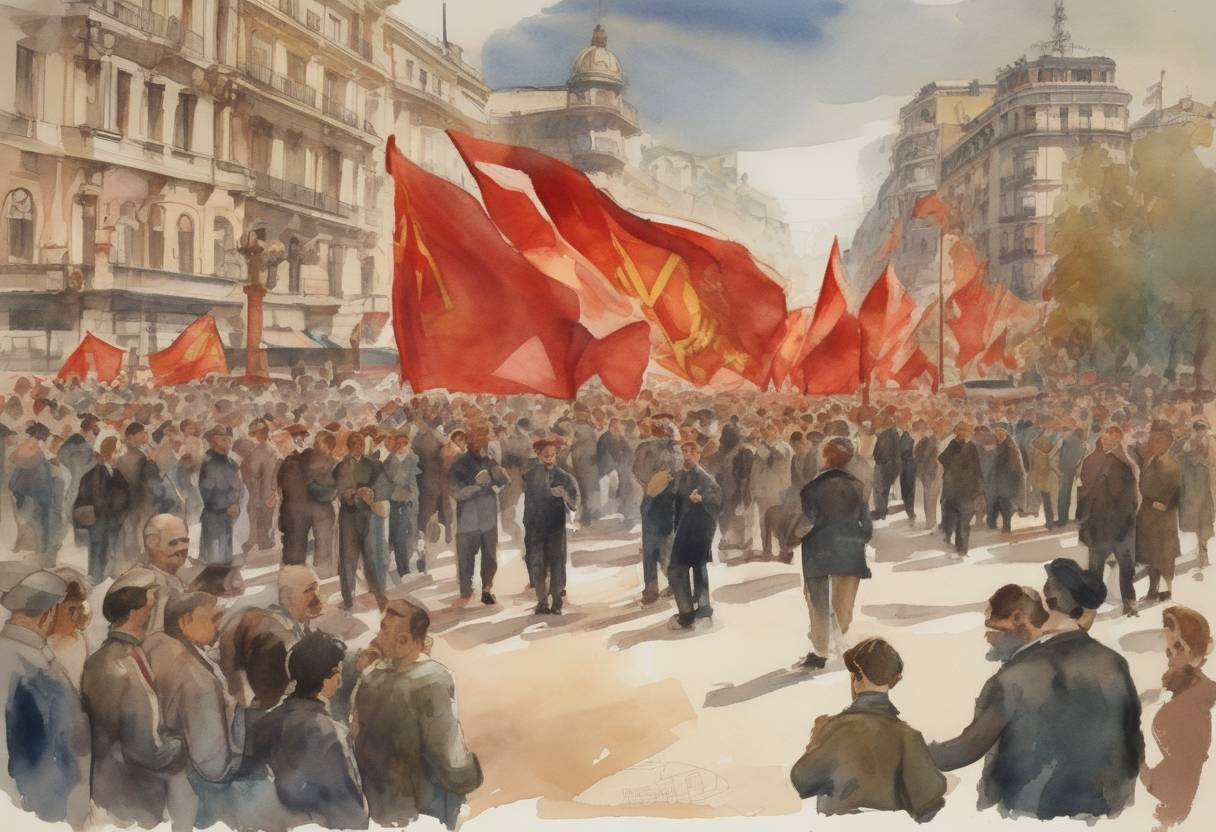
On March 8, 1921, the Spanish Communist Workers’ Party (Partido Comunista Obrero Español, PCOE) was founded. This event marked a significant moment in the history of Spain’s labor and political movements during the early 20th century, a period characterized by social upheaval and the rise of leftist ideologies across Europe.
The early 1920s in Spain were a time of political instability and social unrest. The country was grappling with the aftermath of World War I, economic difficulties, and widespread dissatisfaction with the ruling monarchy and its policies. The Russian Revolution of 1917 had also inspired many leftist movements across Europe, including in Spain, where socialist and communist ideologies began to gain traction among workers and intellectuals.
The Spanish Communist Workers’ Party was established by a faction that split from the Spanish Socialist Workers’ Party (Partido Socialista Obrero Español, PSOE). This faction was dissatisfied with the PSOE’s moderate stance and sought to align more closely with the principles of the Communist International (Comintern), which advocated for a more radical approach to achieving socialism.
The founding of the PCOE was part of a broader trend of fragmentation within leftist movements in Spain, as various groups sought to define their positions in relation to the growing influence of communism.
One of the prominent figures in the founding of the PCOE was Andrés Nin, a notable Spanish communist and later a leader of the Workers’ Party of Marxist Unification (POUM). Nin and others who were instrumental in the creation of the PCOE were driven by the desire to establish a party that would be more committed to revolutionary change and the establishment of a proletarian government.
The establishment of the PCOE contributed to the diversification of leftist political forces in Spain. However, the party faced challenges in gaining widespread support due to internal divisions and competition with other leftist groups, including the Communist Party of Spain (Partido Comunista de España, PCE), which was also founded in 1921 and eventually became the dominant communist party in Spain.
The PCOE’s influence was relatively limited, and it eventually merged with the PCE in 1921, as part of efforts to consolidate communist forces in the country. This merger was indicative of the broader trend of unification among leftist groups to present a stronger front against the rising tide of fascism and authoritarianism in Europe during the interwar period.
The founding of the Spanish Communist Workers’ Party on March 8, 1921, represents a key moment in the history of Spain’s leftist movements. It highlights the ideological struggles and realignments that characterized the political landscape of the time, as well as the broader impact of international communist movements on national politics.
Source: en.wikipedia.org