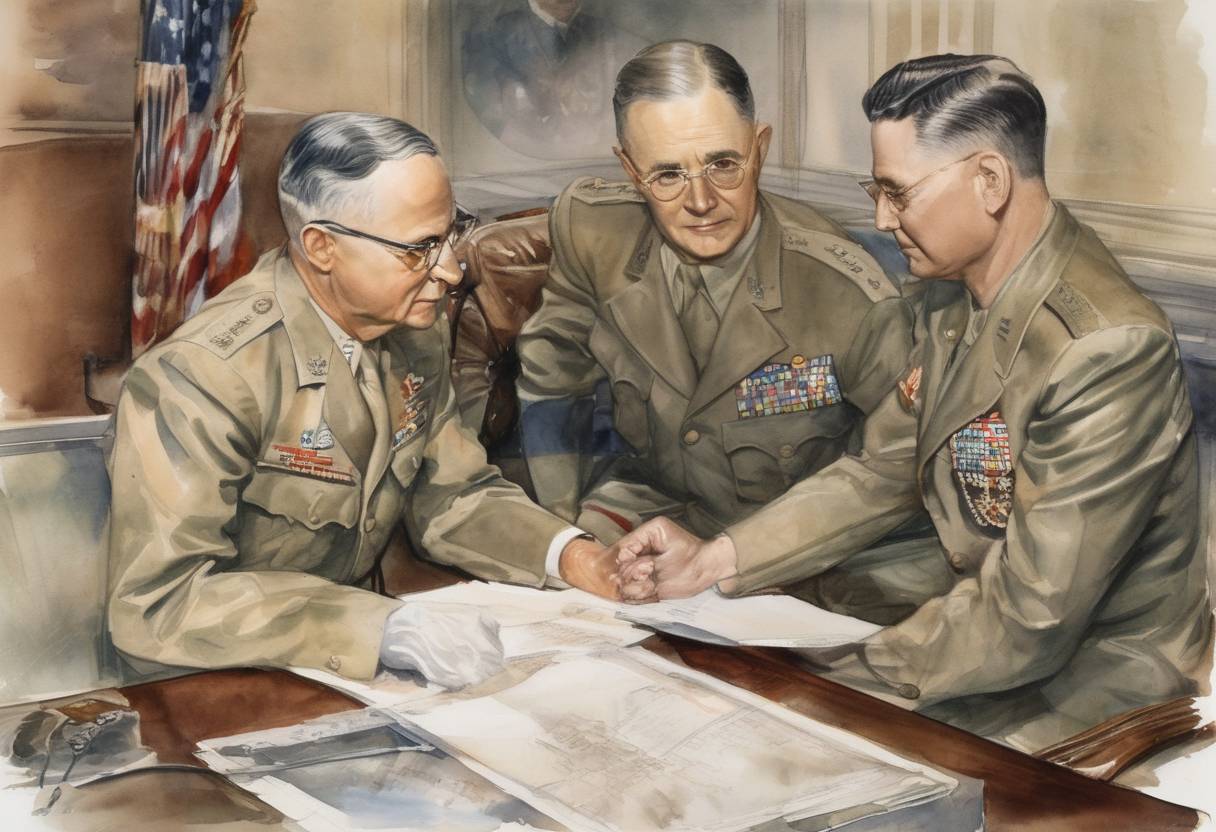
Truman Relieves MacArthur of Command - April 11, 1951
On April 11, 1951, President Harry S. Truman made the momentous decision to relieve General Douglas MacArthur of his command during the Korean War. This decision was rooted in a series of policy disagreements and issues of insubordination that had developed between the President and the General.
Background
The Korean War began on June 25, 1950, when North Korean forces invaded South Korea. The United Nations, with the United States as a principal force, intervened to support South Korea. General Douglas MacArthur, a highly respected and decorated military leader, was appointed as the Commander of the United Nations forces in Korea.
Policy Disagreements
The primary point of contention between Truman and MacArthur was the conduct of the war and the broader strategy in East Asia:
Limited War vs. Total War: Truman advocated for a “limited war” approach, aiming to contain the conflict within Korea to avoid a larger war with China or the Soviet Union. MacArthur, however, favored a more aggressive strategy, including the possibility of expanding the war into China, which he believed was necessary for a decisive victory.
Use of Nuclear Weapons: MacArthur suggested the use of nuclear weapons against Chinese forces, a proposal that was strongly opposed by Truman and his advisors, who feared it could escalate into World War III.
Insubordination
MacArthur’s insubordination became increasingly apparent through his public statements and actions:
Public Criticism: MacArthur openly criticized Truman’s policies and decisions, which was seen as undermining civilian control over the military. His public statements often contradicted the administration’s official stance, creating confusion and tension.
Letter to Congressman Martin: A pivotal moment came when MacArthur sent a letter to Republican House Minority Leader Joseph W. Martin, Jr., which was read publicly. In the letter, MacArthur criticized the administration’s war strategy, further straining his relationship with Truman.
The Decision to Relieve MacArthur
Faced with MacArthur’s continued defiance and the potential for his actions to undermine U.S. foreign policy and military strategy, Truman decided to relieve him of his command. On April 11, 1951, Truman announced MacArthur’s dismissal, citing the need to maintain civilian control over the military and to ensure a unified strategy in the Korean War.
Aftermath and Significance
Public Reaction: The decision was controversial and sparked a significant public outcry. MacArthur was a popular figure, and many Americans viewed his dismissal as unjust. However, Truman stood by his decision, emphasizing the importance of civilian oversight of the military.
Congressional Hearings: The dismissal led to congressional hearings where MacArthur testified, further highlighting the deep divisions over U.S. policy in Korea.
Legacy: Truman’s decision underscored the principle of civilian control over the military, a cornerstone of American democracy. It also highlighted the complexities of Cold War-era conflicts and the challenges of balancing military objectives with diplomatic considerations.
In summary, the relief of General Douglas MacArthur by President Truman was a pivotal moment in U.S. military and political history, reflecting the tensions between military strategy and civilian oversight during a critical period of the Cold War.