The Council of Chalcedon: October 7, 451
451 · Chalcedon, Byzantine Empire
The Council of Chalcedon, the fourth ecumenical council of the Christian Church, begins. It is significant for its definition of the two natures of Christ.
October 8, 0451
The Council of Chalcedon, a significant ecumenical council in the history of Christianity, commenced. It addressed the nature of Christ and resulted in the Chalcedonian Definition, which became a key point of doctrine for many Christian denominations.
Chalcedon, Byzantine Empire | Christian Church
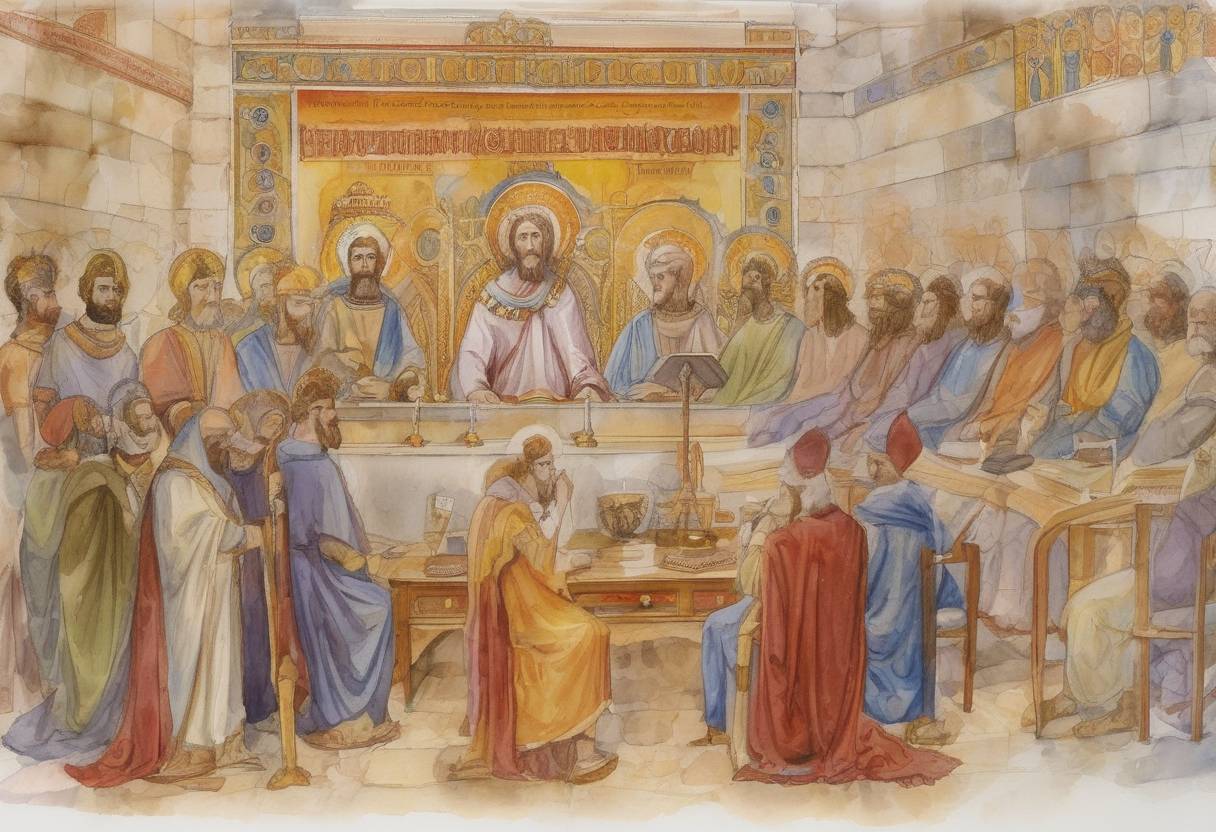
The Council of Chalcedon, convened on October 8, 451, stands as a pivotal moment in the history of Christianity, particularly concerning Christological debates. This ecumenical council, held in Chalcedon (modern-day Kadıköy, Turkey), was the fourth of its kind and was instrumental in shaping the theological landscape of Christianity.
The Council of Chalcedon was primarily convened to address the ongoing theological disputes regarding the nature of Christ. These debates were largely fueled by differing interpretations of Christ’s divinity and humanity. The controversy was exacerbated by the teachings of Eutyches, an archimandrite in Constantinople, who advocated for a form of Monophysitism. This doctrine posited that Christ had only one nature, which was divine, rather than two distinct natures, divine and human.
Prior to Chalcedon, the Second Council of Ephesus in 449, often referred to as the “Robber Council,” had controversially supported Eutyches’ views, leading to significant unrest and division within the church. The need for a definitive resolution became urgent, prompting the calling of the Council of Chalcedon by Emperor Marcian and Pope Leo I.
The Council of Chalcedon was attended by approximately 520 bishops, making it one of the largest gatherings of its kind. Over the course of several weeks, the council fathers engaged in intense theological debates and discussions. The central outcome of the council was the Chalcedonian Definition, a doctrinal statement that articulated the dual nature of Christ.
The Chalcedonian Definition declared that Jesus Christ is to be acknowledged in two natures, without confusion, change, division, or separation. Each nature retained its own attributes, yet they were united in one person and one hypostasis. This formulation aimed to preserve the full divinity and full humanity of Christ, countering both Monophysitism and Nestorianism, which had suggested a separation between Christ’s natures.
The decisions of the Council of Chalcedon had profound and lasting impacts on Christianity:
Doctrinal Unity and Division: While the Chalcedonian Definition was accepted by the majority of the Christian world, it also led to significant schisms. The Oriental Orthodox Churches rejected the council’s conclusions, leading to a lasting division that persists to this day.
Influence on Christian Theology: The Chalcedonian Definition became a cornerstone of Christological doctrine for many Christian denominations, including the Roman Catholic, Eastern Orthodox, and most Protestant churches.
Political and Ecclesiastical Repercussions: The council also addressed various ecclesiastical and disciplinary issues, reinforcing the authority of the Bishop of Rome and the Patriarch of Constantinople, which had implications for the power dynamics within the church.
In summary, the Council of Chalcedon was a defining moment in the history of Christianity, establishing a theological framework that continues to influence Christian doctrine and inter-denominational relations. Its legacy is a testament to the complex interplay of theology, politics, and ecclesiastical authority in shaping religious history.
Source: en.wikipedia.org