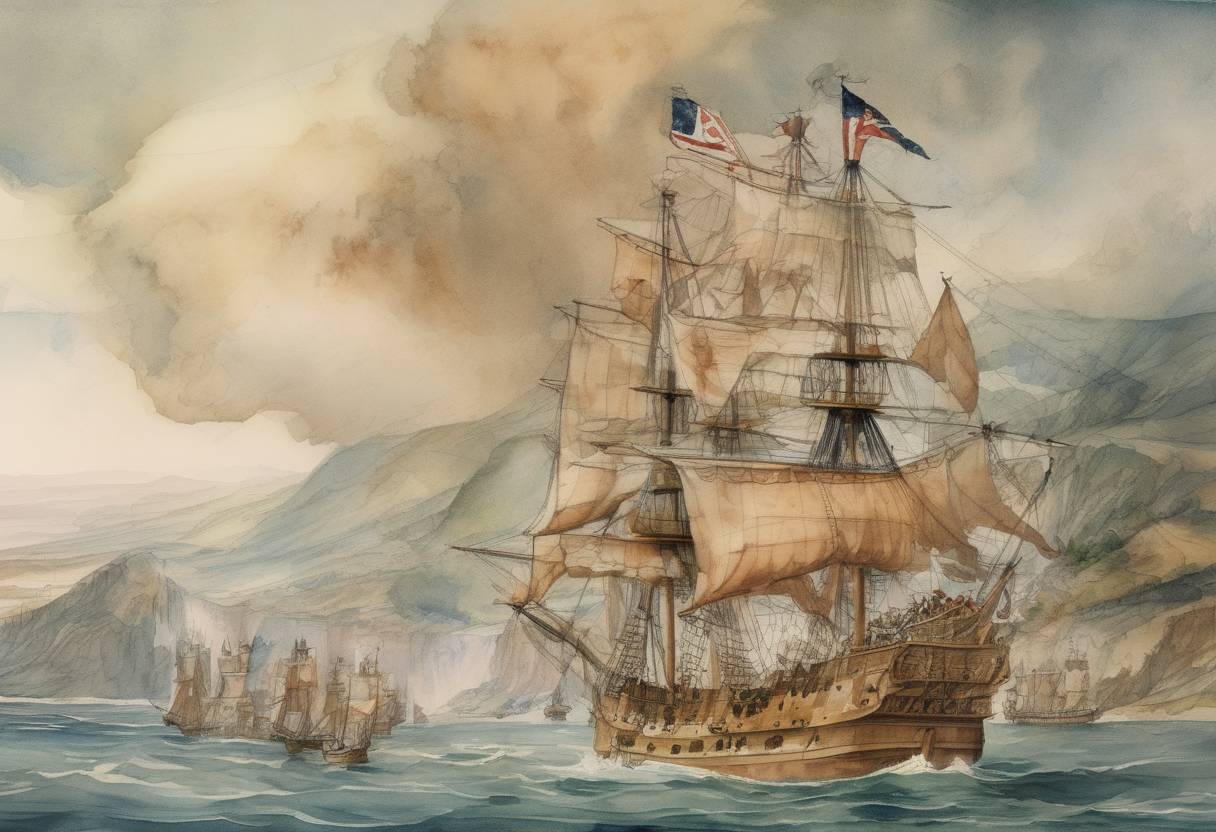
Sir Francis Drake Claims Nova Albion for England - June 17, 1579
On June 17, 1579, the English privateer and explorer Sir Francis Drake made a significant mark in the annals of exploration by claiming a portion of the western coast of North America for England. This land, which he named “Nova Albion,” is believed to be part of modern-day California.
Background
Sir Francis Drake embarked on his circumnavigation of the globe in 1577, under the commission of Queen Elizabeth I. His journey was not only a quest for exploration but also aimed at disrupting Spanish interests and acquiring wealth through privateering. Drake’s expedition took him along the western coast of South America, where he captured Spanish treasure ships, significantly enriching the English crown.
The Claim of Nova Albion
After navigating the treacherous waters of the Strait of Magellan and sailing up the Pacific coast of the Americas, Drake sought a suitable location to repair his ship, the Golden Hind. On June 17, 1579, he landed on a site that historians generally agree is somewhere along the northern California coast, possibly near present-day Point Reyes.
Drake and his crew spent several weeks in the area, interacting with the local indigenous people, whom they found to be friendly. During this time, Drake conducted a formal ceremony to claim the land for England, naming it “Nova Albion,” which means “New Britain.” The name was inspired by the white cliffs he observed, reminiscent of the cliffs of Dover in England.
Significance
Drake’s claim of Nova Albion was part of England’s broader strategy to expand its influence and challenge Spanish dominance in the New World. Although the claim did not lead to immediate colonization, it symbolized England’s growing ambitions and laid the groundwork for future exploration and settlement.
Aftermath
Drake continued his journey, completing his circumnavigation in 1580 and returning to England as a celebrated hero. His successful voyage demonstrated the potential for English maritime power and exploration, encouraging further expeditions.
The claim of Nova Albion, while not immediately impactful in terms of colonization, was a precursor to later English ventures in North America. It also contributed to the mythos of Drake as a legendary figure in English history, celebrated for his daring and navigational prowess.
In summary, Sir Francis Drake’s claim of Nova Albion on June 17, 1579, was a notable event in the age of exploration, reflecting England’s aspirations and setting the stage for future endeavors in the New World.