1650 · Stockholm, Sweden
René Descartes, the influential French philosopher, mathematician, and scientist, known for his statement 'Cogito, ergo sum' (I think, therefore I am), died in Stockholm.
November 10, 1619
René Descartes has his visions (or dreams) that inspire his philosophy of a modern scientific method, while serving in the military during the Thirty Years' War. This is considered a turning point in developing his ideas that form the basis of Cartesian philosophy.
Neuburg an der Donau, Holy Roman Empire
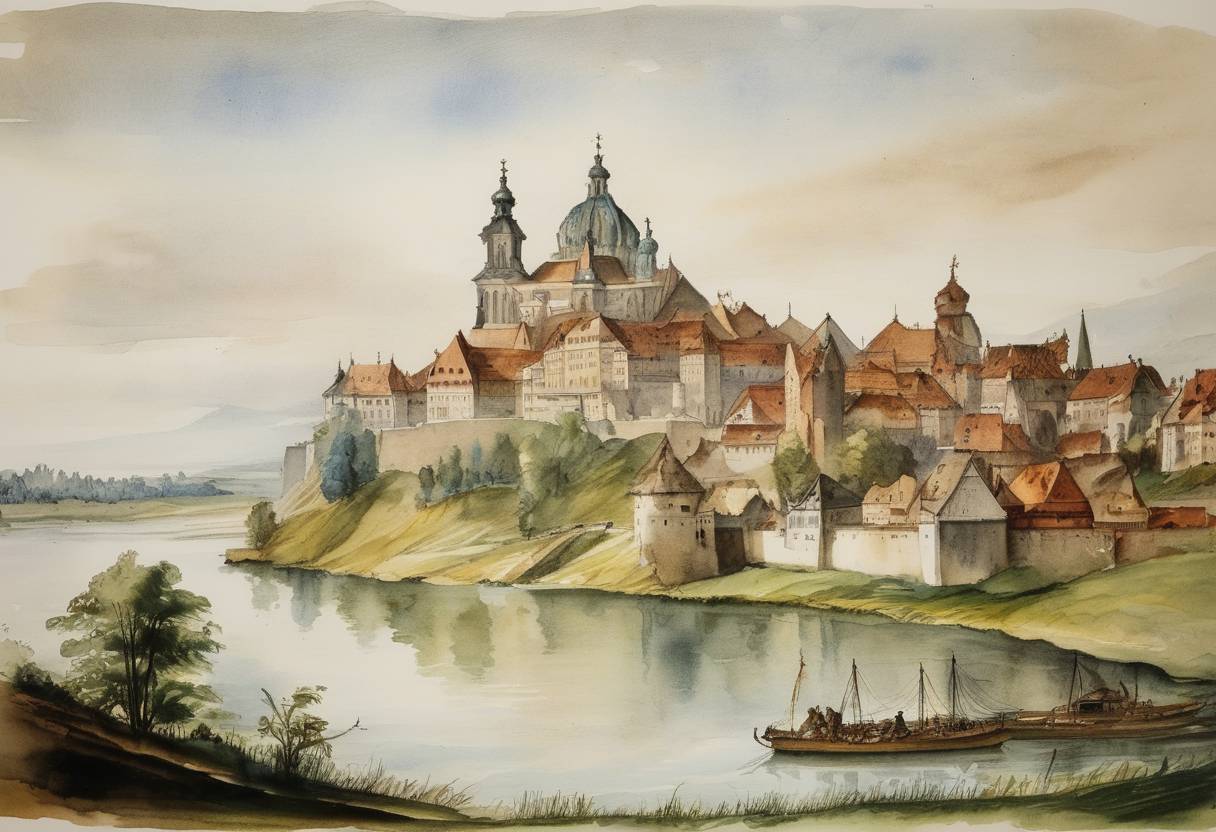
René Descartes, the esteemed French philosopher and mathematician, experienced a series of profound dreams on the night of November 10, 1619, which played a pivotal role in shaping his future philosophical and scientific endeavors. At the time, Descartes was serving as a soldier in the army of Maximilian of Bavaria during the Thirty Years’ War—a period marked by widespread conflict across central Europe primarily fought for religious and dynastic reasons.
Descartes, born in 1596 in La Haye en Touraine, France, had already shown a keen interest in mathematics and philosophy by the time he joined the military. The Thirty Years’ War provided him with a unique environment for reflection and intellectual development. Finding the war’s tumultuous conditions not conducive to his scholarly ambitions, Descartes sought solitude and opportunities to pursue his true passions: knowledge and the understanding of universal truths.
According to Descartes’ own accounts, he experienced three vivid dreams or visions on the night of November 10, 1619. These experiences had a profound and lasting impact on him, leading him to interpret them as divine signs to pursue his philosophical inquiry.
First Dream: In Descartes’ first dream, he found himself struggling to walk against a powerful wind that threatened to engulf him. He was struck by anxiety, which he later interpreted as a symbol representing the tumult of his mind.
Second Dream: The second dream was more elusive. Descartes found himself lying in bed, suddenly awakened by a thunderclap. He saw sparks flying in his room, a vision he took to symbolize the Enlightenment and the pursuit of truth.
Third Dream: In the final dream, Descartes encountered a book of poetry and a phrase suggesting “What path shall I pursue in life?” along with another phrase asserting “Yes and No” (affirmation and negation), reflecting the dual qualities of doubt and certainty in his thoughts, fundamental to his future work.
These dreams were interpreted by Descartes as a mystical revelation guiding him towards a new method of inquiry. They contributed to his development of the method of doubt, which became a cornerstone of his philosophical attitude. This method involved doubting all knowledge to establish certainty and is foundational to Cartesian philosophy.
Descartes’ future works, including “Meditations on First Philosophy” and “Discourse on the Method,” reflect the influence of these visions, emphasizing clear, rational thinking and skepticism as paths to true knowledge. He laid the groundwork for the scientific method, melding empirical observation with logical reasoning.
René Descartes’ visions and subsequent writings significantly influenced the rise of modern philosophy and science. His emphasis on reason, clarity, and the mathematization of nature was integral to the Scientific Revolution. The Cartesian coordinate system in mathematics exemplifies this legacy, showcasing his influence beyond philosophy into mathematics and science.
The events of November 10, 1619, provided the mental and spiritual catalyst that propelled Descartes to advocate for new ways of thinking and viewing the world—a legacy that endures through the ages.