Disbandment of the Warsaw Pact: February 25, 1991
1991 · Budapest, Hungary
The Warsaw Pact, a military alliance of communist nations in Eastern Europe, was declared disbanded at a meeting in Hungary.
December 26, 1948
Cardinal József Mindszenty was arrested in Hungary and accused of treason and espionage.
Budapest, Hungary | Hungarian Communist Government
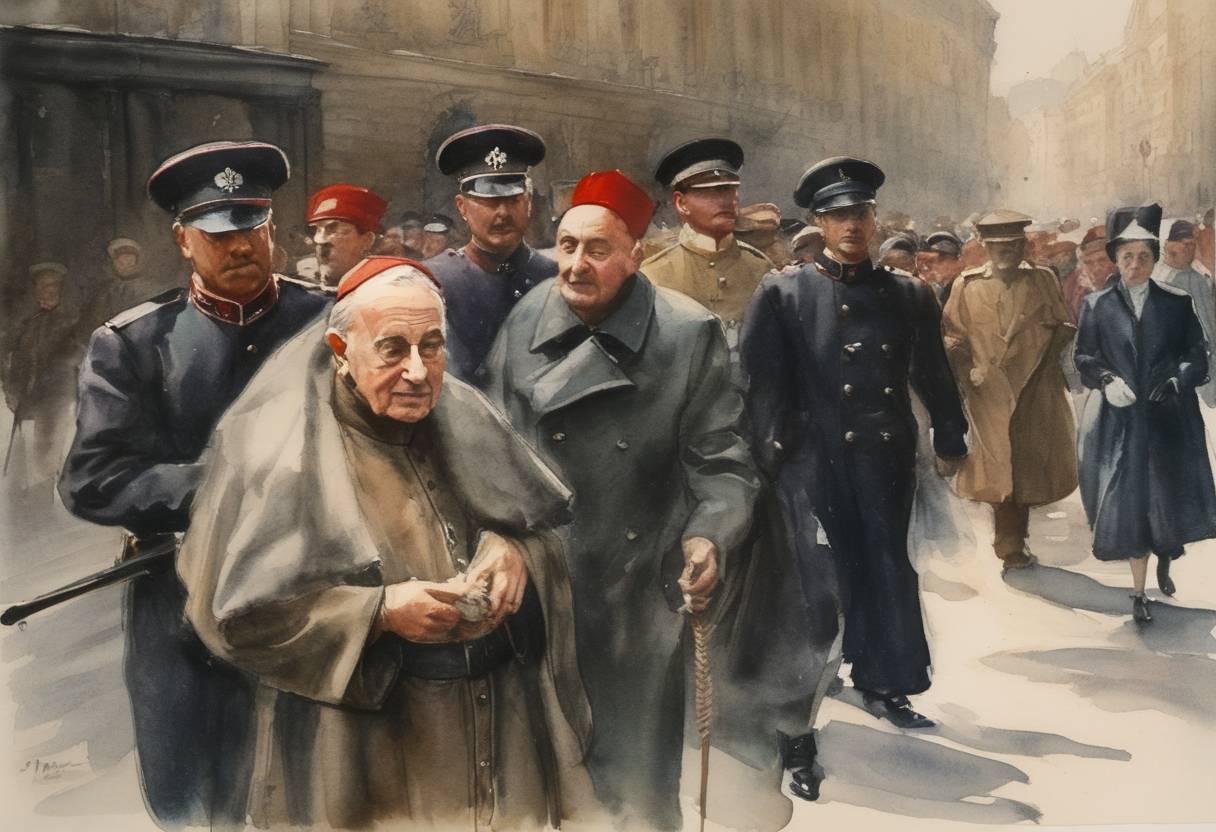
Cardinal József Mindszenty, the Archbishop of Esztergom and the Primate of Hungary, was arrested on December 26, 1948, in Budapest. His arrest marked a significant event in post-World War II Hungary as it illustrated the increasing repression by the communist regime against religious institutions and individuals perceived as threats.
Following World War II, Hungary underwent significant political changes, culminating in a communist government firmly aligned with the Soviet Union by 1948. As a vocal opponent of communism and a steadfast advocate for the Hungarian people’s traditional religious values, Mindszenty became a target for the regime. The authorities, aiming to consolidate power and suppress dissent, viewed the Catholic Church’s influence under Mindszenty’s leadership as a barrier to achieving their ideological objectives.
Mindszenty was charged with treason, espionage, and other crimes against the state. These charges were fabricated as part of a wider strategy by the Hungarian People’s Republic to silence opposition and diminish the Church’s authority.
The arrest followed a period of intensified anti-religious campaigns by the government, which included nationalizing church properties, closing religious schools, and targeting clergy members deemed resistant to the new communist policies.
The trial was publicized as a show trial, common in Soviet-style justice, intended to intimidate opponents and justify harsh political crackdowns. Mindszenty’s trial began in February 1949, where he was coerced into confessing the allegations against him, amidst reports of psychological and physical torture.
The trial and sentencing of Mindszenty to life imprisonment drew strong international condemnation, particularly from the Vatican and Western governments, highlighting the growing ideological divide of the Cold War era.
Mindszenty’s imprisonment lasted until the Hungarian Revolution of 1956, when he was released. However, he sought asylum in the U.S. embassy in Budapest, where he remained for 15 years until he was allowed to leave the country in 1971. Mindszenty’s continued advocacy and symbolic resistance became significant during Cold War tensions.
His arrest is remembered as emblematic of the broader struggle between oppressive regimes and religious institutions during a time when Eastern Europe was under the heavy influence of Soviet communist ideology. Mindszenty remains a symbol of resistance to religious persecution and totalitarianism in Hungary and is recognized for his unwavering stance in the face of adversity.
Source: en.wikipedia.org