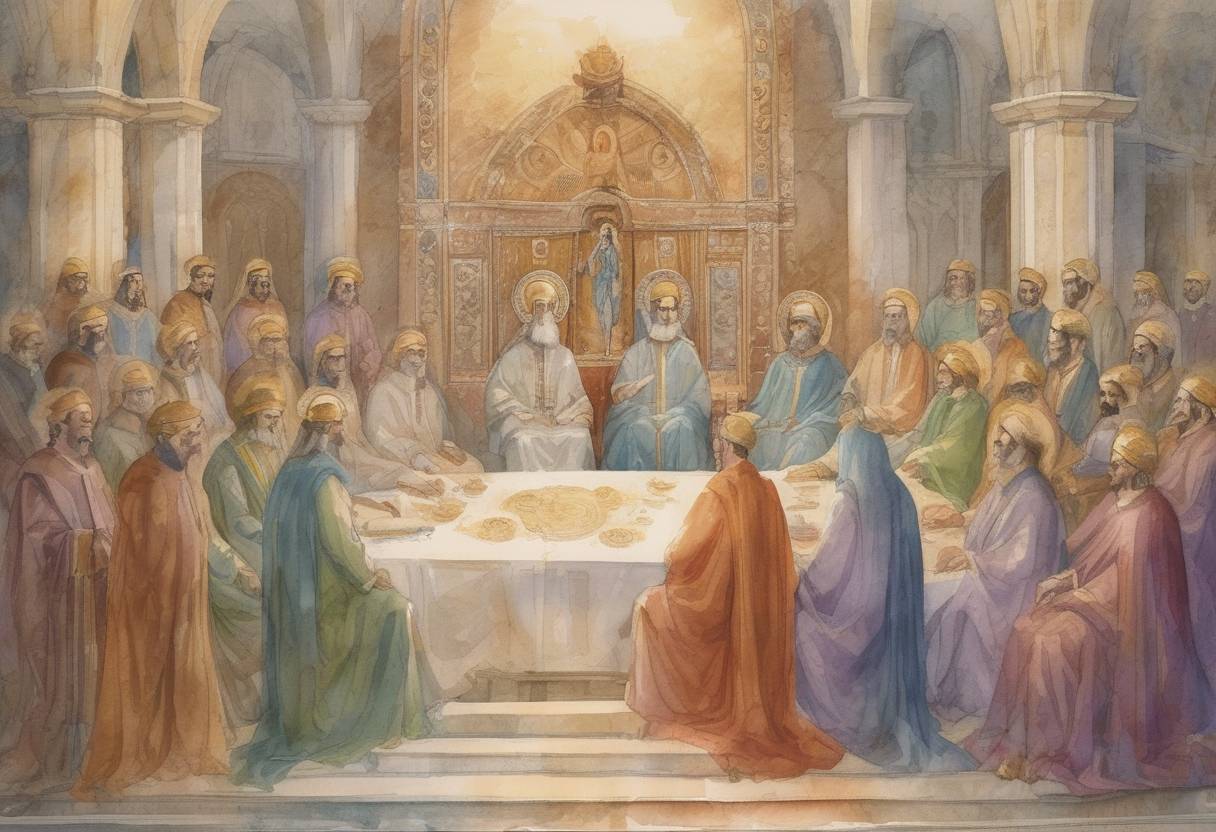
The Council of Chalcedon: October 7, 451
The Council of Chalcedon, convened on October 7, 451, stands as a pivotal moment in the history of Christianity, marking the fourth ecumenical council of the Christian Church. This council was significant for its doctrinal decisions, particularly concerning the nature of Christ, which have had a lasting impact on Christian theology.
Historical Context
The Council of Chalcedon was called by the Roman Emperor Marcian and his wife, Empress Pulcheria, in response to ongoing theological disputes within the Church. The primary issue at hand was the nature of Christ, a topic that had been a source of contention since the early days of Christianity. The council aimed to address the controversies that had arisen from the teachings of Eutyches, an archimandrite in Constantinople, who advocated for a monophysite understanding of Christ, suggesting that Christ had only one nature, a divine one, after the Incarnation.
Key Events Leading to the Council
The First Council of Ephesus (431): This earlier council had addressed the Nestorian controversy, which emphasized the disunion between Christ’s human and divine natures. The decisions made here laid the groundwork for further debates.
The Rise of Monophysitism: Eutyches’ teachings gained traction, leading to significant theological discord. His views were initially condemned at the Synod of Constantinople in 448, but the controversy persisted.
The Robber Council of Ephesus (449): This council, later deemed illegitimate, supported Eutyches and further polarized the Church, necessitating a more authoritative resolution.
The Council’s Proceedings
The Council of Chalcedon was attended by approximately 520 bishops, making it one of the largest gatherings of its kind. The council’s primary objective was to articulate a clear and orthodox understanding of Christ’s nature. After extensive deliberations, the council produced the Chalcedonian Definition, which declared that Jesus Christ is to be recognized in two natures, fully divine and fully human, without confusion, change, division, or separation.
The Chalcedonian Definition
The definition emphasized the dual nature of Christ, affirming that:
- Christ is “truly God and truly man.”
- The two natures coexist “without confusion, without change, without division, without separation.”
- Each nature retains its own attributes, yet they are united in one person and one hypostasis.
Aftermath and Significance
The Council of Chalcedon’s decisions were instrumental in shaping the Christological orthodoxy of the Christian Church. However, the council also led to significant schisms, particularly with the Oriental Orthodox Churches, which rejected the Chalcedonian Definition and adhered to miaphysitism, a belief in the united nature of Christ.
The council’s outcomes have had a profound and enduring influence on Christian doctrine, contributing to the theological foundations of many mainstream Christian denominations. The Chalcedonian Definition remains a cornerstone of Christological teaching, underscoring the complexity and depth of early Christian theological development.
In summary, the Council of Chalcedon was a defining moment in the history of Christianity, addressing critical theological disputes and establishing doctrines that continue to resonate within the Christian faith today.