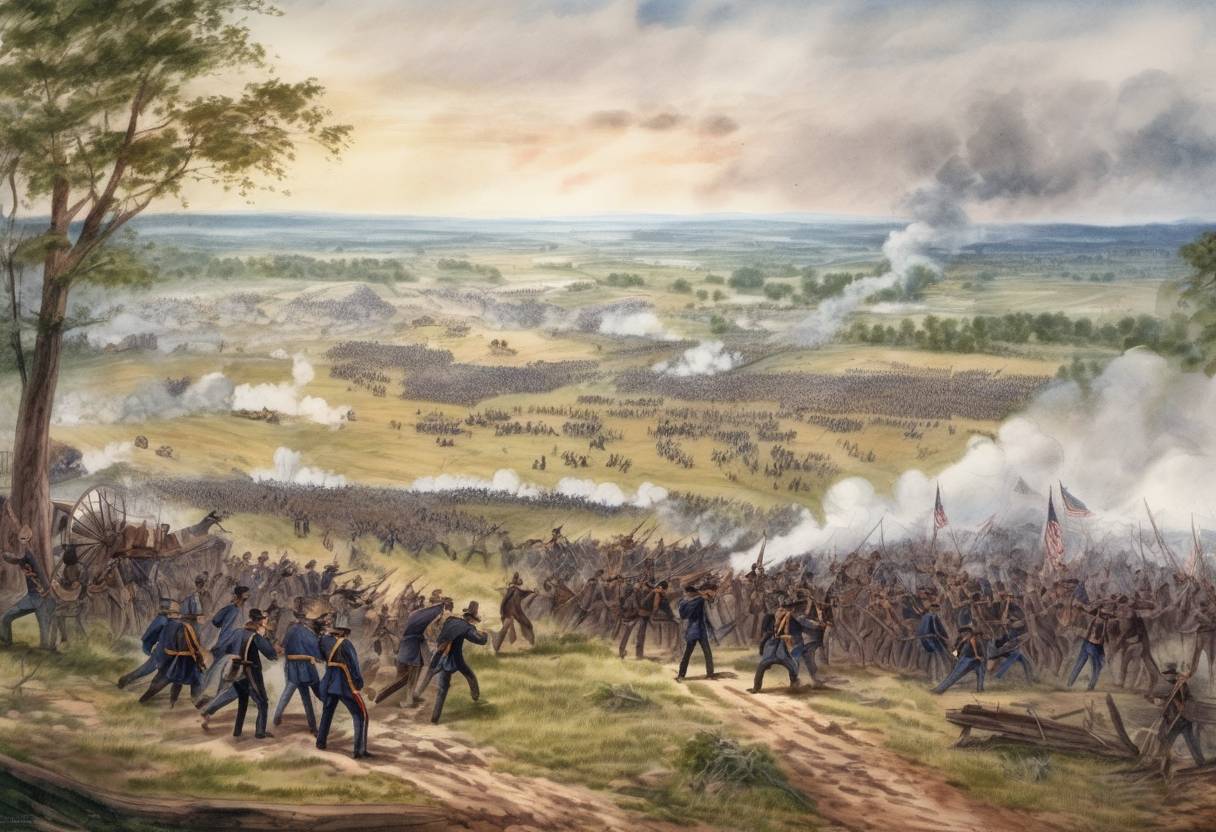
The Battle of Gettysburg Begins: July 1, 1863
The Battle of Gettysburg, one of the most significant engagements of the American Civil War, commenced on July 1, 1863. This battle marked a pivotal turning point in the conflict, influencing the course of the war and the future of the United States.
Context Leading to the Battle
- Strategic Movements: In June 1863, Confederate General Robert E. Lee led his Army of Northern Virginia into Pennsylvania, aiming to relieve pressure on Virginia’s farmlands and to potentially sway Northern public opinion towards peace.
- Union Response: The Union Army of the Potomac, commanded by Major General George G. Meade, moved to intercept Lee’s forces. The two armies converged near the small town of Gettysburg, Pennsylvania.
Key Events of July 1, 1863
- Initial Engagements: The battle began when Confederate forces, under the command of General A.P. Hill, encountered Union cavalry led by Brigadier General John Buford. Buford’s forces held their ground until Union reinforcements arrived.
- Union Defensive Positions: Throughout the day, Union forces, including the I Corps under Major General John F. Reynolds and the XI Corps under Major General Oliver O. Howard, established defensive positions on high ground south of the town.
- Confederate Advances: Despite early successes, Confederate forces, led by Generals Hill and Richard S. Ewell, failed to dislodge Union troops from key positions, such as Cemetery Hill and Culp’s Hill.
Significance and Aftermath
- Turning Point: The Battle of Gettysburg is often cited as the turning point of the Civil War. It ended Lee’s invasion of the North and marked the beginning of a strategic offensive by Union forces.
- Casualties: The three-day battle resulted in heavy casualties on both sides, with estimates of approximately 51,000 soldiers killed, wounded, or missing.
- Gettysburg Address: Later that year, President Abraham Lincoln delivered the Gettysburg Address at the dedication of the Soldiers’ National Cemetery, underscoring the Union’s commitment to preserving the nation and the principles of liberty and equality.
Broader Historical Impact
- Union Morale: The Union victory at Gettysburg boosted Northern morale and strengthened the resolve to continue the fight.
- Confederate Setback: The defeat weakened the Confederate army, both in terms of manpower and morale, and marked the beginning of a decline in Confederate fortunes.
The Battle of Gettysburg remains a defining moment in American history, symbolizing the high cost of the Civil War and the enduring struggle for national unity and equality.