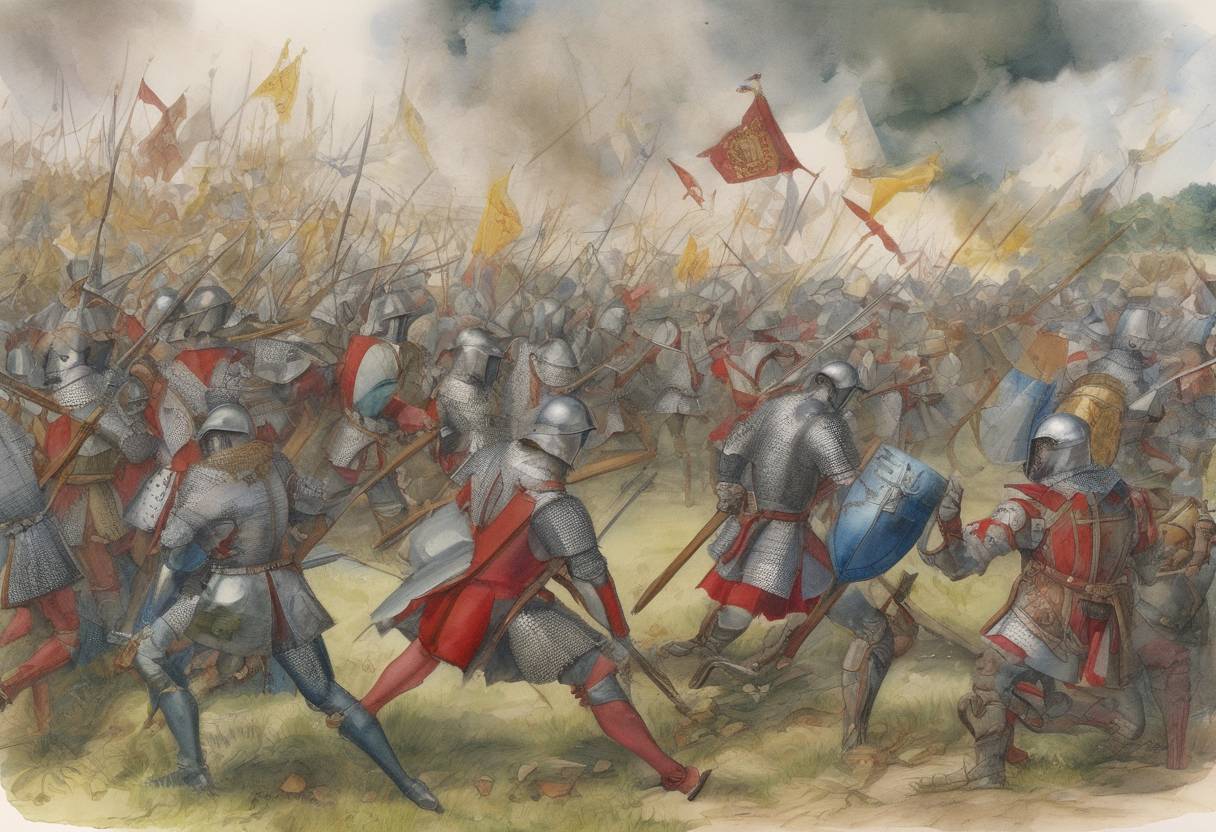
The Battle of Barnet: April 14, 1471
The Battle of Barnet was a pivotal engagement during the Wars of the Roses, a series of dynastic conflicts that plagued England in the latter half of the 15th century. This battle, fought on April 14, 1471, marked a significant turning point in the struggle between the rival houses of York and Lancaster.
Context and Prelude
The Wars of the Roses were primarily a contest for the English throne between the House of York, represented by the white rose, and the House of Lancaster, symbolized by the red rose. By the late 1460s, Edward IV of York had established himself as king, but his reign was fraught with challenges, including opposition from Richard Neville, the Earl of Warwick, known as the “Kingmaker” for his role in the ascent of both Yorkist and Lancastrian monarchs.
Warwick initially supported Edward IV but later turned against him due to political disagreements and personal grievances. In 1470, Warwick allied with the Lancastrians, restoring Henry VI to the throne. However, Edward IV returned from exile in early 1471, determined to reclaim his crown.
The Battle
The Battle of Barnet took place near the town of Barnet, north of London. Edward IV’s forces, numbering around 10,000 men, faced the Lancastrian army led by Warwick, which was of similar size. The battle commenced in the early hours of April 14 under the cover of dense fog, which played a crucial role in the unfolding of events.
Key Events
Fog and Confusion: The thick fog led to confusion on the battlefield, causing miscommunication and misidentification among the troops. This confusion was particularly detrimental to the Lancastrians, as some of Warwick’s forces mistakenly attacked each other.
Yorkist Strategy: Edward IV capitalized on the chaos, directing his forces with precision. His strategic acumen and the loyalty of his troops were instrumental in gaining the upper hand.
Warwick’s Death: The death of the Earl of Warwick during the battle was a severe blow to the Lancastrian cause. His leadership and influence had been central to their efforts, and his loss demoralized the Lancastrian forces.
Aftermath and Significance
The victory at Barnet was decisive for Edward IV. It not only solidified his claim to the throne but also weakened the Lancastrian faction significantly. Just weeks later, Edward achieved another critical victory at the Battle of Tewkesbury, further securing his reign.
The Battle of Barnet marked the decline of Lancastrian power and the end of Warwick’s influence. It underscored the volatility and shifting allegiances of the Wars of the Roses, highlighting the precarious nature of medieval English politics.
Edward IV’s restoration to the throne after Barnet set the stage for a period of relative stability until his death in 1483, after which the Wars of the Roses would flare up once more, eventually leading to the rise of the Tudor dynasty.