Jacques Chirac Announces a "Definitive End" to French Nuclear Testing
1996 · Paris, France
President Jacques Chirac announces a "definitive end" to French nuclear testing.
February 13, 1960
France conducted its first nuclear test, code-named 'Gerboise Bleue', in the Algerian Sahara.
Reggane, Algeria | French Government
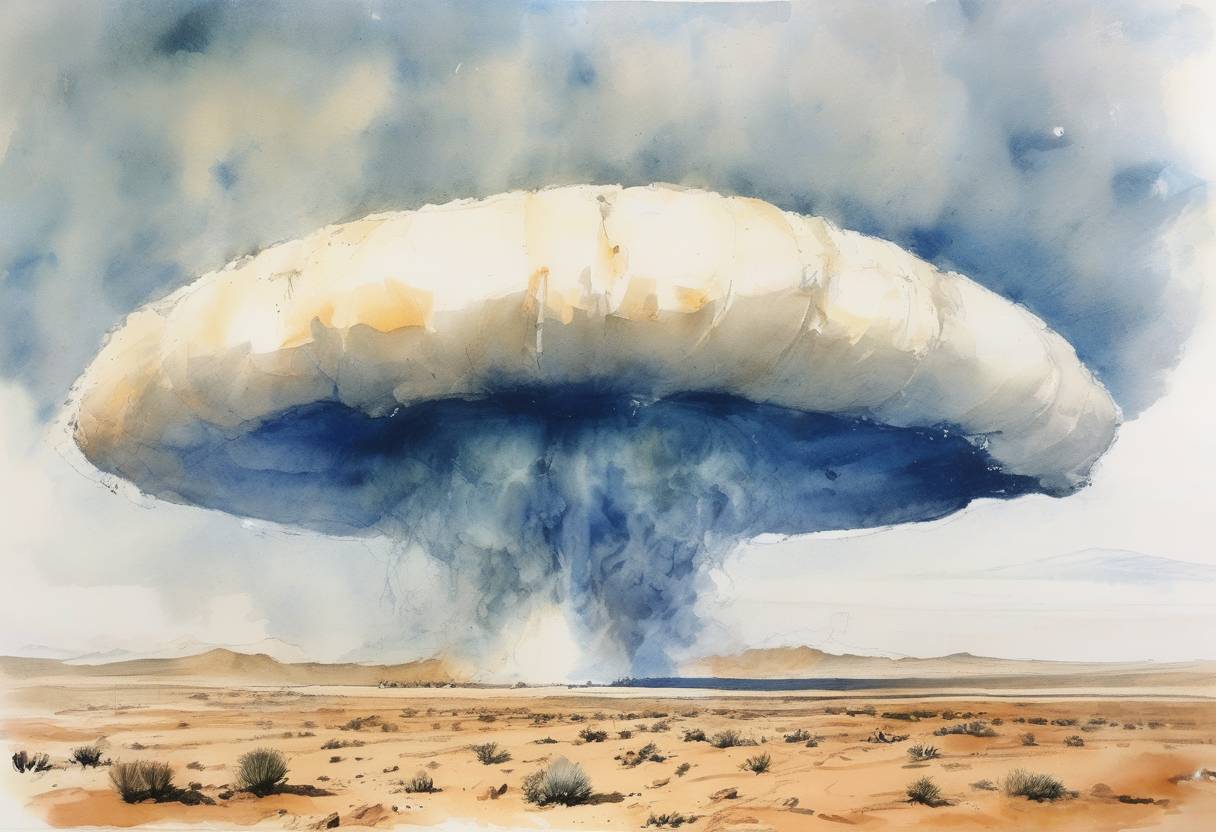
On February 13, 1960, France conducted its first nuclear test, code-named “Gerboise Bleue,” in the Algerian Sahara. This event marked a significant milestone in France’s military and technological history, as it became the fourth nation to develop and successfully test a nuclear weapon, following the United States, the Soviet Union, and the United Kingdom.
Post-WWII Nuclear Arms Race: After World War II, the global landscape was dominated by the Cold War and the nuclear arms race. Major powers were keen on developing nuclear capabilities to assert their influence and ensure national security.
French Nuclear Ambitions: France’s pursuit of nuclear weapons was driven by a desire for strategic independence, particularly from the United States and NATO. The French government, under President Charles de Gaulle, sought to establish France as a major power with its own deterrent force.
Location: The test was conducted at the Reggane test site in the Algerian Sahara, a region under French control at the time, as Algeria was still a French colony.
Code Name: “Gerboise Bleue” translates to “Blue Jerboa,” with “blue” representing the color associated with France and “jerboa” being a desert rodent native to the Sahara, symbolizing the test’s location.
Yield: The device had an estimated yield of 70 kilotons, significantly more powerful than the first atomic bombs used during World War II.
Execution: The test was carried out successfully, demonstrating France’s capability to produce and detonate a nuclear weapon.
International Reaction: The test drew mixed reactions globally. While it was a point of national pride for France, it raised concerns about nuclear proliferation and the environmental impact of testing in the Sahara.
Algerian War of Independence: The test occurred during the Algerian War of Independence (1954-1962). It added complexity to the conflict, as it highlighted the strategic importance of Algeria to France.
Nuclear Policy: Following the test, France continued to develop its nuclear arsenal, conducting further tests and eventually establishing a comprehensive nuclear force, known as the “Force de Frappe.”
Decolonization and Environmental Impact: The test site remained a point of contention during and after Algeria’s independence in 1962. Concerns about radioactive contamination and its effects on local populations persisted for decades.
The successful detonation of “Gerboise Bleue” solidified France’s status as a nuclear power and underscored its commitment to maintaining an independent defense policy. It also contributed to the broader narrative of nuclear proliferation during the Cold War, influencing international arms control discussions and treaties in subsequent years.
Source: en.wikipedia.org