Galileo Galilei and the 1616 Church Ban on Heliocentrism
1616 · Rome, Italy
Galileo Galilei was formally banned by the Roman Catholic Church from teaching or defending the heliocentric ideas of Copernicus.
October 10, 1580
Overbury's trial: Galileo Galilei presents his lecture on the "Hydrostatic Balance," marking one of his early efforts to revolutionize scientific thought.
Florence, Italy | None
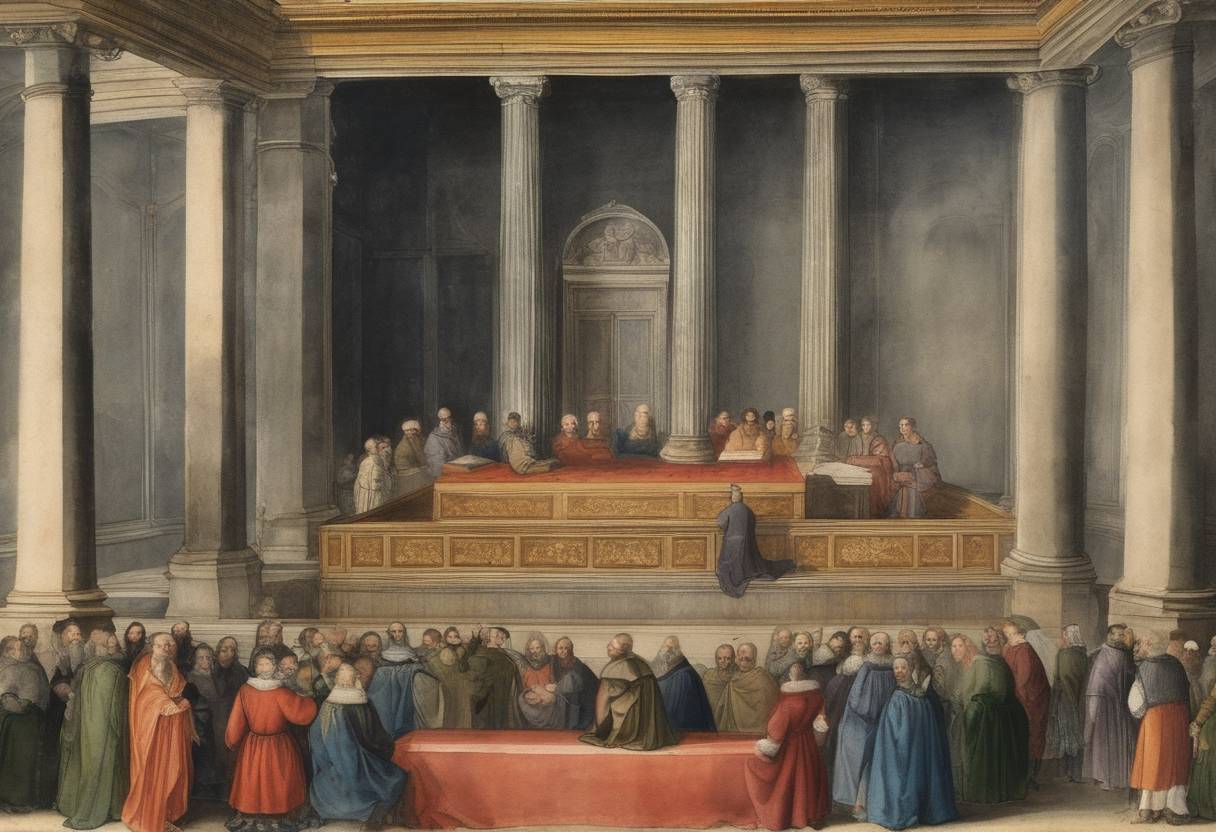
Date: October 10, 1580
Event: On October 10, 1580, Galileo Galilei, then a young scholar at the University of Pisa, presented his lecture on the “Hydrostatic Balance.” This innovative instrument and the ideas behind it marked one of his earliest contributions to scientific thought and placed him on the path to becoming one of the pivotal figures in the Scientific Revolution.
Background: During this period, the study of natural sciences was gaining momentum, and ancient philosophies were being challenged. Galileo, an Italian physicist and astronomer, was beginning to question prevailing Aristotelian teachings, searching for a more empirical and mathematical approach to understanding the natural world.
The Hydrostatic Balance: The Hydrostatic Balance was an instrument devised by Galileo to determine the specific gravity of objects, essentially measuring their density relative to water. This balance operated on Archimedean principles, allowing more precise and reliable measurements compared to existing methods. The development and demonstration of this tool highlighted Galileo’s ingenuity and his commitment to experimental science.
Significance:
Legacy: Galileo’s 1580 lecture on the Hydrostatic Balance represents his proactive effort to engage in and transform scientific inquiry. Although this event was just one of many in Galileo’s illustrious career, it exemplified the methodologies and principles that would come to define his role in the scientific community. Through his work, Galileo set the stage for a shift toward modern scientific methods, which prioritized observation, experimentation, and mathematical analysis.
Source: en.wikipedia.org