Election of Stefan Batory as King of Poland
1576 · Warsaw, Poland
Stefan Batory is elected King of Poland, marking a significant moment in Polish history as he became a notable ruler who strengthened the Polish-Lithuanian Commonwealth.
February 24, 1766
The Stanislaus I of Poland abdicates his throne, paving the way for the election of the new king.
Warsaw, Poland | Polish-Lithuanian Commonwealth
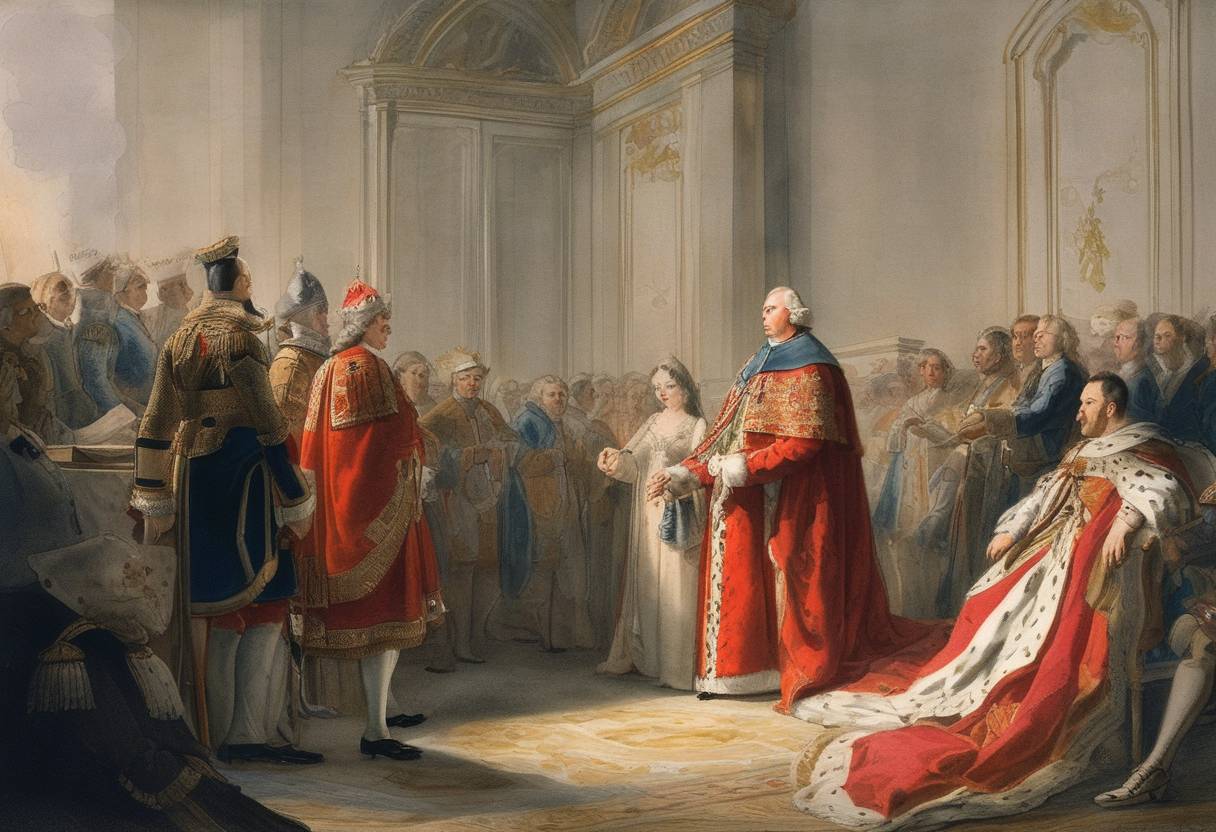
On February 24, 1766, Stanislaus I Leszczyński, former King of Poland, is already an abdicated monarch, having effectively relinquished his claim to the Polish throne in 1736. As such, there is no record of an abdication occurring specifically on February 24, 1766. Instead, Stanislaus I’s significant political actions and ultimate abdication pertain to the earlier years of his tumultuous reign and its eventual end, which occurred in 1736.
Stanislaus I first ascended to the Polish throne during the War of the Polish Succession in 1704, amid the broader geopolitical conflict involving Sweden and Russia. His reign was part of the power struggle between Augustus II the Strong and the coalition of Swedish allies. Stanislaus lost the throne in 1709 when Augustus II regained control with the support of Russian forces after the Swedish defeat at the Battle of Poltava.
After Augustus II’s death in 1733, Stanislaus was again elected king, largely backed by his son-in-law, Louis XV of France. This sparked the War of the Polish Succession (1733–1738), with rival factions supporting Augustus III, the son of Augustus II. Ultimately, the Treaty of Vienna in 1738 concluded this conflict, recognizing Augustus III as King of Poland.
Stanislaus resigned in 1736, accepting the Duchy of Lorraine and Bar, which he ruled until his death in 1766. Although he abdicated in 1736, Stanislaus remained a significant cultural and political figure in Europe until his passing.
The abdication of Stanislaus I allowed for the stabilization of Poland’s internal politics and facilitated a period of relative peace in the region. It also marked a shift in the balance of power in Europe, particularly highlighting the influence of France and the waning Swedish dominance. Stanislaus I’s legacy comprises not only his kingly endeavors but also the cultural advancements and intellectual patronage he fostered in Lorraine.
Source: en.wikipedia.org