The North-West Rebellion: March 26, 1885
1885 · Duck Lake, Canada
The Métis people, led by Louis Riel, begin the North-West Rebellion in Canada.
November 16, 1885
Louis Riel, a Canadian political and Métis leader, was executed for treason in Regina, Northwest Territories, after leading the North-West Rebellion against the Canadian government.
Regina, Canada | Canadian Government
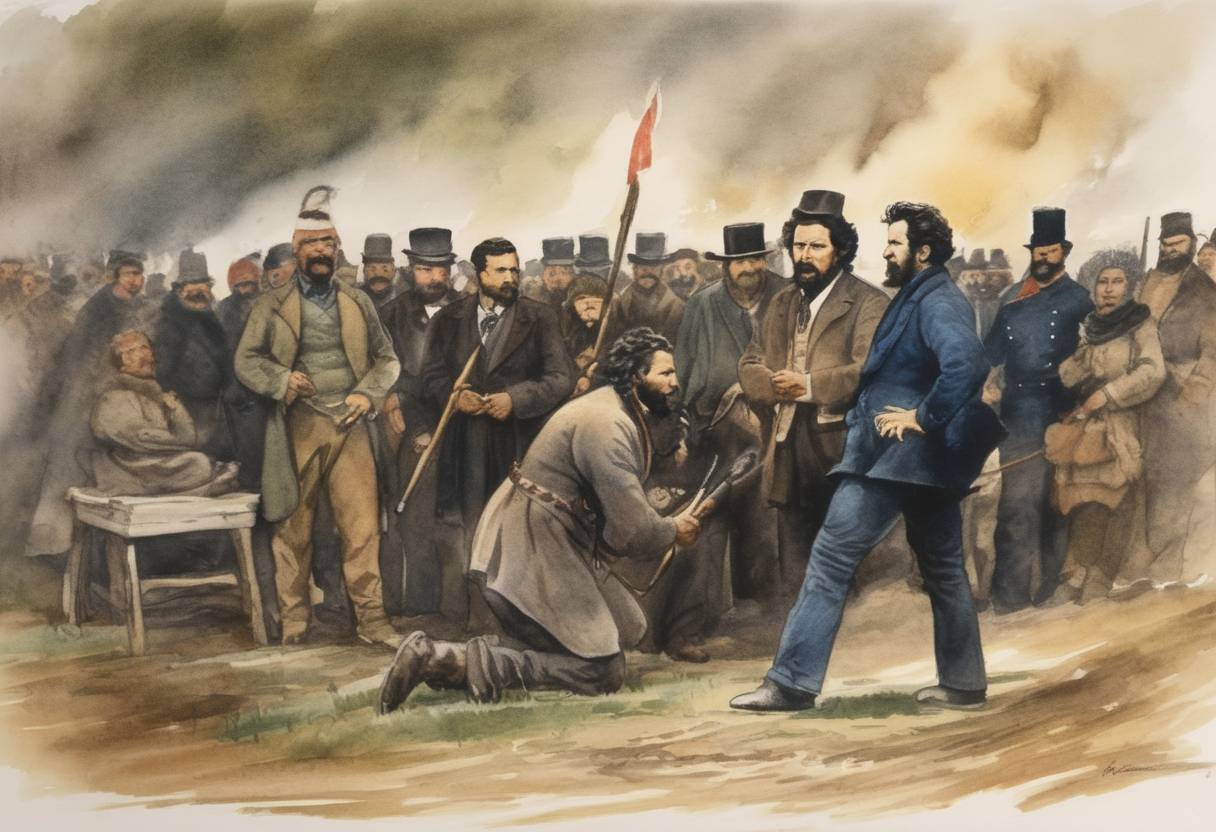
On November 16, 1885, Louis Riel, a prominent Canadian political leader and a key figure in the Métis rights movement, was executed by hanging in Regina, Northwest Territories. His execution was the culmination of complex political and social tensions that boiled over into the North-West Rebellion.
Louis Riel was born on October 22, 1844, in the Red River Settlement, in what is now Manitoba. Riel was a central figure in the Red River Resistance of 1869-1870, which ultimately led to the creation of the province of Manitoba and the recognition of Métis rights. He championed the rights of the Métis—a group of mixed Indigenous and European ancestry—and sought to protect their lands and culture against an expanding Canadian government.
In 1885, Riel led the North-West Rebellion, a short and violent conflict that was driven by the discontentment of the Métis and Indigenous groups in the Canadian prairies. They were frustrated with the Canadian government’s policies, perceived neglect, and encroachments on their traditional lands. The conflict saw several confrontations, the most significant being the Battle of Batoche, where Riel’s forces were defeated by Canadian troops in May 1885.
Following the suppression of the rebellion, Riel surrendered to Canadian forces on May 15, 1885. He was charged with high treason and stood trial in Regina. Despite the complex socio-political contexts and arguments for Riel’s mental instability, the jury, composed entirely of English-speaking Protestants, found him guilty. The trial was controversial; Riel’s defenders argued that he was fighting to safeguard the rights of marginalized peoples against a neglectful government.
Riel was executed on November 16, 1885, in what many contemporaries and historians view as a politically motivated act intended to quell further unrest among the Métis and Indigenous populations. His execution sparked lasting divisions in Canadian society, particularly between French-speaking Catholics sympathetic to Riel and English-speaking Protestants who viewed him as a rebel.
Riel is remembered as a complex and polarizing figure. For many, especially among the Métis and Francophone communities, he is celebrated as a martyr and a founding father of Manitoba. His legacy continues to influence Canadian discussions on reconciliation and the rights of Indigenous peoples.
Source: en.wikipedia.org