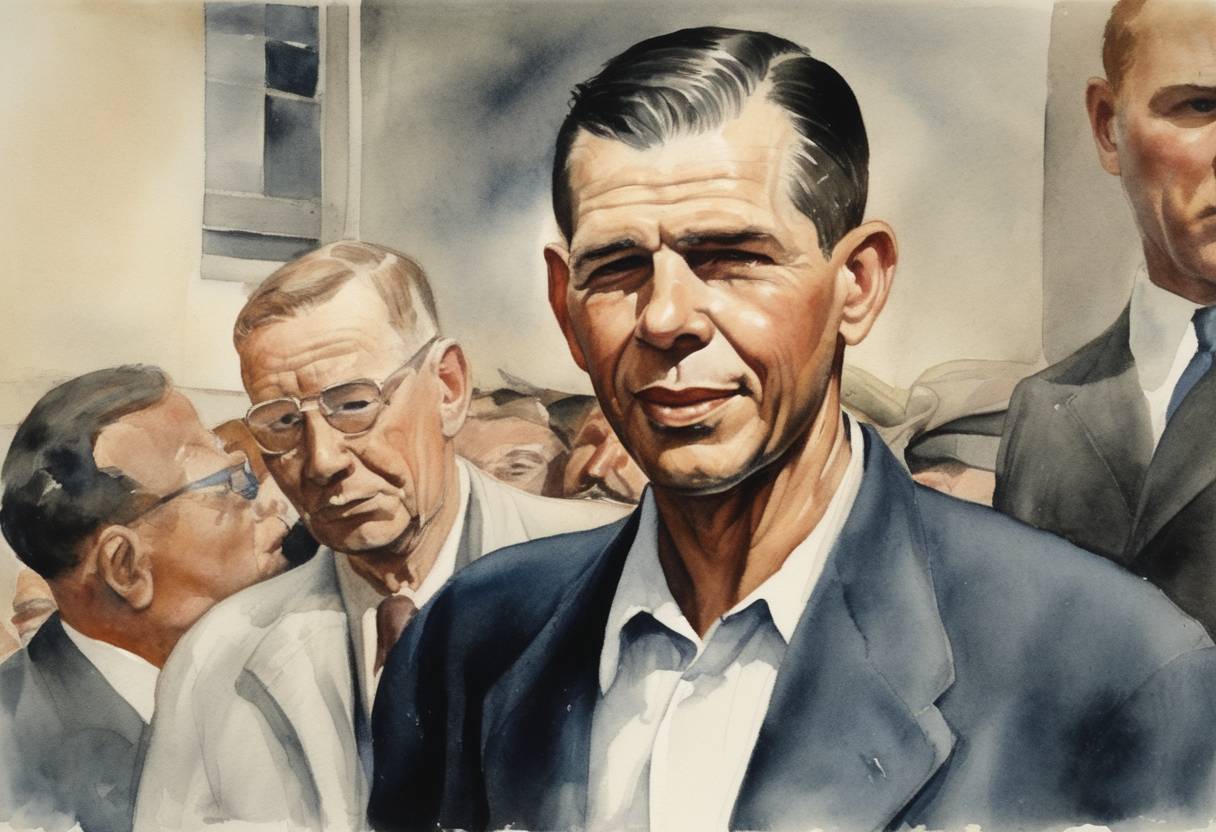
Alger Hiss’s Release from Prison
On November 27, 1954, Alger Hiss, a former U.S. State Department official, was released from Lewisburg Federal Penitentiary after serving 44 months of a five-year sentence for perjury. His conviction was linked to espionage charges during the fervent anti-communist era of the Cold War.
Background
Alger Hiss’s troubles began during the late 1940s, a period characterized by intense fear of communist infiltration within the United States. Hiss was accused by Whittaker Chambers, a former Communist Party member, of being a Soviet spy. Chambers testified before the House Un-American Activities Committee (HUAC) in 1948, claiming that Hiss had relayed government documents to the Soviet Union and had been a covert member of the Communist Party.
The Trial and Conviction
The legal proceedings against Hiss were notable for their complexity and the involvement of high-profile figures. Given the lack of conclusive evidence to convict him of espionage, Hiss was charged with perjury—lying under oath about passing state secrets to Chambers. The trial gained significant public attention and was instrumental in the rise of Richard Nixon, then a young congressman, who played a pivotal role in the investigation. Hiss’s first trial in 1949 ended with a hung jury, but a second trial resulted in his conviction in January 1950.
Impact and Aftermath
Hiss maintained his innocence throughout his life, drawing significant public and scholarly debate about his guilt. His case became emblematic of the domestic tensions of the Cold War era, highlighting the divisive nature of anti-communist sentiment and the impact of McCarthyism in the United States.
Following his release from prison, Hiss’s case continued to be discussed and analyzed, with various declassified documents and later research casting differing perspectives on his culpability. The controversy surrounding Alger Hiss remains a significant chapter in the history of Cold War America.