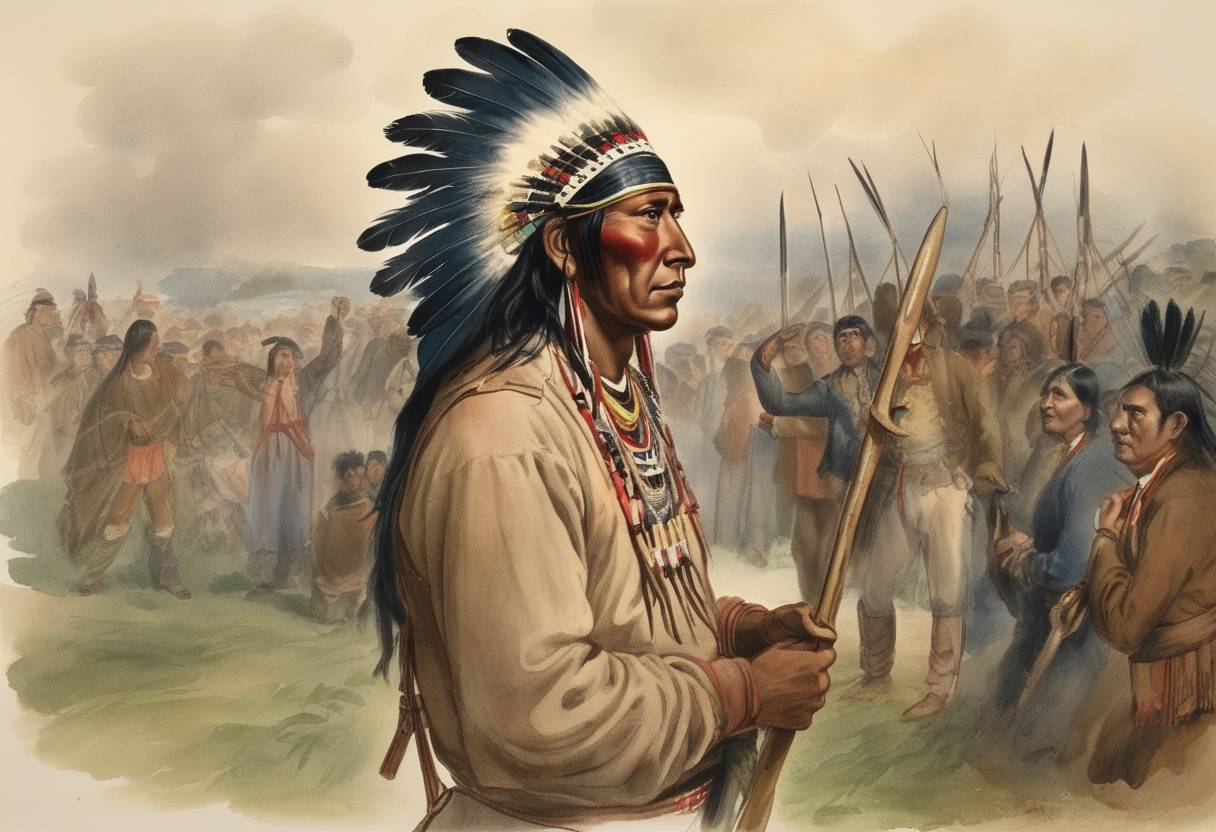
Black Hawk’s Surrender and the Conclusion of the Black Hawk War - August 27, 1832
On August 27, 1832, the Native American leader Black Hawk, a chief of the Sauk tribe, surrendered to U.S. authorities, marking the effective end of the Black Hawk War. This conflict arose out of tensions between American settlers and Native American tribes over land disputes in the Illinois and Wisconsin territories.
Context Leading to the Conflict
The origins of the Black Hawk War lay in the Treaty of St. Louis, signed in 1804, in which the Sauk and Fox tribes ceded lands east of the Mississippi River to the United States. Black Hawk and his followers disputed the treaty, maintaining that it was signed under duress and without the full consent of the tribes. The escalation of tensions led to Black Hawk’s attempt to reclaim traditional lands, culminating in his return across the Mississippi in 1832 with a band of warriors and non-combatants, including women and children.
Key Events
After crossing the Mississippi River, Black Hawk’s group faced increasingly hostile responses from American settlers and military forces. The conflict consisted of several skirmishes, notably the Battle of Stillman’s Run and the Battle of Bad Axe, where U.S. forces severely outmatched Black Hawk’s band. Despite initial minor victories, the Native American coalition suffered heavy casualties as they retreated.
The culmination occurred when Black Hawk was captured by the Winnebago tribe, allied with U.S. forces, thus concluding the war. On August 27, Black Hawk was handed over to Lieutenant Jefferson Davis and polite negotiations led to his effective surrender.
Aftermath and Significance
Black Hawk’s surrender had significant implications for the Native American tribes in the region, accelerating their removal and loss of lands. The Black Hawk War was a crucial event that paved the way for further enforced migration westward under policies such as the Indian Removal Act.
The war also reinforced American control over the Northwest Territory, demonstrating the federal government’s resolve to expand and settle west. Black Hawk’s resistance is remembered for its symbolic stance against the loss of native lands and the increasing encroachment of European settlers.
In subsequent years, Black Hawk dictated his autobiography, “Life of Ma-ka-tai-me-she-kia-kiak or Black Hawk,” providing a crucial Native American perspective on the events of his time and ensuring that his experiences and resistance were recorded for posterity. His legacy endures as a figure of perseverance and leadership amidst overwhelming challenges.