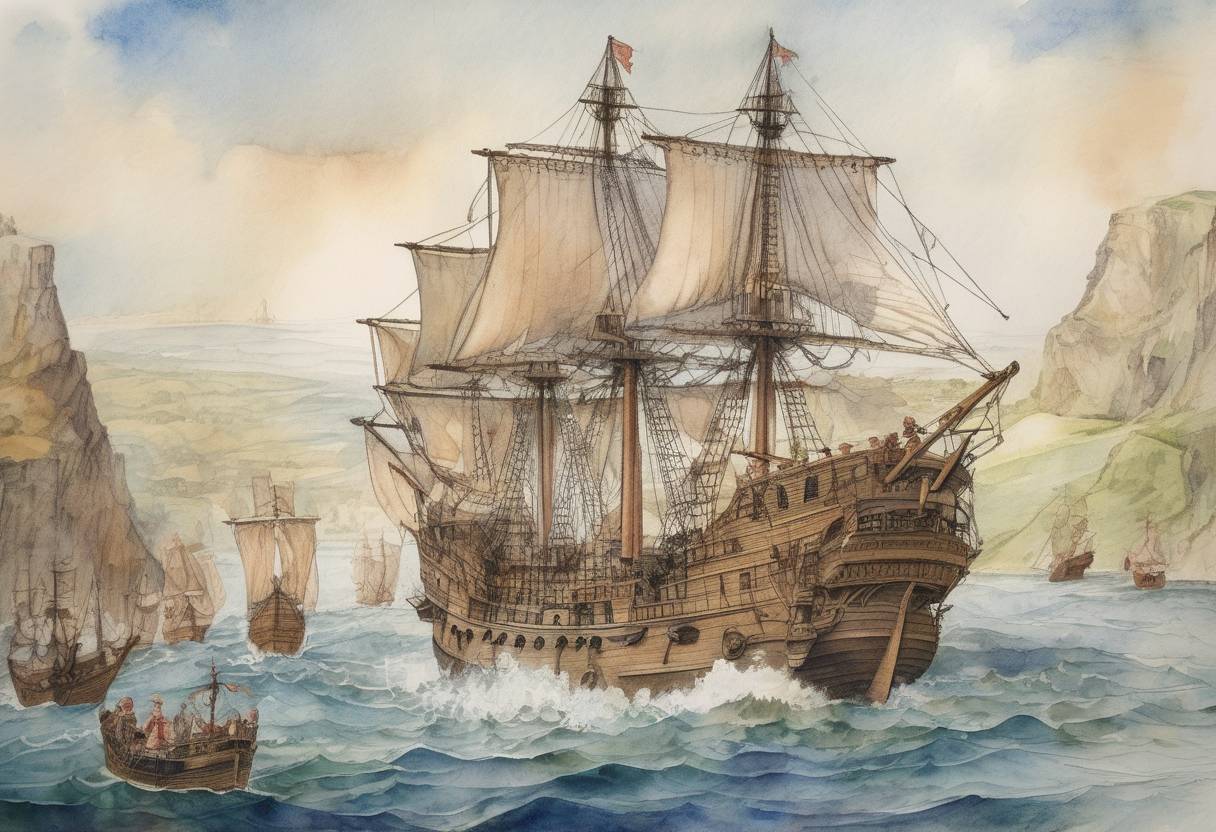
Sir Francis Drake’s Voyage Around the World
On December 13, 1577, Sir Francis Drake set sail from Plymouth, England, embarking on a historic circumnavigation of the globe. This expedition, which lasted until September 26, 1580, marked Drake as the first Englishman to complete such a journey and only the second known circumnavigation after Ferdinand Magellan’s expedition.
Context and Background
Elizabethan Era: The voyage took place during the reign of Queen Elizabeth I, a period marked by exploration and expansion. England was eager to challenge Spanish dominance in the New World and the lucrative trade routes.
Royal Commission: Drake’s expedition was sanctioned by Queen Elizabeth I, who provided him with a privateering commission. This allowed him to capture Spanish ships and claim their treasures, which was a significant motivation for the voyage.
The Voyage
Fleet Composition: Drake’s fleet initially consisted of five ships: the Pelican (later renamed the Golden Hind), the Elizabeth, the Marigold, the Swan, and the Benedict.
Route and Challenges:
- Atlantic Crossing: The fleet sailed down the coast of Africa and crossed the Atlantic to South America.
- Strait of Magellan: In August 1578, Drake navigated through the treacherous Strait of Magellan, entering the Pacific Ocean.
- Pacific Raids: Drake conducted raids on Spanish settlements along the Pacific coast of South America, capturing valuable treasures.
- Crossing the Pacific: The expedition continued across the Pacific Ocean, reaching the Moluccas (Spice Islands) and eventually sailing through the Indian Ocean.
Renaming of the *Pelican*: During the voyage, Drake renamed his flagship the Golden Hind in honor of his patron, Sir Christopher Hatton, whose crest featured a golden hind.
Aftermath and Significance
Return to England: Drake returned to Plymouth on September 26, 1580, with a wealth of captured Spanish treasures, which significantly bolstered England’s economy and naval prestige.
Knighthood: In April 1581, Queen Elizabeth I knighted Drake aboard the Golden Hind, recognizing his achievements and contributions to England’s maritime prowess.
Impact on Exploration: Drake’s successful circumnavigation demonstrated the feasibility of global sea travel and encouraged further English exploration and colonization efforts.
Anglo-Spanish Relations: The voyage exacerbated tensions between England and Spain, contributing to the events leading up to the Spanish Armada’s attempted invasion of England in 1588.
Drake’s journey remains a landmark in the history of exploration, showcasing the daring and ambition of the Elizabethan era and paving the way for future maritime endeavors.