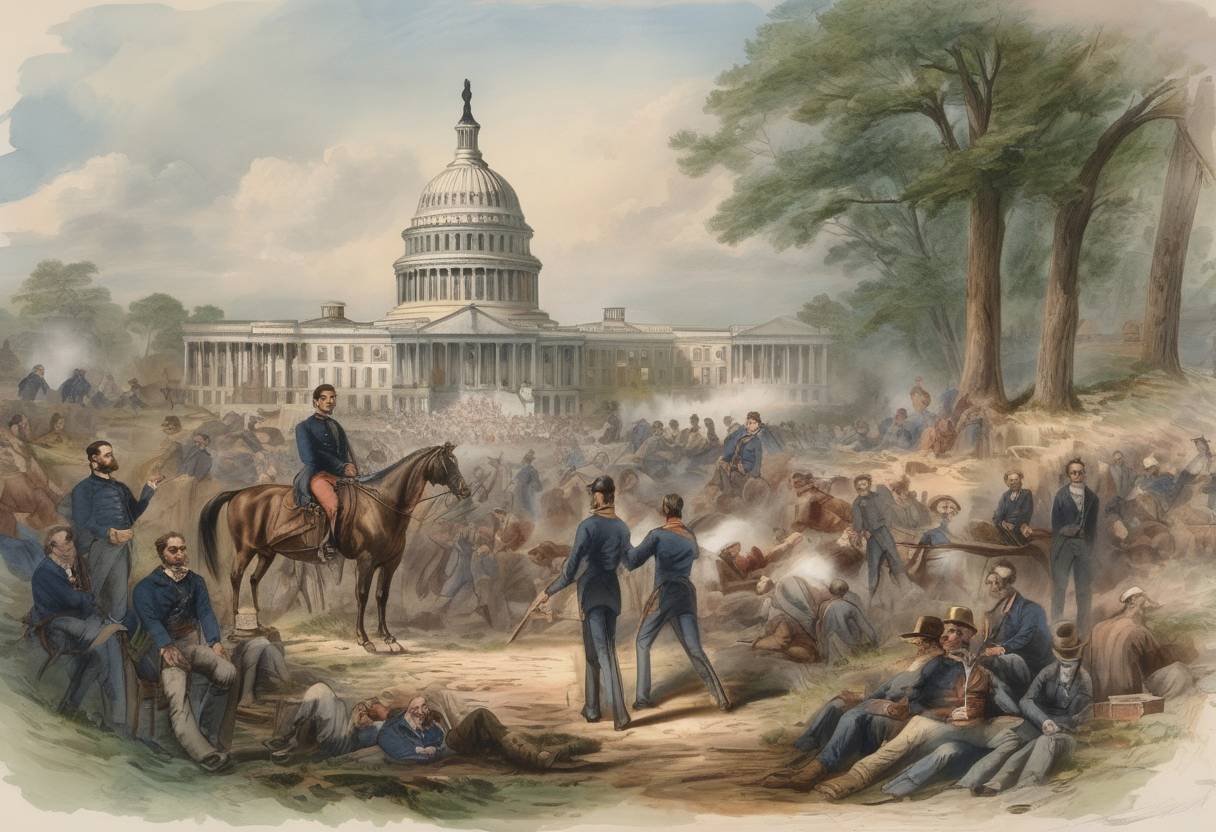
The Crittenden-Johnson Resolution: July 25, 1861
On July 25, 1861, the United States Congress passed the Crittenden-Johnson Resolution, a significant declaration during the early stages of the American Civil War. This resolution was a joint effort by Senator John J. Crittenden of Kentucky and Representative Andrew Johnson of Tennessee, both of whom were Unionists from border states with complex positions on slavery.
Context and Background
Outbreak of the Civil War: The Civil War began in April 1861 with the Confederate attack on Fort Sumter. The conflict quickly escalated, and the Union sought to clarify its war aims to maintain support from border states and Northern Democrats who were wary of a war focused on abolition.
Political Climate: At the time, there was significant tension between those who wanted to preserve the Union and those advocating for the abolition of slavery. The Union’s primary goal was to prevent the secession of Southern states and maintain the United States as a single nation.
Key Provisions of the Resolution
Preservation of the Union: The Crittenden-Johnson Resolution explicitly stated that the primary objective of the Civil War was to preserve the Union. It emphasized that the war was not being waged for “overthrowing or interfering with the rights or established institutions of those states,” which was a clear reference to slavery.
Reassurance to Border States: By focusing on the Union’s preservation, the resolution aimed to reassure border states like Kentucky, Missouri, and Maryland, which were slave states that had not seceded, that their institutions would not be immediately threatened.
Passage and Impact
Congressional Support: The resolution passed with overwhelming support in Congress, reflecting a broad consensus at the time that the Union’s preservation was paramount. The House of Representatives passed it with a vote of 117 to 2, and the Senate approved it 30 to 5.
Short-Term Effectiveness: Initially, the resolution helped solidify support for the Union cause among those who were concerned about the war’s implications for slavery. It also provided a unified front for the Union’s military efforts in the early months of the conflict.
Aftermath and Historical Significance
Shift in War Aims: As the war progressed, the focus shifted towards emancipation as a strategic and moral imperative. President Abraham Lincoln’s issuance of the Emancipation Proclamation in 1863 marked a significant turning point, redefining the war’s objectives to include the abolition of slavery.
Legacy: The Crittenden-Johnson Resolution is often seen as a reflection of the complex political landscape at the war’s outset. It highlights the initial reluctance of many in the Union to address slavery directly, a stance that would evolve as the war continued.
In summary, the Crittenden-Johnson Resolution was a critical early statement of the Union’s war aims, emphasizing the preservation of the nation over the abolition of slavery. Its passage illustrated the delicate balancing act faced by Union leaders in maintaining support across diverse political and regional lines.