Establishment of the "Hotline" - June 20, 1963
1963 · Washington D.C., United States
The United States and the Soviet Union agree to establish a direct communications link, known as the "Hotline," to reduce the risk of accidental nuclear war.
October 14, 1962
The Cuban Missile Crisis began when a U.S. reconnaissance plane photographed Soviet missile bases under construction in Cuba.
Cuba, Cuba | Soviet Union
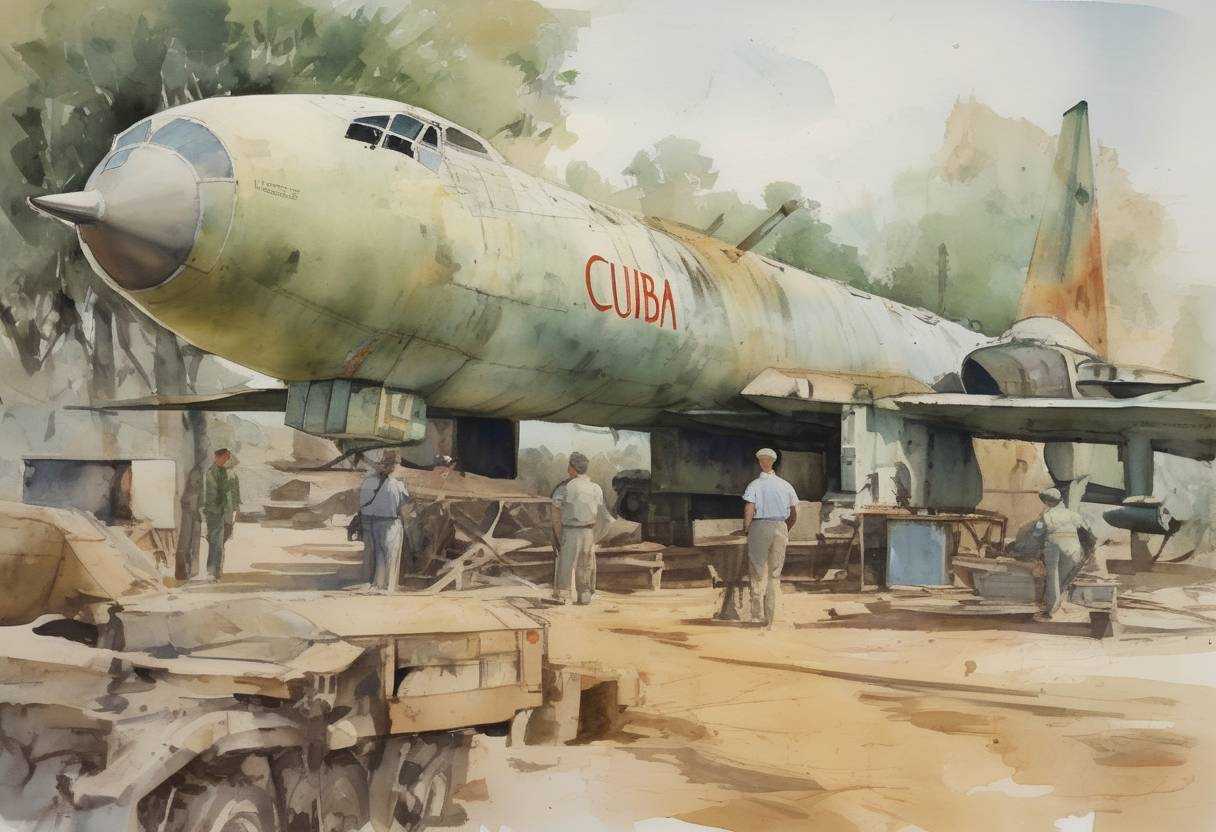
On October 14, 1962, a pivotal moment in Cold War history unfolded when a U.S. reconnaissance plane captured photographic evidence of Soviet missile bases under construction in Cuba. This discovery marked the beginning of the Cuban Missile Crisis, a 13-day confrontation between the United States and the Soviet Union that brought the world perilously close to nuclear conflict.
The roots of the Cuban Missile Crisis can be traced back to the Cold War tensions between the United States and the Soviet Union. Following the failed Bay of Pigs invasion in 1961, Cuban leader Fidel Castro sought to strengthen his ties with the Soviet Union. In response, Soviet Premier Nikita Khrushchev decided to place nuclear missiles in Cuba, just 90 miles off the coast of Florida, as a strategic counterbalance to U.S. missiles stationed in Turkey and Italy.
On October 14, a U-2 spy plane, piloted by Major Richard Heyser, flew over western Cuba and captured images of missile sites under construction. These photographs provided irrefutable evidence that the Soviet Union was installing medium-range ballistic missiles capable of carrying nuclear warheads. The missiles posed a direct threat to the United States, with the potential to strike major cities within minutes.
Upon reviewing the reconnaissance photographs, President John F. Kennedy convened the Executive Committee of the National Security Council (ExComm) to deliberate on the appropriate course of action. The options ranged from diplomatic negotiations to a full-scale military invasion of Cuba. Ultimately, Kennedy opted for a naval blockade, termed a “quarantine,” to prevent further Soviet shipments of military equipment to Cuba.
The announcement of the blockade on October 22, 1962, escalated tensions as both superpowers stood on the brink of nuclear war. Over the following days, intense negotiations ensued between Kennedy and Khrushchev, with the world anxiously watching. The crisis reached its peak on October 27, when a U.S. U-2 plane was shot down over Cuba, and the U.S. military was placed on high alert.
The crisis was defused on October 28, when Khrushchev agreed to dismantle the missile sites in exchange for a U.S. public declaration not to invade Cuba and a secret agreement to remove U.S. missiles from Turkey. The resolution of the Cuban Missile Crisis is often cited as a turning point in Cold War diplomacy, leading to improved communication channels between the superpowers, including the establishment of the Moscow-Washington hotline.
The Cuban Missile Crisis remains a significant event in history, highlighting the dangers of nuclear proliferation and the importance of diplomatic negotiation in resolving international conflicts.
Source: en.wikipedia.org