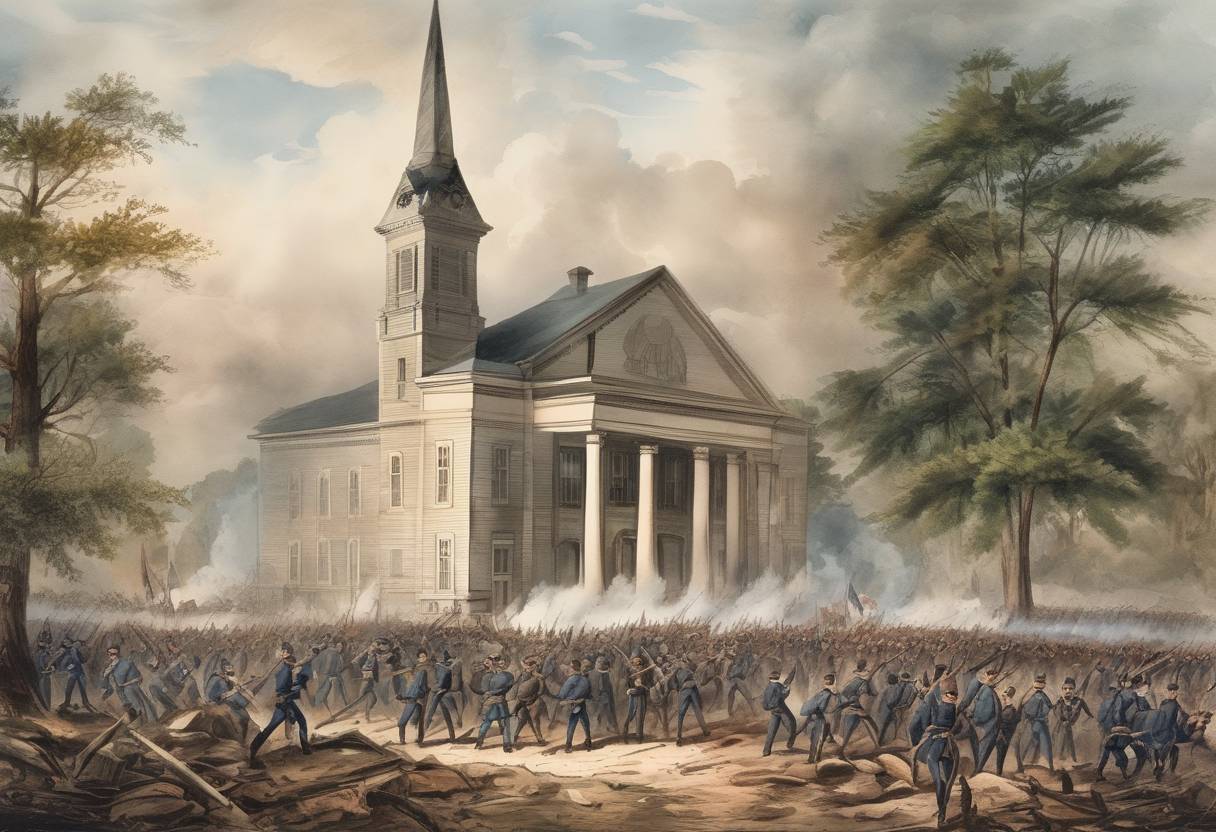
The Battle of Ezra Church
Overview
The Battle of Ezra Church was a significant engagement during the American Civil War, occurring on July 28, 1864. It was part of the Atlanta Campaign, a series of battles fought throughout northwest Georgia. The battle resulted in a Union victory under the command of Major General William T. Sherman.
Context
- Atlanta Campaign: The campaign was a crucial Union initiative aimed at capturing the strategic city of Atlanta, a vital railroad hub and industrial center for the Confederacy. The campaign began in May 1864 and involved several battles as Union forces advanced towards Atlanta.
- Union Strategy: Major General William T. Sherman led the Union forces with a strategy of maneuver warfare, aiming to outflank and cut off Confederate supply lines rather than engage in direct assaults on fortified positions.
Key Events Leading to the Battle
- Fall of Atlanta’s Outer Defenses: By late July 1864, Sherman’s forces had already engaged in several battles around Atlanta, including the Battle of Peachtree Creek and the Battle of Atlanta, weakening the city’s outer defenses.
- Confederate Command: Confederate General John Bell Hood, who had recently taken command of the Army of Tennessee, sought to defend Atlanta by launching aggressive counterattacks against Sherman’s forces.
The Battle
- Location: The battle took place near Ezra Church, a small chapel west of Atlanta.
- Union Forces: Led by Major General Oliver O. Howard, the Union Army of the Tennessee was tasked with cutting the last remaining railroad supply line into Atlanta.
- Confederate Attack: General Hood ordered Lieutenant General Stephen D. Lee to attack Howard’s forces. The Confederates launched a series of frontal assaults against well-entrenched Union positions.
- Outcome: The Union forces successfully repelled the Confederate attacks, inflicting heavy casualties. The Confederates suffered approximately 3,000 casualties, while Union losses were around 600.
Aftermath and Significance
- Union Victory: The victory at Ezra Church further weakened the Confederate hold on Atlanta and contributed to the eventual fall of the city on September 2, 1864.
- Impact on the War: The capture of Atlanta was a significant turning point in the Civil War, boosting Northern morale and contributing to President Abraham Lincoln’s re-election in November 1864.
- Sherman’s March to the Sea: Following the fall of Atlanta, Sherman embarked on his famous “March to the Sea,” a campaign of total war aimed at crippling the Confederacy’s ability to sustain the war effort.
The Battle of Ezra Church exemplified Sherman’s strategic acumen and the effectiveness of his campaign tactics, which played a crucial role in the eventual Union victory in the Civil War.