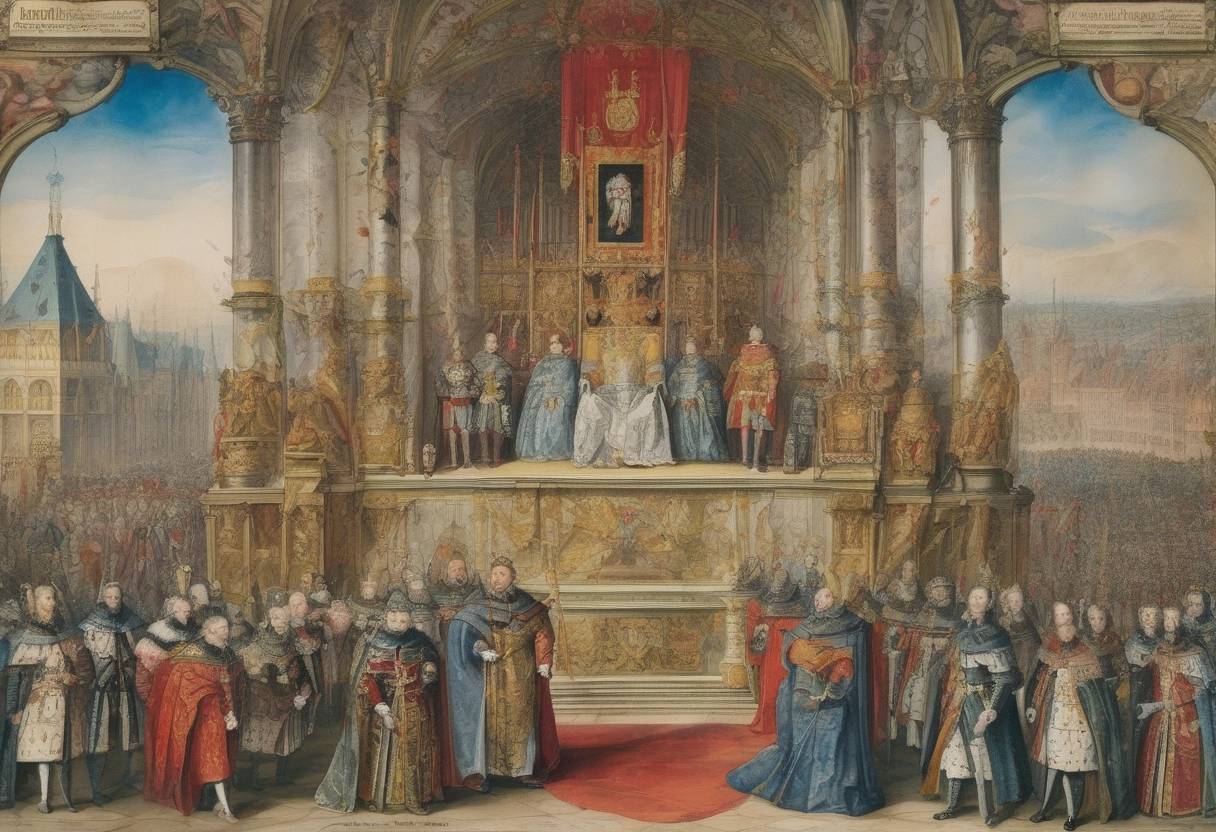
The Abdication of Charles V: Division of the Habsburg Empire
On January 16, 1556, Charles V, Holy Roman Emperor, formally abdicated his throne, marking a significant moment in European history. This decision led to the division of the vast Habsburg Empire between his brother Ferdinand I and his son Philip II, reshaping the political landscape of Europe.
Background
Charles V was born on February 24, 1500, in Ghent, present-day Belgium. He inherited a vast empire that spanned Europe and the Americas, becoming one of the most powerful rulers of the 16th century. His reign was marked by numerous conflicts, including the Protestant Reformation, wars with France, and battles against the Ottoman Empire.
Reasons for Abdication
By the mid-1550s, Charles V was exhausted by the constant warfare and the immense responsibilities of ruling such a vast empire. Additionally, he suffered from poor health, including severe gout, which made it increasingly difficult for him to govern effectively. Recognizing the need for a more stable and manageable administration, Charles decided to abdicate and divide his empire.
The Division of the Empire
Ferdinand I: Charles’s brother, Ferdinand I, was already the King of the Romans and had been managing the affairs of the Holy Roman Empire in Charles’s absence. Upon Charles’s abdication, Ferdinand officially became the Holy Roman Emperor. This transition was formalized in 1558, after Charles’s abdication was recognized by the Imperial Diet.
Philip II: Charles’s son, Philip II, inherited the Spanish Empire, which included Spain, the Netherlands, parts of Italy, and the vast Spanish colonies in the Americas. Philip’s rule marked the height of Spanish power, with Spain becoming a dominant global force.
Consequences and Significance
The abdication of Charles V and the subsequent division of the Habsburg Empire had profound implications:
Political Realignment: The division created two distinct branches of the Habsburg dynasty, with the Austrian Habsburgs under Ferdinand and the Spanish Habsburgs under Philip. This realignment influenced European politics for centuries.
Religious Tensions: Ferdinand’s rule in the Holy Roman Empire coincided with ongoing religious tensions between Catholics and Protestants, leading to the eventual outbreak of the Thirty Years’ War in 1618.
Spanish Dominance: Under Philip II, Spain reached the zenith of its power, with significant influence in Europe and the Americas. However, this period also saw the beginning of Spain’s gradual decline due to economic challenges and military overextension.
Legacy of Charles V: Charles’s abdication symbolized the challenges of managing a vast, multi-ethnic empire in a time of religious and political upheaval. His decision to divide the empire was a pragmatic response to these challenges, setting a precedent for future rulers.
In conclusion, Charles V’s abdication on January 16, 1556, was a pivotal event that reshaped the Habsburg Empire and had lasting effects on European history. The division of his empire between Ferdinand I and Philip II marked the beginning of a new era in European politics and set the stage for future conflicts and alliances.