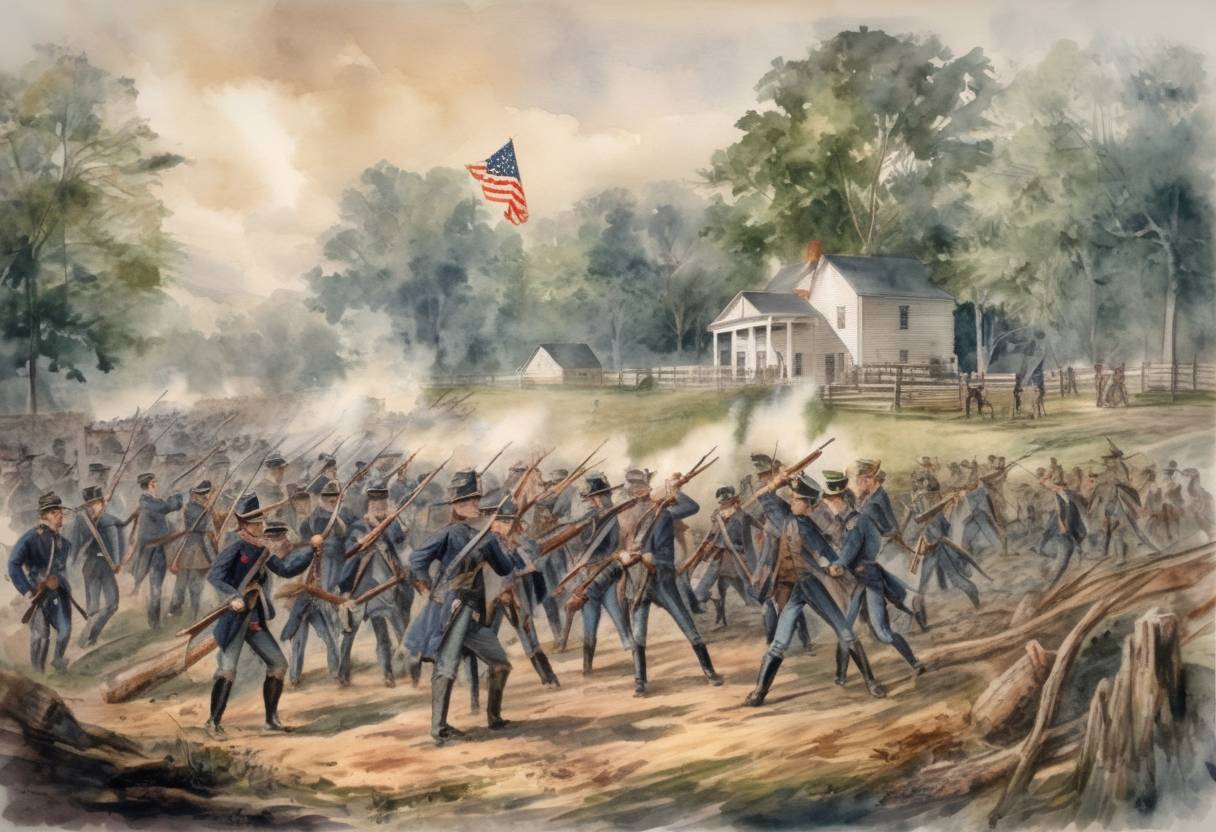
The Battle of Spotsylvania Court House
Overview
The Battle of Spotsylvania Court House was a significant engagement during the American Civil War, taking place from May 8 to May 21, 1864. It was part of the Overland Campaign, a series of battles orchestrated by Union General Ulysses S. Grant with the strategic goal of defeating the Confederate Army of Northern Virginia, led by General Robert E. Lee.
Context
- Overland Campaign: Initiated in May 1864, this campaign marked a shift in Union strategy. Grant aimed to engage Lee’s forces continuously, leveraging the Union’s numerical superiority and resources.
- Wilderness Battle: Prior to Spotsylvania, the Battle of the Wilderness (May 5-7, 1864) had ended inconclusively, with heavy casualties on both sides. Grant, unlike previous Union commanders, chose not to retreat but to press on towards Richmond, the Confederate capital.
Key Events
- May 8, 1864: Union forces, pursuing Lee’s army, encountered Confederate troops entrenched at Spotsylvania Court House. Initial skirmishes set the stage for a prolonged and bloody confrontation.
- May 10, 1864: Union General Winfield Scott Hancock launched a significant assault on the Confederate lines, known as the “Mule Shoe” salient. Despite initial success, the attack was ultimately repelled.
- May 12, 1864: The most intense fighting occurred during the “Bloody Angle” assault, where Union forces temporarily breached Confederate defenses. The battle saw brutal hand-to-hand combat, with neither side gaining a decisive advantage.
- May 13-21, 1864: The fighting devolved into a series of smaller engagements and trench warfare, with both armies suffering heavy casualties. Grant continued to probe Confederate defenses but was unable to break through decisively.
Aftermath
- Casualties: The battle resulted in approximately 18,000 Union and 12,000 Confederate casualties, reflecting the high human cost of the Overland Campaign.
- Strategic Impact: Although the battle was tactically inconclusive, it demonstrated Grant’s determination to maintain pressure on Lee’s forces. This relentless strategy would eventually contribute to the depletion of Confederate resources and manpower.
- Continued Campaign: Following Spotsylvania, Grant continued his offensive operations, leading to further engagements at places like Cold Harbor and eventually the Siege of Petersburg.
Historical Significance
The Battle of Spotsylvania Court House exemplified the brutal and attritional nature of the Civil War’s later stages. It underscored the shift in Union tactics under Grant’s leadership, focusing on sustained pressure rather than single decisive battles. This approach would play a crucial role in the eventual Union victory and the end of the Civil War in 1865.