The Constitution of Denmark: A Monumental Shift on January 16, 1864
1864 · Copenhagen, Denmark
The Danish Monarchy declared the Constitution of Denmark, adopting parliamentary democracy while maintaining the monarchy.
November 18, 1863
King Christian IX of Denmark signed the November Constitution, which declared Schleswig a part of Denmark, leading to the Second Schleswig War.
Copenhagen, Denmark | Danish Government
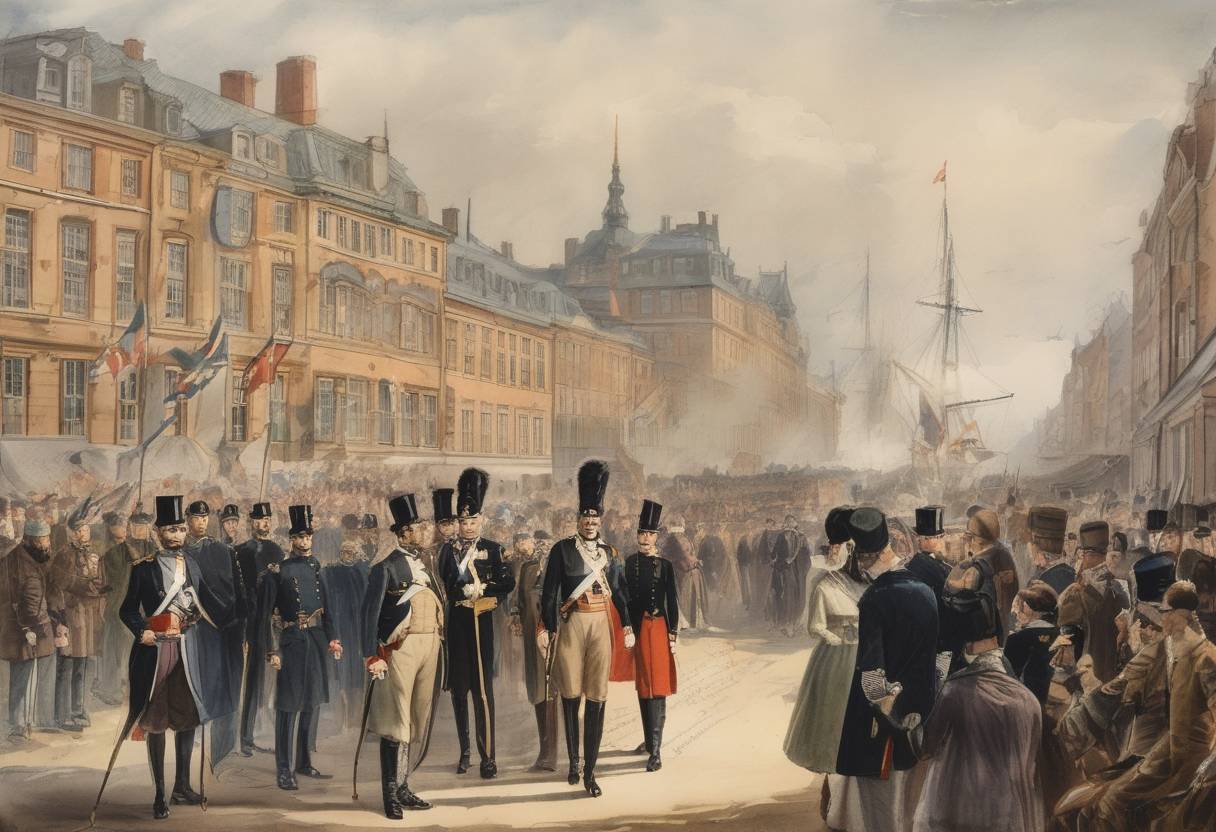
On November 18, 1863, King Christian IX of Denmark signed the November Constitution, a pivotal event that significantly influenced the political landscape of 19th-century Europe. This constitution declared the duchy of Schleswig as an integral part of Denmark, a move that directly led to the outbreak of the Second Schleswig War.
The duchies of Schleswig and Holstein were two territories with complex political and cultural ties to both Denmark and the German Confederation. Historically, Schleswig was a Danish fief, while Holstein was a member of the German Confederation. The two duchies were often treated as a single entity, but their status was a contentious issue, particularly as nationalist sentiments grew in both Denmark and the German states.
In the mid-19th century, the question of Schleswig-Holstein’s status became a focal point of Danish and German nationalism. The First Schleswig War (1848-1851) had already seen conflict over this issue, ending with the London Protocol of 1852, which attempted to maintain the status quo by affirming the duchies’ association with the Danish crown while respecting their distinct identities.
The November Constitution was an attempt by Denmark to formally incorporate Schleswig into the Danish kingdom, thereby ignoring the provisions of the London Protocol. This action was driven by Danish nationalists who sought to strengthen Denmark’s territorial integrity and counter German influence in the region.
King Christian IX’s signing of the constitution was controversial and seen as a provocative act by the German Confederation, particularly by the Kingdom of Prussia and the Austrian Empire, who had interests in maintaining the balance of power in the region.
The signing of the November Constitution directly led to the Second Schleswig War (1864). Prussia and Austria, acting on behalf of the German Confederation, demanded that Denmark revoke the constitution. When Denmark refused, the two powers declared war in February 1864.
The conflict was brief but decisive. The technologically superior and better-organized Prussian and Austrian forces quickly defeated the Danish army. By October 1864, the Treaty of Vienna was signed, resulting in Denmark ceding control of both Schleswig and Holstein to Prussia and Austria.
The Second Schleswig War had significant consequences for Denmark and the broader European political landscape:
Territorial Loss: Denmark’s defeat resulted in the loss of approximately one-third of its territory and population, a blow to Danish national pride and influence.
German Unification: The war marked a step towards the unification of Germany under Prussian leadership. It demonstrated Prussia’s military prowess and set the stage for further conflicts that would eventually lead to the establishment of the German Empire in 1871.
Shift in Power: The conflict altered the balance of power in Europe, weakening Denmark and strengthening Prussia, which would later play a dominant role in European affairs.
The November Constitution and the subsequent war underscore the complexities of nationalism and state sovereignty in 19th-century Europe, illustrating how regional disputes could escalate into broader conflicts with lasting impacts.
Source: en.wikipedia.org