Vasco Núñez de Balboa and the Discovery of the Pacific Ocean
1513 · Panama, Panama
Spanish explorer Vasco Núñez de Balboa reached the Pacific Ocean, becoming the first European to see it from the New World, after crossing the Isthmus of Panama.
May 5, 1494
Christopher Columbus lands on the island of Jamaica and claims it for Spain.
Jamaica, Jamaica | Spanish Empire
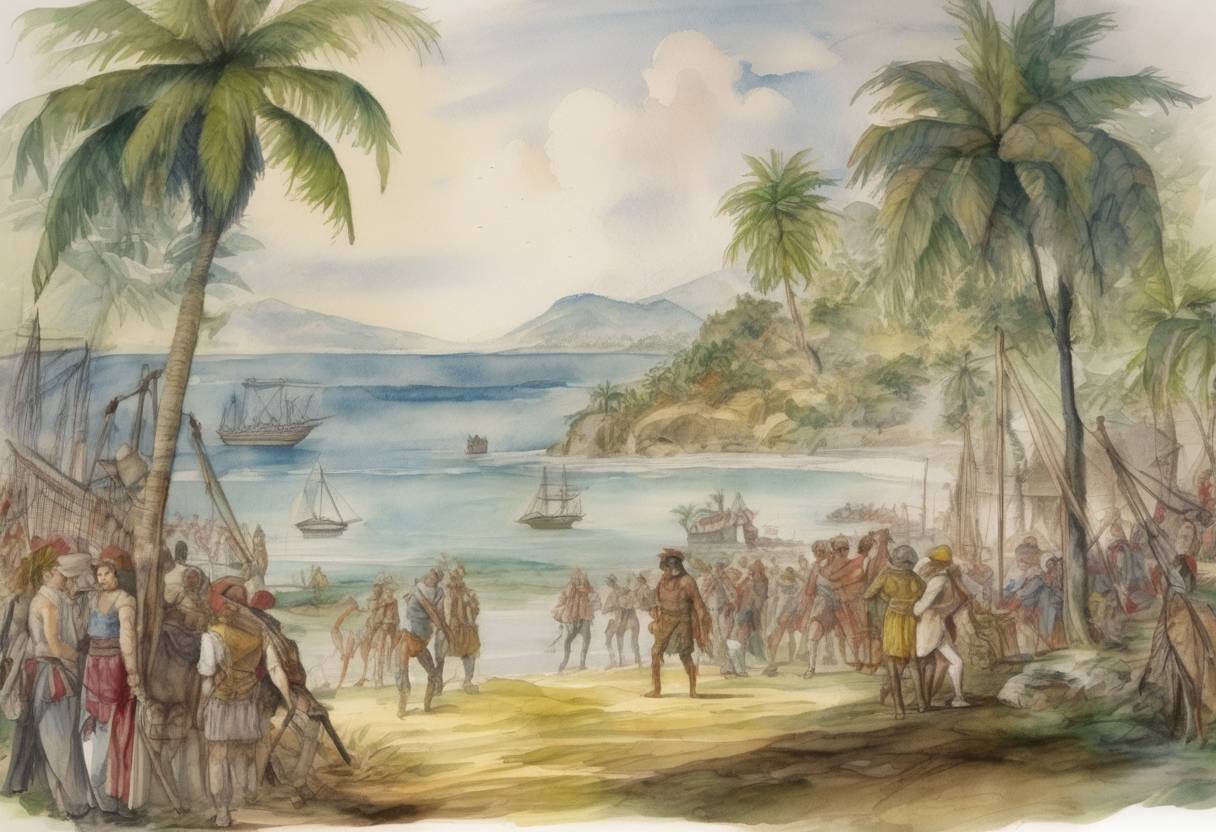
On May 5, 1494, during his second voyage to the New World, Christopher Columbus landed on the island of Jamaica. This event marked a significant moment in the Age of Exploration, as Columbus claimed the island for Spain, further expanding Spanish influence in the Caribbean.
Second Voyage (1493-1496): Columbus’s second voyage was much larger than his first, consisting of 17 ships and about 1,200 men. The primary goal was to establish Spanish colonies in the New World and continue the search for a westward route to Asia.
Previous Discoveries: Before reaching Jamaica, Columbus had already explored parts of the Caribbean, including the islands of Hispaniola (modern-day Haiti and the Dominican Republic) and Cuba, which he initially believed to be part of the Asian continent.
Discovery and Claim: Columbus arrived on the north coast of Jamaica on May 5, 1494. He named the island “Santiago” in honor of Saint James, although the indigenous Taíno people called it “Xaymaca,” meaning “Land of Wood and Water.”
Interaction with Indigenous Peoples: The Taíno inhabitants initially greeted Columbus and his crew with curiosity and hospitality. However, the arrival of Europeans eventually led to significant disruptions in their society due to disease, enslavement, and cultural changes.
Spanish Colonization: Although Columbus claimed Jamaica for Spain, it was not immediately colonized. It wasn’t until 1509 that the Spanish established a permanent settlement on the island, which became a strategic point for further exploration and conquest in the region.
Impact on Indigenous Populations: The arrival of Europeans had devastating effects on the indigenous populations of the Caribbean, including the Taíno of Jamaica. The introduction of European diseases, forced labor, and violent conflicts led to a dramatic decline in their numbers.
Legacy of Columbus’s Voyages: Columbus’s voyages opened the door for European exploration and colonization of the Americas, fundamentally altering the course of history. His landing in Jamaica was part of a broader pattern of European expansion that reshaped global trade, culture, and geopolitics.
Expansion of the Spanish Empire: The claim of Jamaica contributed to the expansion of the Spanish Empire, which became one of the largest and most powerful empires in history during the 16th and 17th centuries.
Cultural Exchange and Conflict: Columbus’s voyages initiated a period of cultural exchange and conflict known as the Columbian Exchange, which had profound effects on both the Old and New Worlds, including the exchange of crops, animals, and technologies, as well as the spread of diseases.
In summary, Columbus’s landing on Jamaica on May 5, 1494, was a pivotal event in the history of European exploration and colonization, with lasting impacts on the indigenous peoples of the Caribbean and the trajectory of global history.
Source: en.wikipedia.org