Establishment of Full Diplomatic Relations between Egypt and Israel
1980 · Cairo, Egypt
Egypt and Israel established full diplomatic relations following the Camp David Accords.
November 19, 1977
Egyptian President Anwar Sadat becomes the first Arab leader to officially visit Israel, meeting with Israeli Prime Minister Menachem Begin.
Jerusalem, Israel | Egyptian Government
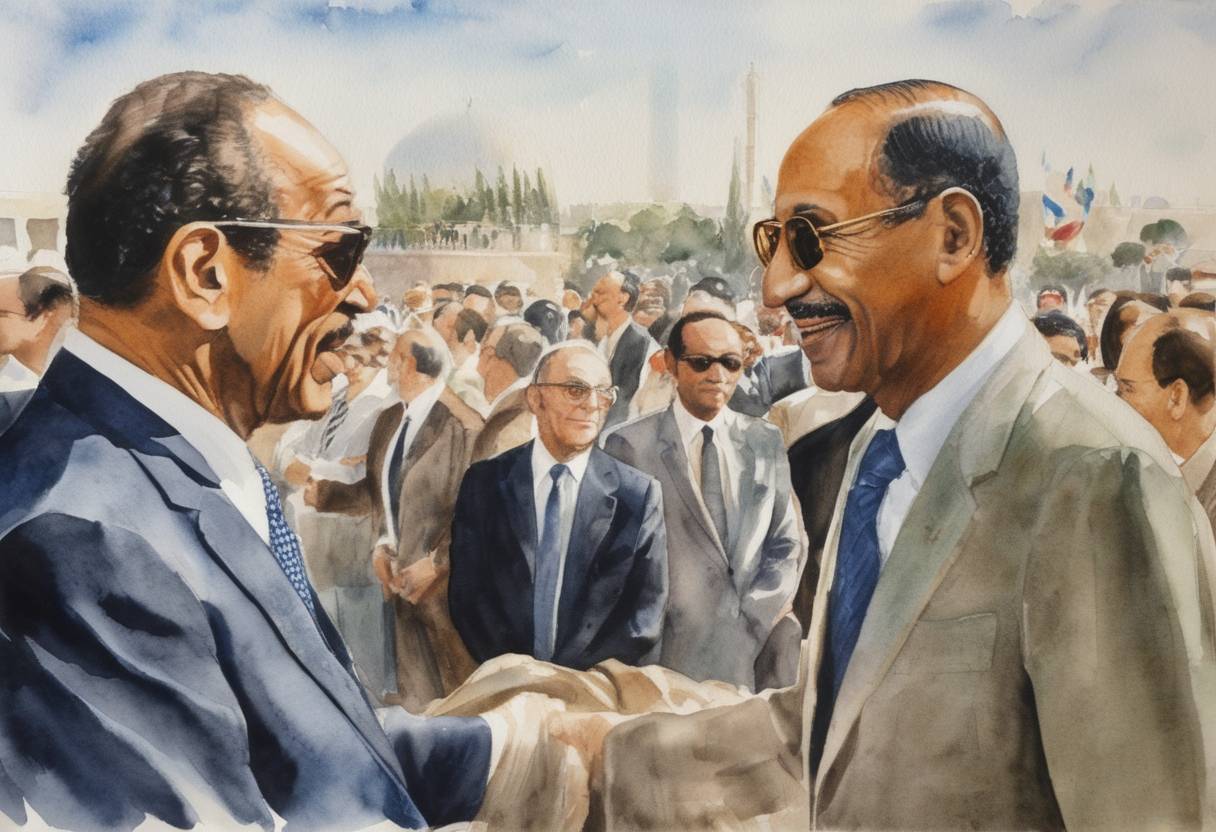
On November 19, 1977, Egyptian President Anwar Sadat made a groundbreaking visit to Israel, marking the first time an Arab leader officially visited the country. This unprecedented event took place amidst decades of hostility and was a critical moment in Middle Eastern history, signifying the potential for peace in a region long plagued by conflict.
The visit came after years of intense conflict between Israel and its Arab neighbors, most notably the Arab-Israeli wars in 1948, 1956, 1967, and 1973. The 1973 Yom Kippur War particularly underscored the persistent tensions, with Egypt and Syria launching a surprise attack on Israel. Despite these hostilities, Anwar Sadat had been increasingly signaling his interest in pursuing peace with Israel to ensure regional stability and economic growth for Egypt.
Anwar Sadat’s journey to Israel set in motion a series of events leading to the signing of the Camp David Accords in September 1978. Under the mediation of U.S. President Jimmy Carter, these accords laid the groundwork for the Egypt-Israel Peace Treaty, signed in 1979. This treaty established Egypt as the first Arab country to officially recognize Israel, significantly altering the geopolitical landscape of the Middle East.
Sadat’s bold move was met with both admiration and criticism. While it earned him international praise and the Nobel Peace Prize shared with Menachem Begin in 1978, it also led to domestic unrest and criticism from other Arab nations. Sadat’s peace initiative ultimately cost him his life when he was assassinated on October 6, 1981, by extremists within Egypt who opposed his rapprochement with Israel.
The visit symbolized a pivotal shift toward potential reconciliation in the Middle East. It highlighted the complex interplay between peace, politics, and regional diplomacy. Sadat’s actions opened the door for subsequent peace efforts and set a precedent for conflict resolution between Israel and its neighbors.
Source: www.history.com