Execution of King Charles I of England
1649 · London, England
King Charles I of England was executed for treason after being convicted by a High Court of Justice.
January 24, 1644
The Long Parliament in England formally executes Royalist commander William Laud, the Archbishop of Canterbury, signaling a significant power struggle during the English Civil War.
London, England | Long Parliament
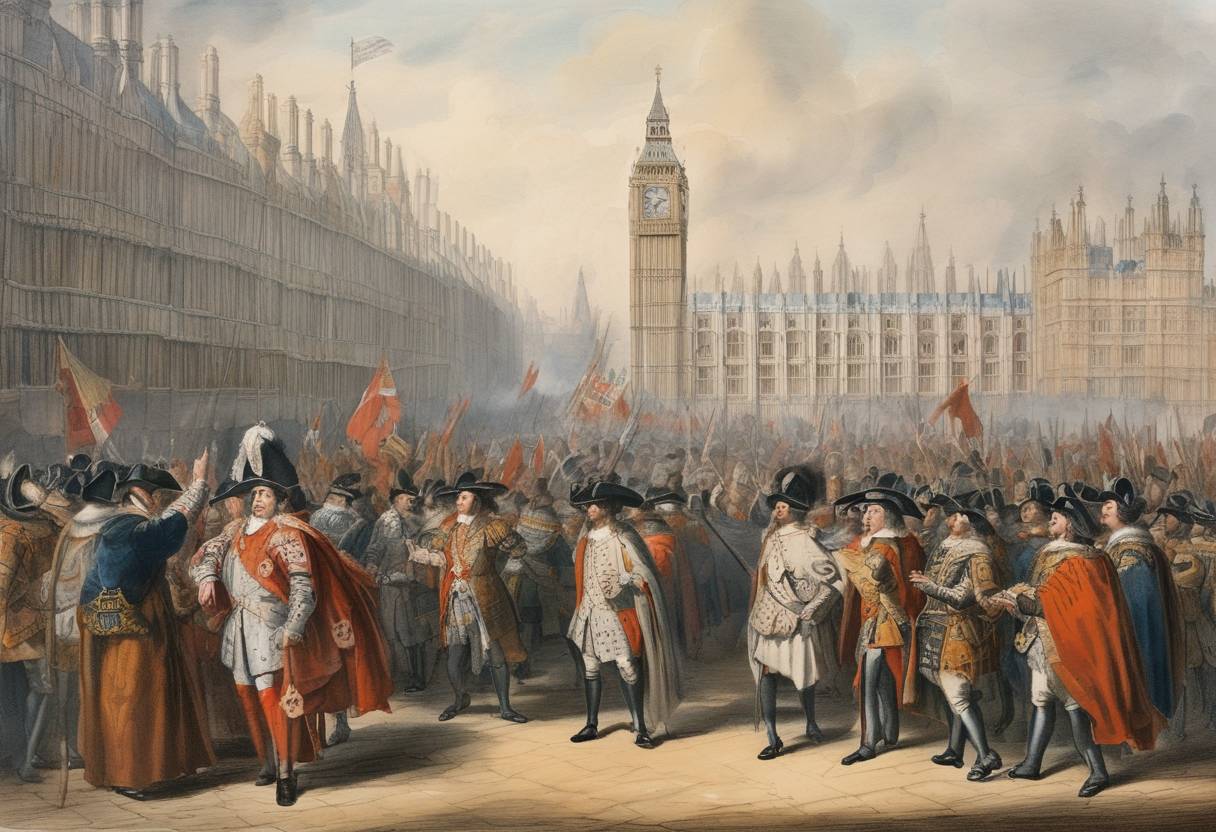
On January 24, 1645, William Laud, the Archbishop of Canterbury, was executed after being charged with high treason by the Long Parliament. This marked a significant point in the ongoing power struggle between the monarchy and Parliament during the English Civil War.
William Laud was a key figure in the Anglican Church and a staunch supporter of King Charles I. As Archbishop of Canterbury, Laud sought to impose a form of high liturgical practice that many in England viewed as too closely aligned with Catholicism. His reforms, known as Laudianism, sparked considerable controversy and resistance, particularly among Puritans who favored simpler forms of worship.
Laud’s close association with King Charles I and his unpopular religious reforms exacerbated tensions between the Crown and Parliament. This friction was part of a broader context of political and religious conflict that eventually erupted into the English Civil War (1642-1651).
In 1640, as tensions between the Crown and Parliament intensified, the Long Parliament was convened. Quickly, its members moved against Laud, accusing him of attempting to subvert the laws and governance of the Church of England to return it to papal control. In 1641, Laud was arrested and imprisoned in the Tower of London.
After prolonged imprisonment, Laud was brought to trial in 1644. Although the charges of treason were legally tenuous — as “treason” typically involved offenses against the state, not ecclesiastical matters — the trial was more a question of politics and power than justice.
On January 24, 1645, Archbishop Laud was beheaded on Tower Hill. His execution reflected the determination of Parliament to assert its authority and the shifting tides of power during the early years of the civil war. Laud’s death symbolized the broader move against the old hierarchy and the contentious reforms associated with the King.
The execution of William Laud highlighted the depth of division between the royalist supporters and the Parliamentarians. It was a resolution to the conflicts initiated by Laud’s policies, playing a role in the broader narrative of the English Civil War and the eventual trial and execution of King Charles I in 1649.
Laud’s demise was a critical chapter in the struggle to define the future of English governance and religion. The outcome of the English Civil War would ultimately lead to temporary abolition of the monarchy and establishment of a Commonwealth, followed by the Restoration in 1660.
Source: en.wikipedia.org