The Siege of Jerusalem (April 8, 70 CE)
70 · Jerusalem, Judea (modern-day Israel)
The Siege of Jerusalem by Roman forces commenced as part of the First Jewish-Roman War.
April 14, 0073
The Siege of Masada culminated in a mass suicide, ending the First Jewish–Roman War.
Masada, Roman Empire (modern-day Israel) | Roman Empire
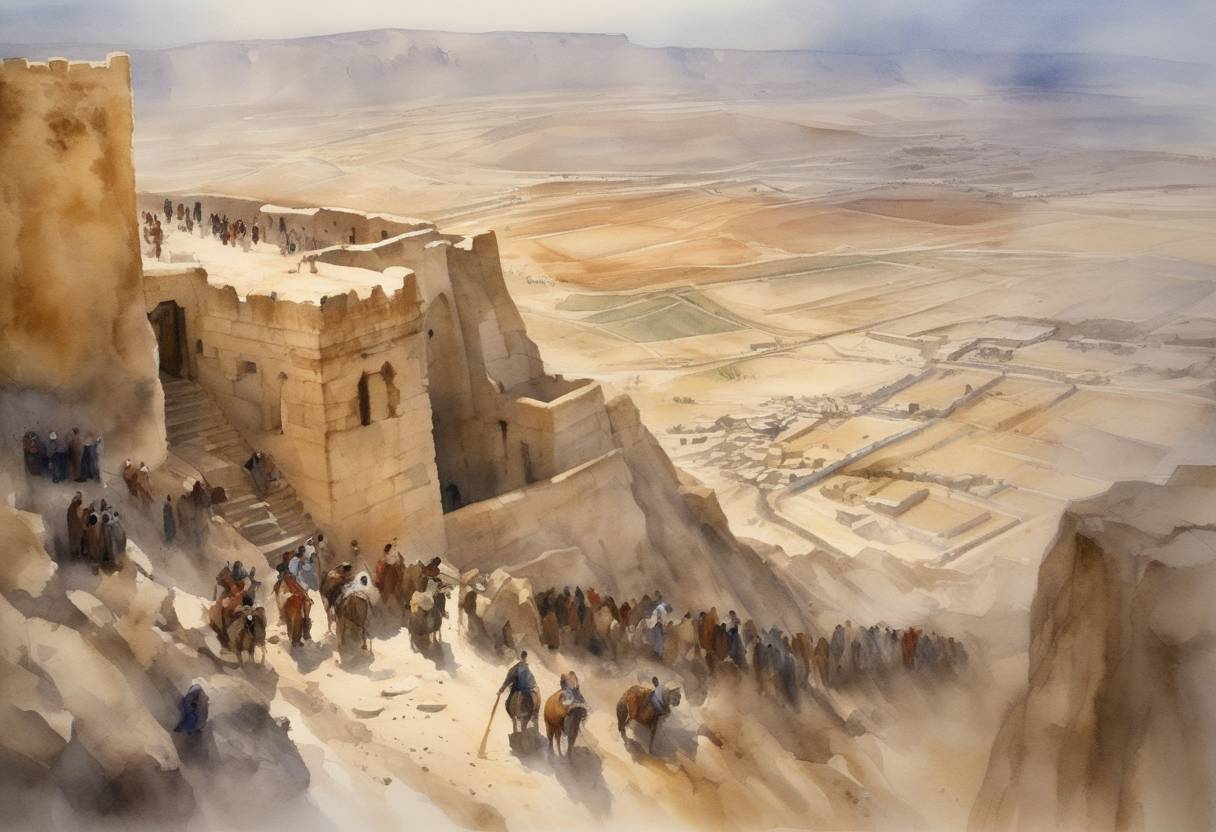
The conclusion of the Siege of Masada on April 14, 73 CE, marked a dramatic endpoint to the First Jewish–Roman War, a conflict that had profound implications for Jewish society and its diaspora. Masada, a formidable fortress atop a rock plateau in present-day Israel, had become a symbol of resistance against Roman occupation.
The First Jewish–Roman War (66-73 CE), also known as the Great Revolt, was sparked by religious tensions and oppressive Roman governance over Judea. As the revolt escalated, Jerusalem fell to Roman forces in 70 CE, leading to the destruction of the Second Temple—an event of immense religious and historical significance. The last stronghold of Jewish rebels was Masada, captured by a group of Sicarii zealots led by Eleazar ben Ya’ir.
Lucius Flavius Silva, the Roman governor of Judea, was tasked with besieging Masada. He commanded the Tenth Legion and auxiliary forces, which methodically constructed a circumvallation wall and a massive earthen ramp to breach the fortress’s defenses. This methodical military engineering was characteristic of the Roman approach to sieges.
After months of siege, with the completion of the ramp and siege tower, Roman forces breached the walls of Masada. According to the Jewish historian Flavius Josephus, the defenders—faced with certain defeat—chose death over enslavement. The mass suicide was purportedly carried out by mutual consent, leaving only two women and five children alive, hidden within the complex, to tell the tale of their last stand.
The fall of Masada marked the end of major hostilities in the First Jewish–Roman War and exemplified the lengths to which the Jewish rebels would go to assert their independence. Its aftermath precipitated a scattering of Jewish people across the Roman Empire, influencing diasporic communities for centuries. The story of Masada endures as a potent symbol of resistance and sacrifice in Jewish culture and history.
The accuracy of Josephus’s account is debated among historians, yet the site remains an archaeological and cultural landmark, attracting visitors and scholars worldwide to study its storied past. The siege underscores the enduring tension between imperial forces and subjugated peoples, a theme resonant throughout history.
Source: www.history.com