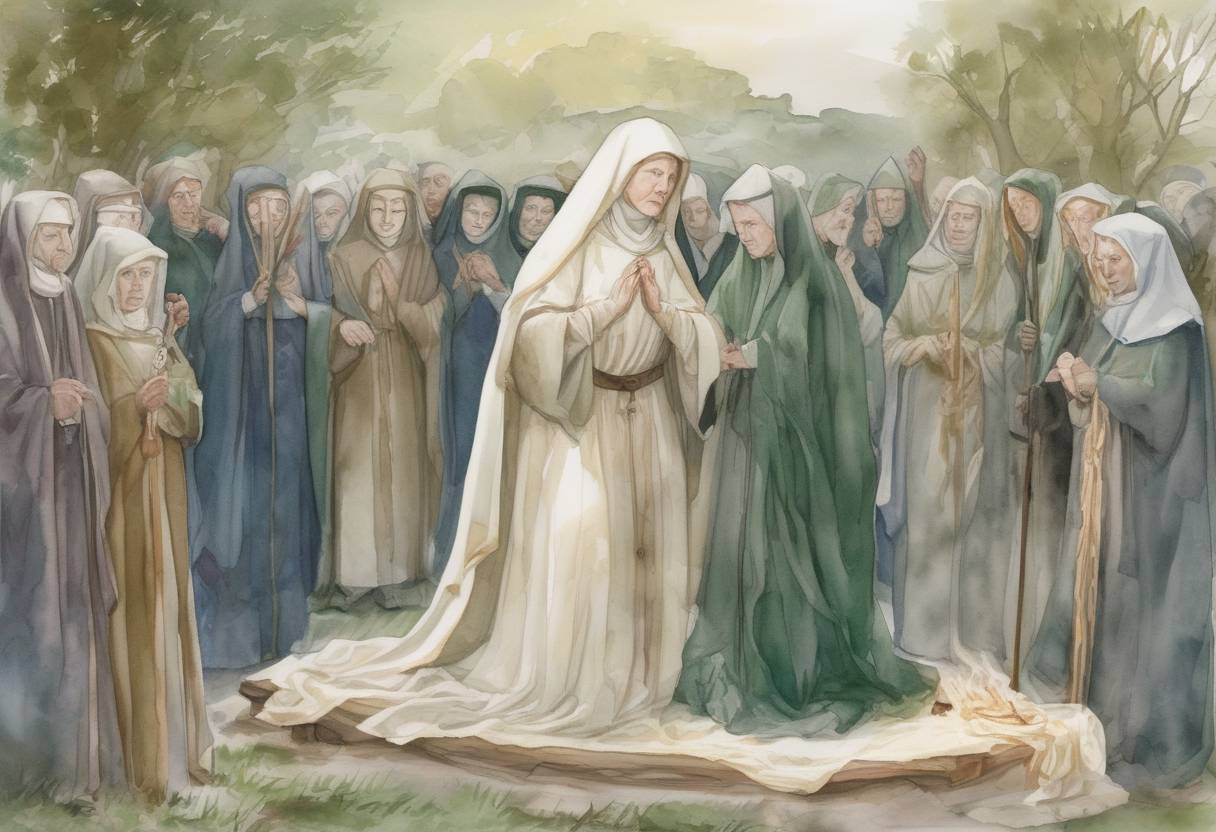
The Death of Saint Brigid of Kildare
Saint Brigid of Kildare, one of the patron saints of Ireland, is traditionally commemorated on February 1st, although her death is often noted as occurring on February 6, 523. She was a pivotal figure in early Irish Christianity, known for her role as a nun, abbess, and founder of several monasteries.
Early Life and Conversion
Brigid was born around 451 AD in Faughart, near Dundalk in modern-day County Louth, Ireland. According to tradition, her father was a chieftain named Dubhthach, and her mother was a slave named Brocca. From a young age, Brigid was known for her piety and charity, often giving away her family’s possessions to the poor.
Her conversion to Christianity is attributed to the influence of Saint Patrick, who was actively evangelizing in Ireland during her lifetime. Brigid’s commitment to the Christian faith led her to take vows as a nun.
Founding of Monasteries
Brigid is most renowned for founding the monastery at Kildare, which became one of the most important religious centers in Ireland. The site was originally a pagan shrine dedicated to the Celtic goddess Brigid, and the saint’s establishment of a Christian community there symbolized the transition from paganism to Christianity in Ireland.
The monastery at Kildare was unique in that it was a double monastery, housing both monks and nuns, and Brigid served as its abbess. This institution became a center of learning and spirituality, attracting scholars and pilgrims from across Europe.
Legacy and Sainthood
Saint Brigid’s influence extended beyond her lifetime, as she became a symbol of Irish Christianity and a model of Christian charity and hospitality. Her feast day, February 1st, coincides with the ancient Celtic festival of Imbolc, marking the beginning of spring, which further cemented her association with renewal and growth.
Brigid’s legacy is preserved in numerous legends and stories that highlight her miraculous deeds and deep compassion. She is often depicted with a cross made of rushes, known as St. Brigid’s Cross, which is traditionally hung in Irish homes for protection.
Historical Significance
Saint Brigid’s impact on Irish culture and religion is profound. As one of Ireland’s three patron saints, alongside Saint Patrick and Saint Columba, she played a crucial role in the Christianization of Ireland. Her life and works exemplify the integration of Christian and pre-Christian traditions, reflecting the cultural synthesis that characterized early medieval Ireland.
Her death on February 6, 523, marked the end of a life dedicated to faith and service, but her influence continues to be felt in Ireland and beyond. The monasteries she founded became centers of learning and preservation of Christian teachings during the early medieval period, contributing significantly to the cultural and spiritual heritage of Ireland.