Saint Wenceslaus I, Duke of Bohemia
935 · Stará Boleslav, Bohemia
Saint Wenceslaus I, Duke of Bohemia, is posthumously declared a martyr and saint, having been assassinated by his brother Boleslaus the Cruel in 935.
June 5, 0754
Saint Boniface, an influential missionary and archbishop, was martyred by Frisian bandits in Dokkum, present-day Netherlands, while on a mission to convert the Frisians to Christianity.
Dokkum, Frisia (modern-day Netherlands) | Christian Church
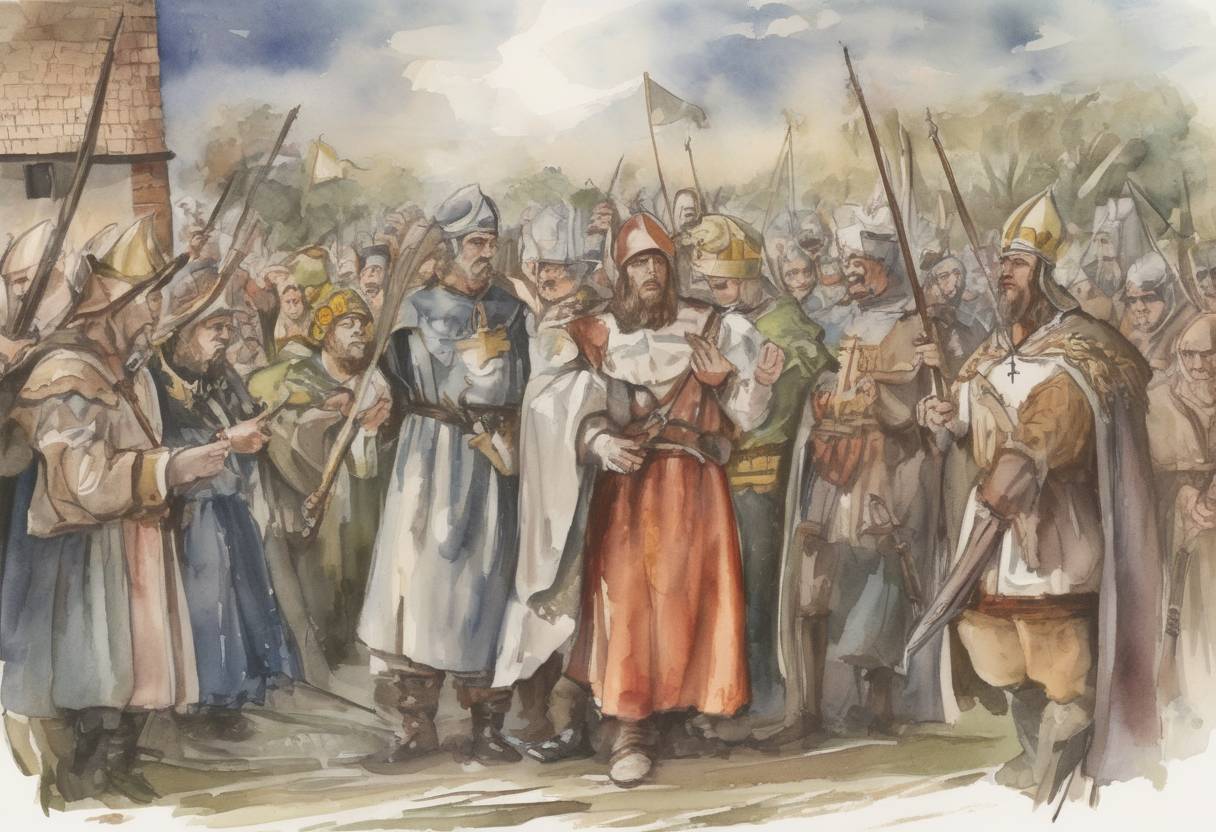
Saint Boniface, born as Winfrid around 675 in the Anglo-Saxon kingdom of Wessex, was a pivotal figure in the Christianization of the Germanic parts of the Frankish Empire during the early Middle Ages. His missionary work and ecclesiastical reforms earned him the title “Apostle of the Germans.”
Boniface was educated in Benedictine monasteries in England, where he became a monk and later a priest. His zeal for missionary work led him to travel to the European continent in 716, where he initially attempted to evangelize the Frisians. However, his efforts were thwarted by political instability and resistance from local pagan leaders.
In 718, Boniface traveled to Rome, where he received the blessing of Pope Gregory II. The Pope renamed him Boniface and commissioned him to spread Christianity among the Germanic tribes. Boniface’s subsequent missions in Hesse and Thuringia were more successful, and he is credited with founding several monasteries, including the influential Abbey of Fulda.
Boniface’s work extended beyond missionary activities. He was instrumental in reforming the Frankish church, aligning it more closely with Roman practices. In 732, he was appointed Archbishop of Mainz, which became a central hub for his ecclesiastical activities. Boniface also played a crucial role in organizing church councils and establishing diocesan structures in Germany.
Despite his successes, Boniface’s mission to convert the Frisians remained incomplete. In 754, at the age of nearly 80, he embarked on a final mission to Friesland. On June 5, 754, while camped near Dokkum in present-day Netherlands, Boniface and his companions were attacked by a group of armed bandits. These bandits, believed to be pagan Frisians opposed to his missionary efforts, martyred Boniface and his followers.
Saint Boniface’s martyrdom did not halt the spread of Christianity in the region. Instead, it galvanized further missionary efforts and solidified his status as a martyr and a saint. He was canonized shortly after his death, and his feast day is celebrated on June 5. Boniface’s legacy is evident in the Christianization of large parts of Europe and the strengthening of ties between the Frankish church and the Papacy.
His life and work remain a testament to the enduring impact of missionary zeal and ecclesiastical reform in shaping medieval Europe.
Source: en.wikipedia.org