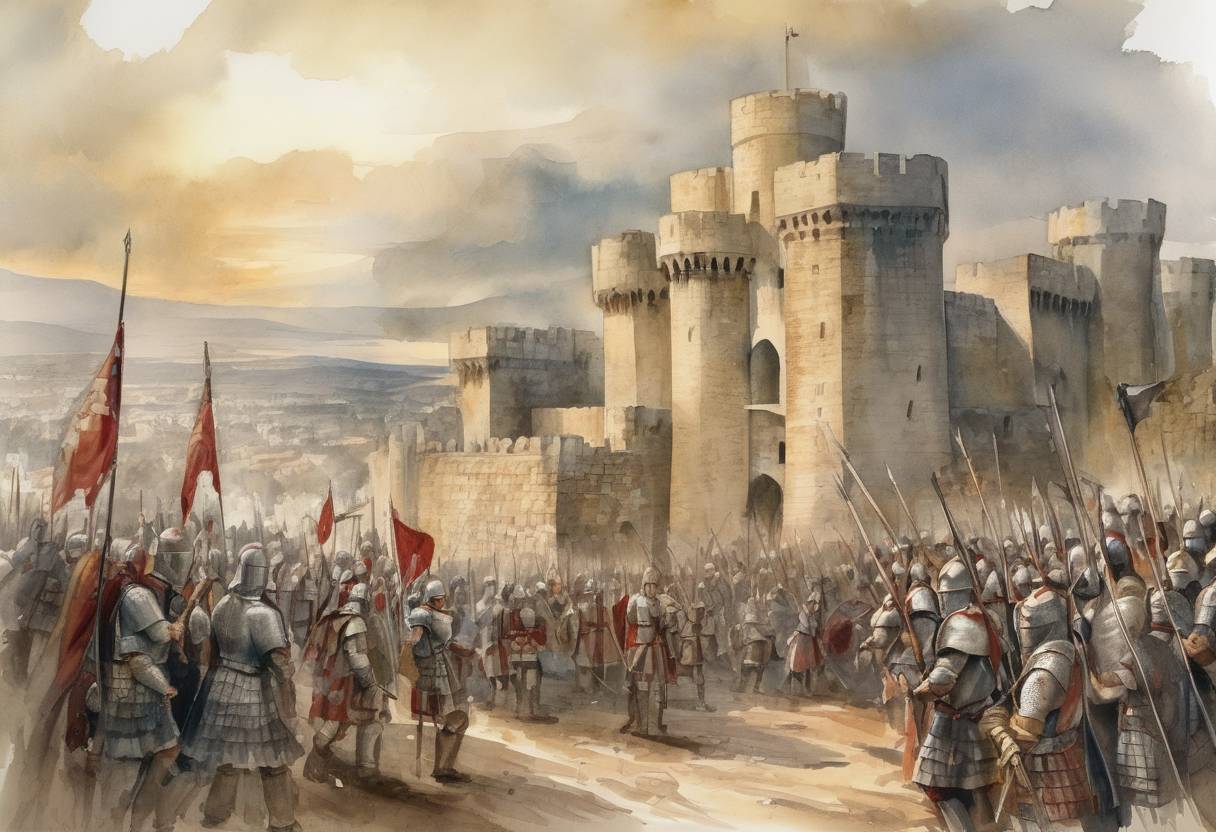
The Siege of Antioch: October 20, 1097
The Siege of Antioch, which began on October 20, 1097, was a crucial event during the First Crusade, marking a significant phase in the Crusaders’ efforts to capture key territories from the Seljuk Turks. This siege was led by prominent figures such as Godfrey of Bouillon, Bohemond of Taranto, and Raymond IV of Toulouse, among others. Antioch was a strategically vital city, serving as a gateway to the Levant and a major obstacle on the Crusaders’ path to Jerusalem.
Context and Prelude
The First Crusade was initiated in 1095 by Pope Urban II, who called for Western European Christians to aid the Byzantine Empire in reclaiming lands lost to Muslim conquests and to secure access to the Holy Land. By 1097, the Crusader forces, composed of various European nobles and their armies, had already achieved significant victories, including the capture of Nicaea and the Battle of Dorylaeum.
Antioch, located in modern-day Turkey, was a formidable city with strong fortifications and a diverse population. It was under the control of the Seljuk Turks, who had taken it from the Byzantine Empire in 1084. The city’s strategic importance made it a prime target for the Crusaders, who needed to secure their supply lines and establish a base for further operations in the region.
The Siege
The siege began on October 20, 1097, and would last for several months, characterized by a series of assaults, blockades, and negotiations. The Crusaders faced numerous challenges, including harsh winter conditions, limited supplies, and the threat of relief forces sent by the Seljuk Turks.
Leadership and Strategy: Godfrey of Bouillon, along with other leaders, coordinated the siege efforts, employing both military tactics and diplomatic maneuvers. The Crusaders constructed siege engines and attempted to breach the city’s walls, while also seeking to cut off Antioch’s supply routes.
Internal Strife and Morale: The prolonged siege tested the morale and unity of the Crusader forces. Internal disputes over leadership and strategy occasionally threatened their cohesion. However, the shared religious fervor and the promise of spiritual rewards kept many committed to the cause.
The Turning Point
The siege reached a turning point in early 1098 when Bohemond of Taranto negotiated with a disaffected Armenian guard named Firouz, who agreed to open a gate to the city. On the night of June 2-3, 1098, the Crusaders entered Antioch and captured it after intense fighting.
Aftermath and Significance
The capture of Antioch was a monumental victory for the Crusaders, but it was immediately followed by a counter-siege by a large Muslim relief army led by Kerbogha of Mosul. The Crusaders, now besieged themselves, managed to hold out and eventually defeated Kerbogha’s forces on June 28, 1098, thanks in part to the discovery of the Holy Lance, which boosted their morale.
The successful siege of Antioch solidified the Crusaders’ presence in the region and paved the way for their eventual march to Jerusalem. It also demonstrated the effectiveness of combined military and diplomatic strategies in overcoming formidable defenses. The fall of Antioch had long-lasting implications, establishing a Crusader state that would endure for nearly two centuries and influencing the geopolitical landscape of the Middle East.
In summary, the Siege of Antioch was a pivotal moment in the First Crusade, showcasing the determination and resilience of the Crusader forces and setting the stage for further conquests in the Holy Land.