Isaac Newton’s *Principia Mathematica* and the Royal Society
1687 · London, Kingdom of England
The first performance of Isaac Newton's Principia Mathematica is made at a meeting of the Royal Society.
July 5, 1687
Isaac Newton's 'Philosophiæ Naturalis Principia Mathematica' was published, laying the groundwork for classical mechanics.
London, England | Royal Society
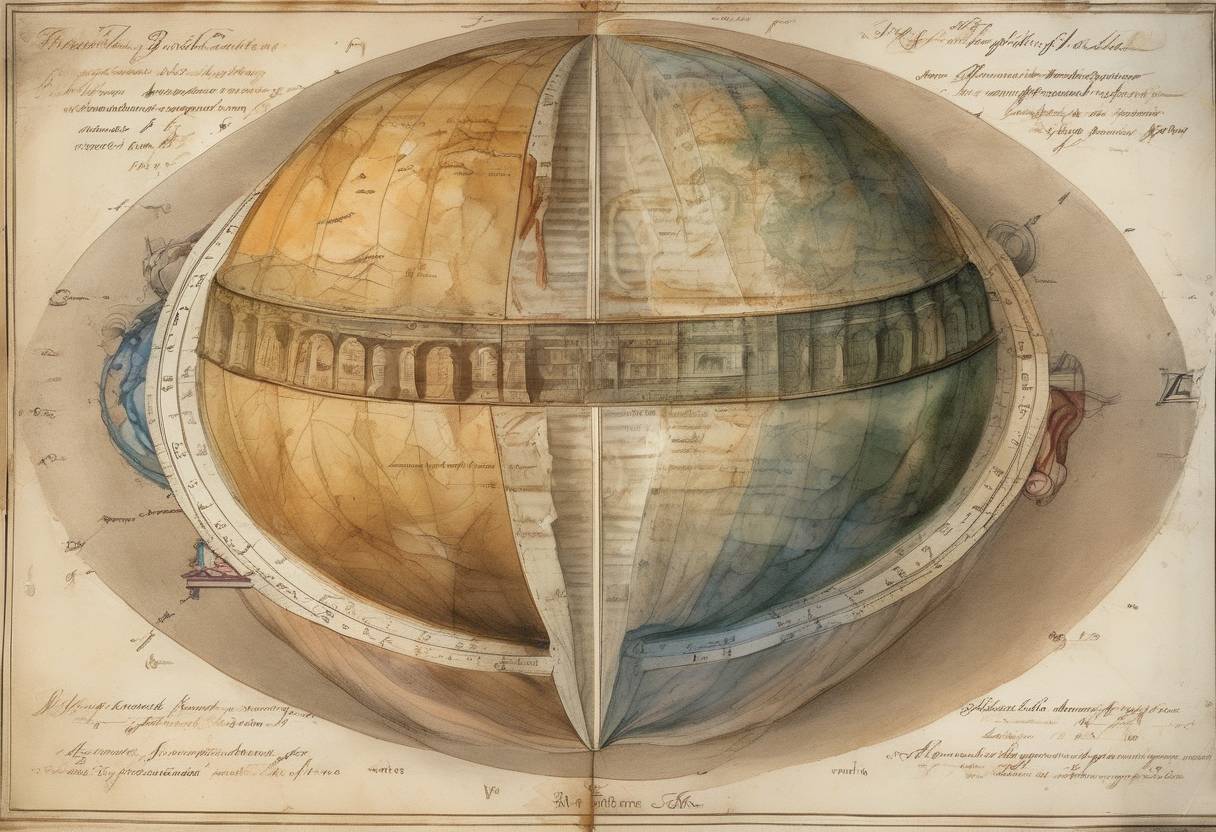
On July 5, 1687, Isaac Newton’s seminal work, Philosophiæ Naturalis Principia Mathematica (commonly known as the Principia), was published. This groundbreaking text laid the foundational principles for classical mechanics and significantly influenced the scientific revolution.
Isaac Newton: An English mathematician, physicist, and astronomer, Newton is one of the most influential scientists of all time. His work in mathematics, optics, and physics has had a lasting impact on the scientific community.
Scientific Revolution: The Principia was published during a period of profound scientific discovery and advancement in Europe, known as the Scientific Revolution. This era was marked by the development of new scientific methods and the questioning of traditional Aristotelian views.
Laws of Motion: Newton formulated the three laws of motion, which describe the relationship between a body and the forces acting upon it. These laws are:
Law of Universal Gravitation: Newton proposed that every particle of matter in the universe attracts every other particle with a force directly proportional to the product of their masses and inversely proportional to the square of the distance between their centers.
Mathematical Framework: The Principia introduced a rigorous mathematical framework for physics, utilizing calculus (though not explicitly named as such in the text) to solve problems related to motion and force.
Scientific Methodology: The Principia exemplified the application of mathematical principles to physical phenomena, setting a new standard for scientific inquiry and experimentation.
Influence on Future Scientists: Newton’s work profoundly influenced subsequent generations of scientists, including figures like Albert Einstein, who built upon Newtonian mechanics with his theory of relativity.
Foundation for Classical Mechanics: The principles outlined in the Principia remained the cornerstone of physics until the early 20th century when quantum mechanics and relativity emerged.
The publication of the Principia marked a pivotal moment in the history of science. It not only solidified Newton’s reputation as a leading scientist of his time but also transformed the way the natural world was understood and studied. The work continues to be a critical reference in the study of physics and the history of science.
In summary, the Principia was a monumental achievement that provided a comprehensive framework for understanding the physical universe, influencing countless scientific advancements and shaping the course of modern science.
Source: en.wikipedia.org