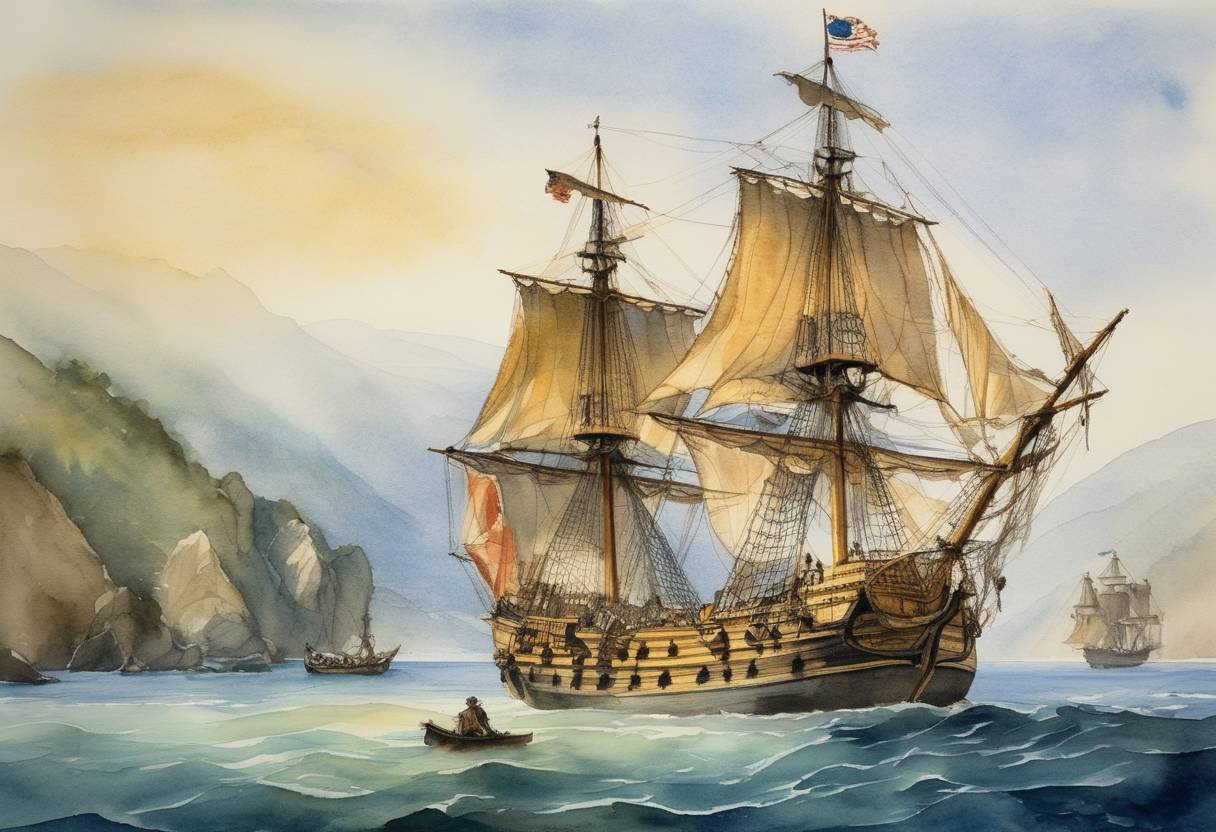
Sir Francis Drake Anchors the Golden Hind at Drake’s Bay, California on July 8, 1579
On July 8, 1579, Sir Francis Drake, the renowned English sea captain and privateer, anchored his ship, the Golden Hind, at a location tentatively identified as Drake’s Bay, California. This event marked a significant moment in the history of exploration and the global ambitions of Elizabethan England.
Background
- Sir Francis Drake’s Expedition: Commissioned by Queen Elizabeth I, Drake’s circumnavigation mission was primarily focused on expanding English knowledge and influence, as well as disrupting Spanish dominance over maritime trade routes.
- Voyage Details: The expedition began in December 1577, when Drake set sail with a fleet of five ships. The Golden Hind, originally named Pelican, became the flagship and ultimately the only ship to complete the journey.
- Challenges and Achievements: En route, the fleet faced numerous challenges, including intense storms, encounters with hostile fleets, and the need for navigational experimentation.
The Landing at Drake’s Bay
- Location Debate: The exact location of Drake’s landing has been subject to debate, but consensus leans towards a coastal inlet in what is now Marin County, California. Known today as Drake’s Bay, it is part of the Point Reyes National Seashore.
- Significance of the Landing: The stop at Drake’s Bay was crucial for the repair of the Golden Hind and allowed Drake and his crew to interact with the local indigenous population, who were mostly Coast Miwok people.
- Claiming the Land: During the approximately five-week stay, Drake claimed the land for England, dubbing it “Nova Albion” (New England), and effectively marking the northernmost point of documented European exploration along the West Coast of North America at that time.
Aftermath and Historical Impact
- Continuation of the Voyage: After completing repairs and resupplying, Drake continued his circumnavigation, eventually returning to England in 1580. His successful return made him the first Englishman to circumnavigate the globe and significantly bolstered English maritime prestige.
- Impact on English Expansion: Drake’s landing and subsequent claim laid the groundwork for future English territorial ambitions and exploration along the western coast of the Americas.
- Legacy: Sir Francis Drake’s expedition is remembered as a landmark achievement of the Elizabethan era, showcasing the growing prowess and ambition of England on the global stage. The location of Drake’s Bay remains a historically significant site, celebrating a moment of early contact between Europeans and the indigenous peoples of the Americas.
Recognition and Commemoration
- Drake Navigators Guild: Modern efforts by historian groups and institutions maintain ongoing research and archaeological projects aimed at further understanding the exact details and impacts of Drake’s anchorage at this site.
- Protected Site: Drake’s Bay is now a protected historical site within the Point Reyes National Seashore, reflecting its enduring significance in American and British history.