Albert Einstein and the General Theory of Relativity
1916 · Berlin, Germany
Albert Einstein published his general theory of relativity, revolutionizing the understanding of gravity and physics.
October 19, 1900
Max Planck, a German physicist, presents his groundbreaking paper on Planck's Law of Black Body Radiation, which leads to the development of quantum theory.
Berlin, Germany | Berlin University
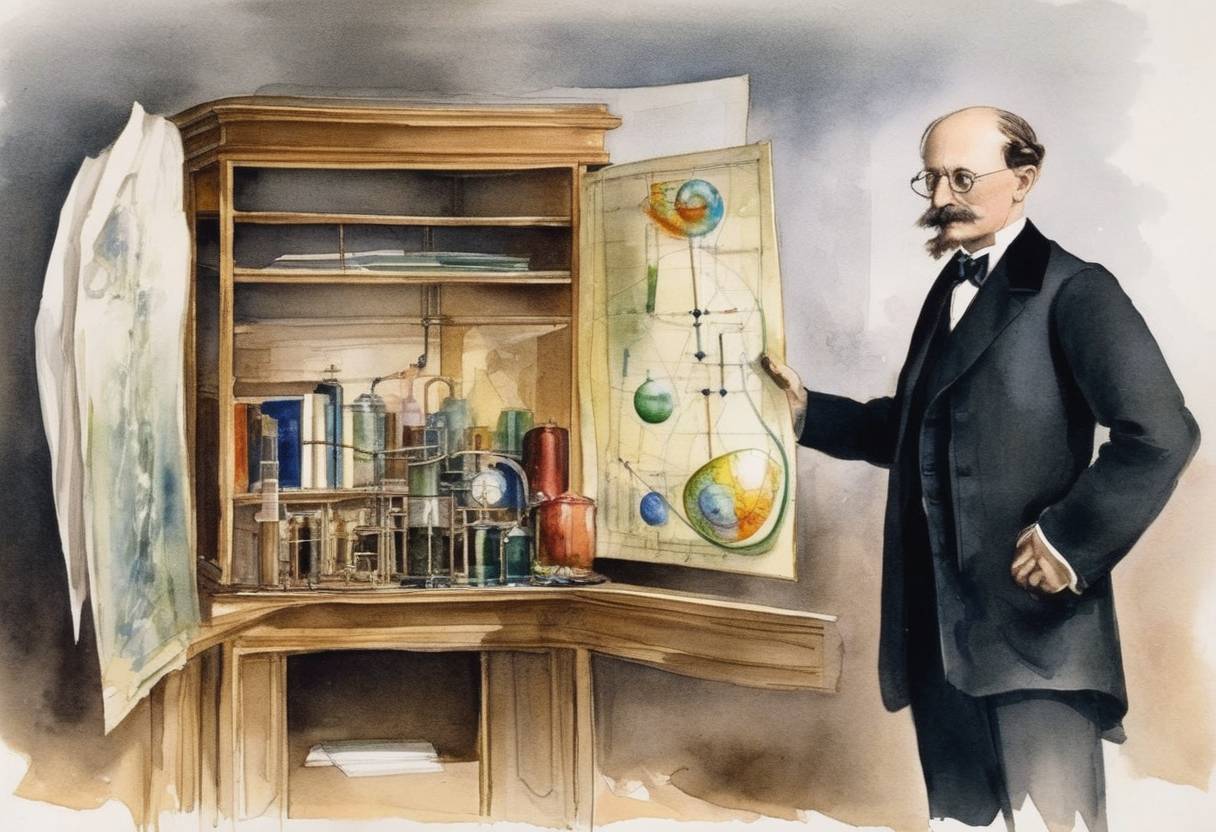
On October 19, 1900, in Berlin, the German physicist Max Planck introduced a pivotal scientific breakthrough that would fundamentally alter the understanding of physics. During a meeting of the German Physical Society, Planck presented his theoretical work on black body radiation, which would later be recognized as Planck’s Law. This was a significant step that laid the groundwork for the development of quantum theory.
In the late 19th century, the issue of black body radiation was a major unsolved problem in physics. According to classical physics, as described by theories like Rayleigh-Jeans Law, an ideal black body, which absorbs all incident electromagnetic radiation, should emit radiation in a pattern that was increasingly intense at shorter wavelengths, leading to the so-called “ultraviolet catastrophe.” This prediction, however, did not match experimental observations, which showed that the intensity of radiation emitted at shorter wavelengths actually decreases.
Max Planck approached this conundrum by proposing that electromagnetic energy could be emitted only in discrete units, or “quanta.” On October 19, 1900, he introduced this radical concept by suggesting that the energy of these quanta was proportional to the frequency of the radiation, with the proportionality constant later named Planck’s constant (h). Planck’s equation, E = hν, where E is energy and ν is frequency, elegantly resolved the discrepancies between theory and observation for black body radiation.
Planck’s introduction of energy quanta was initially met with skepticism, as it contradicted the well-established classical physics framework. However, its success in explaining black body radiation could not be ignored, and it gradually gained acceptance.
Planck’s presentation on October 19, 1900, marks a defining moment in the history of science, illustrating how innovative thinking can profoundly reshape our understanding of the natural world.
Source: www.nobelprize.org