Italian Troops Enter Rome: The Unification of Italy
1870 · Rome, Italy
Italian troops entered Rome, completing the unification of Italy and marking the end of the Papal States.
October 7, 1870
Italian forces captured Rome, marking its annexation to the Kingdom of Italy. This event effectively completed the unification of Italy as Rome became the capital of the Kingdom.
Rome, Italy | Kingdom of Italy
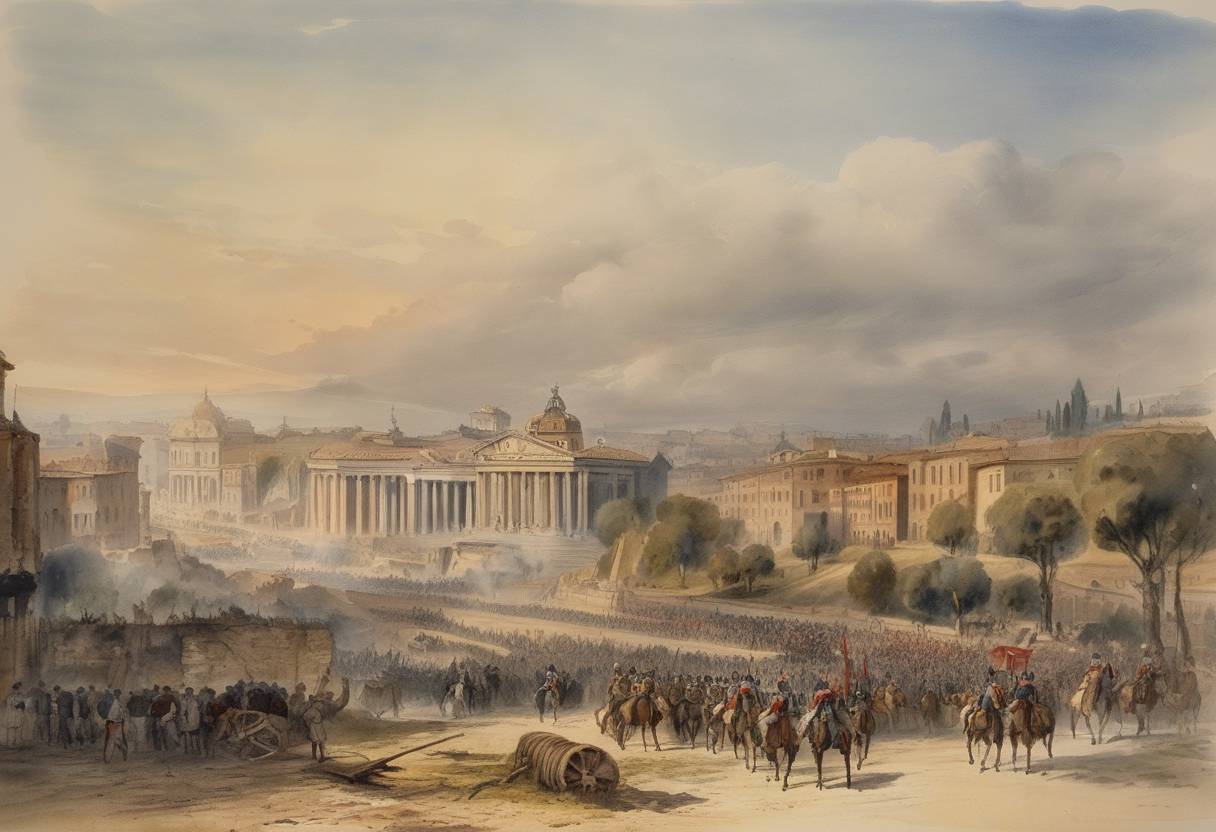
On October 7, 1870, Italian forces captured Rome, a pivotal event in the unification of Italy, which led to the annexation of Rome to the Kingdom of Italy. This event marked the completion of the Italian unification process, known as the Risorgimento, a series of political and military events that consolidated disparate states of the Italian Peninsula into the single state of Italy.
The Franco-Prussian War: The capture of Rome took place in the broader context of the Franco-Prussian War (1870-1871). The involvement of France in this war necessitated the withdrawal of French garrison troops from Rome, which were essential to the Papal States’ defense. This withdrawal weakened papal defenses and provided a timely opportunity for the Kingdom of Italy to annex Rome.
Italian Unification Efforts: For over a decade, leaders like Giuseppe Garibaldi and Count Camillo di Cavour had spearheaded efforts to unify Italy. By 1861, most of the Italian peninsula was unified under King Victor Emmanuel II, except for the Papal States and Venice.
Diplomatic Deliberations: Italy initially sought a diplomatic solution, attempting to negotiate with the Papacy for a peaceful transfer of power. However, Pope Pius IX refused any suggestion that compromised his temporal power.
Italian Offensive: On September 11, 1870, Italian troops began the invasion of Rome, leading with General Raffaele Cadorna. They encountered little resistance at the Porta Pia, a portion of Rome’s Aurelian Walls, due to the diminished capacity of the Papal army.
The Breach: The decisive moment occurred on September 20, 1870, when Italian forces breached the walls near Porta Pia, enabling them to enter the city. This event is commonly referred to as the “Breaching of Porta Pia.”
The Aftermath: Following these events, a plebiscite was held in October 1870, where the population overwhelmingly voted in favor of joining the Kingdom of Italy. Rome officially became the capital of the newly unified Italy shortly thereafter.
Papal Response: Pope Pius IX retreated into the Vatican, refusing to acknowledge the loss of temporal power. This event marked the beginning of the “Roman Question,” a period of contested legality over the Pope’s political role that persisted until the Lateran Treaty of 1929.
Complete Unification: Rome’s annexation symbolized the culmination of the Risorgimento. It positioned Rome as a symbolic and actual center of the new Italian Kingdom, marking a significant transformation in European geopolitics.
Cultural and Political Legacy: The unification and establishment of Rome as the capital bolstered Italian nationalism and brought myriad socio-political changes, laying the groundwork for Italy’s development as a modern nation-state.
The capture of Rome remains a cornerstone in Italian history, representing the realization of a long-held aspiration for unification and national identity.
Source: en.wikipedia.org