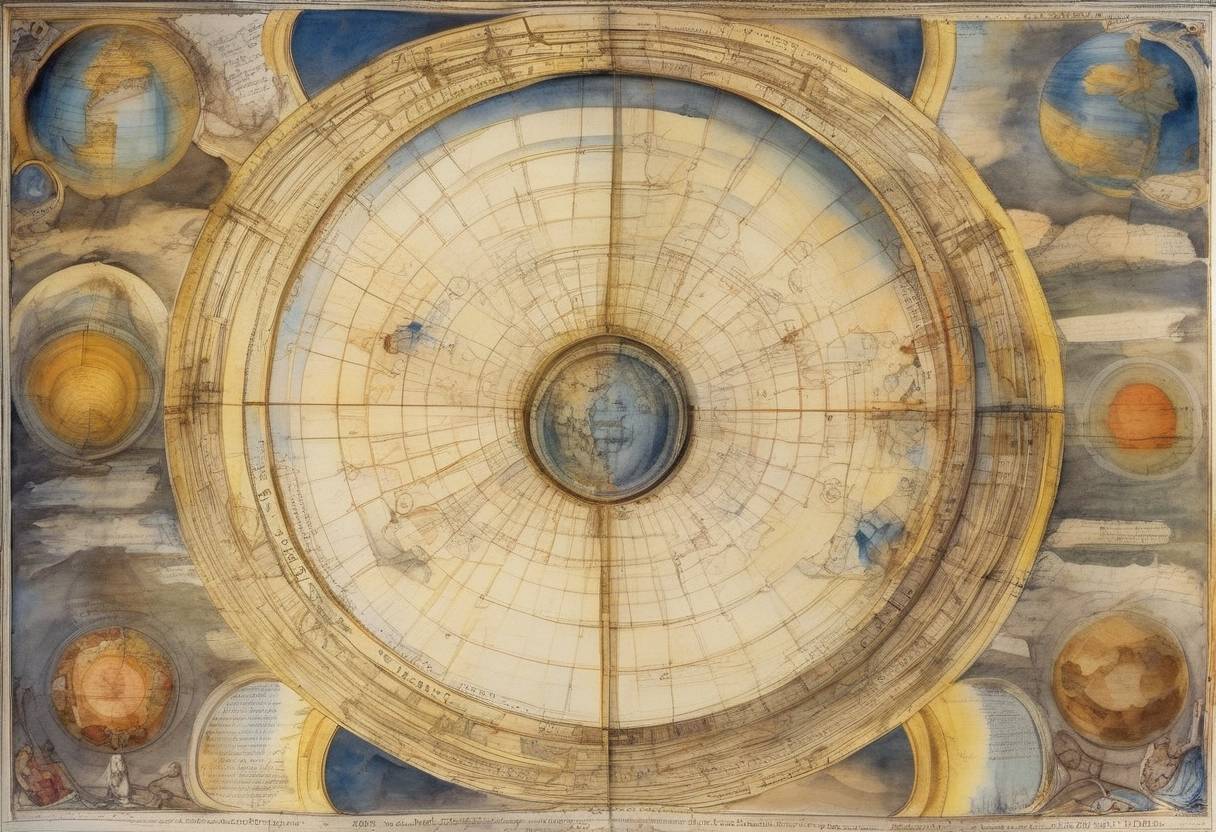
Publication of “Dialogue Concerning the Two Chief World Systems”
On February 22, 1632, Galileo Galilei’s seminal work, Dialogue Concerning the Two Chief World Systems (Dialogo sopra i due massimi sistemi del mondo), was published in Florence, Italy. This book marked a pivotal moment in the history of science, as it presented a comprehensive comparison between the Copernican heliocentric model and the traditional Ptolemaic geocentric system.
Context and Background
Galileo Galilei: An Italian astronomer, physicist, and polymath, Galileo was a key figure in the Scientific Revolution. His support for the Copernican system, which posited that the Earth and other planets revolve around the Sun, was controversial at a time when the geocentric model, endorsed by the Catholic Church, was the accepted cosmological view.
Copernican System: Proposed by Nicolaus Copernicus in the 16th century, this model suggested that the Sun, rather than the Earth, was at the center of the universe. It challenged the long-standing Ptolemaic system, which placed the Earth at the center.
Ptolemaic System: Based on the work of Claudius Ptolemy, this geocentric model was widely accepted in the medieval world and was deeply integrated into the theological and philosophical doctrines of the time.
Content and Structure
Dialogue Format: The book is structured as a dialogue among three characters: Salviati, who argues for the Copernican system; Simplicio, who defends the Ptolemaic system; and Sagredo, an intelligent layman who moderates the discussion. This format allowed Galileo to present the arguments for and against each system in a dynamic and engaging manner.
Scientific Arguments: Galileo used observational evidence, such as the phases of Venus and the moons of Jupiter, to support the heliocentric model. He also discussed the implications of these observations for the understanding of motion and celestial mechanics.
Impact and Consequences
Controversy: The publication of the Dialogue intensified the scrutiny Galileo faced from the Catholic Church. In 1616, the Church had already declared the Copernican model heretical. The Dialogue was perceived as a direct challenge to Church doctrine.
Trial and Condemnation: In 1633, Galileo was summoned to Rome and tried by the Roman Inquisition. He was found “vehemently suspect of heresy” and was forced to recant his support for heliocentrism. Galileo spent the remainder of his life under house arrest.
Legacy: Despite the immediate consequences for Galileo, the Dialogue played a crucial role in the eventual acceptance of the heliocentric model. It laid the groundwork for future scientific inquiry and is considered a cornerstone of modern astronomy.
Broader Historical Significance
Galileo’s Dialogue exemplifies the tension between science and religion during the Scientific Revolution. It highlights the challenges faced by early scientists in advocating for evidence-based understanding of the natural world. The book’s publication is a landmark event that underscores the transformative power of scientific ideas and their ability to reshape human understanding of the universe.