Howard Carter and Lord Carnarvon Enter Tutankhamun's Tomb on November 26, 1922
1922 · Luxor, Egypt
Howard Carter and Lord Carnarvon enter the tomb of Pharaoh Tutankhamun.
August 15, 1799
The Rosetta Stone, crucial to deciphering Egyptian hieroglyphs, was discovered by French soldier Pierre-François Bouchard during Napoleon's campaign in Egypt.
Rosetta, Egypt
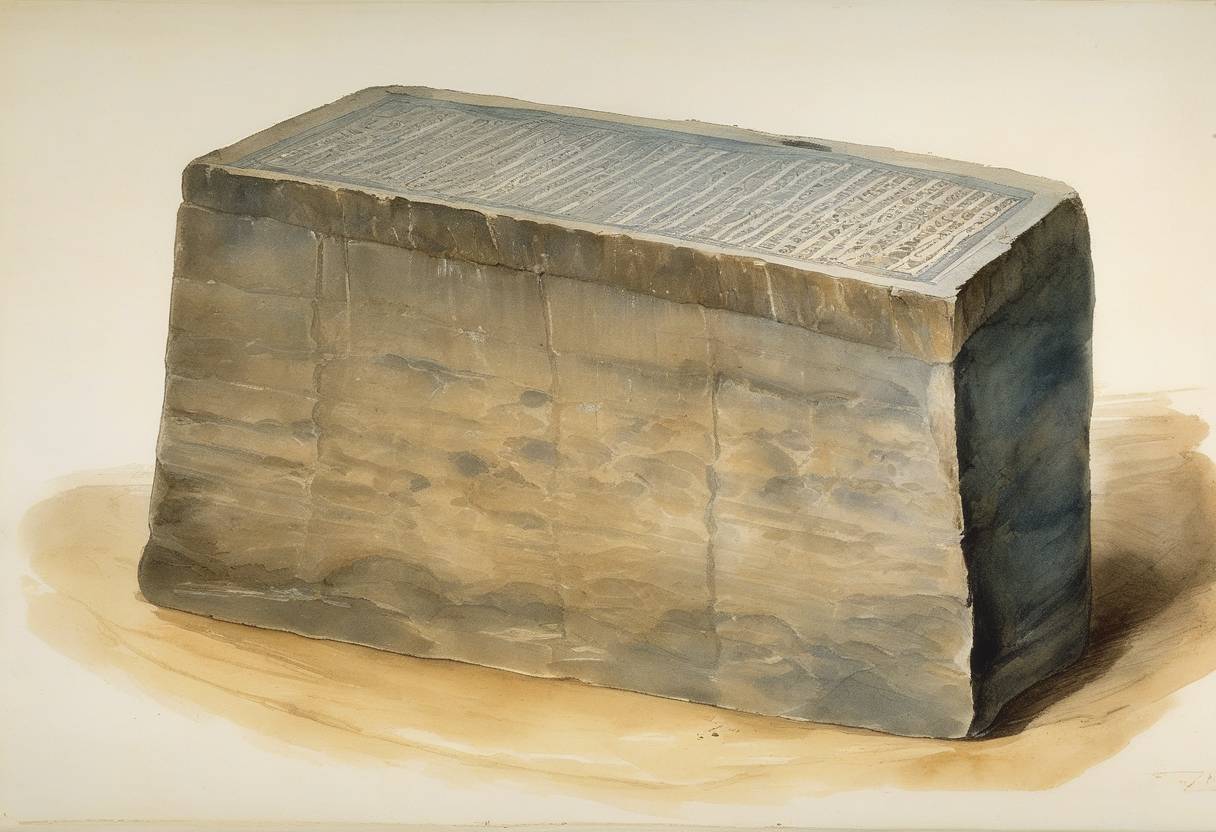
The Rosetta Stone, a granodiorite stele, was discovered on August 15, 1799, by French soldier Pierre-François-Xavier Bouchard during Napoleon Bonaparte’s campaign in Egypt. The discovery occurred in the town of Rosetta (modern-day Rashid) in the Nile Delta, as part of the larger French expedition to Egypt, an effort both military and scholarly.
Napoleon’s Egyptian expedition, which began in 1798, aimed to undermine British access to India and was seen as both a military maneuver and a scientific exploration. The campaign included a significant contingent of scholars and scientists, collectively known as the Commission des Sciences et des Arts, accompanying the military forces. Their mission was to document and study the historical and cultural sites of Egypt.
The Rosetta Stone proved instrumental in developing the understanding of Egyptian hieroglyphs, which had been undecipherable until its discovery. It is a carved stone slab featuring a decree issued in 196 BCE by King Ptolemy V. What made the stone exceptional was its inscription in three scripts: Greek, Demotic, and hieroglyphic. This tripartite text allowed scholars to use the known Greek script to understand the meanings of the other two.
The Rosetta Stone’s significance became evident to scholars across Europe. Notably, Thomas Young, an English polymath, and Jean-François Champollion, a French scholar, played pivotal roles in deciphering the hieroglyphic script. Champollion is particularly celebrated for successfully identifying and interpreting the phonetic characters, laying the groundwork for modern Egyptology.
Following its discovery, the Rosetta Stone was transported to the British Museum in London, where it remains on display today. The decipherment of the hieroglyphs opened a window into ancient Egyptian civilization, allowing historians to unveil vast aspects of Egypt’s history, language, and culture.
The discovery of the Rosetta Stone marked a turning point in the field of archaeology and the study of ancient languages, fundamentally shaping modern understanding of ancient Egypt. Its accidental uncovering was a serendipitous event that bridged millennia of silent history by unlocking the lost language of the pharaohs.
Source: www.britannica.com