Discovery of the Higgs Boson Particle
2012 · Geneva, Switzerland
The discovery of the Higgs boson particle was announced by scientists at CERN, confirming a key part of the Standard Model of particle physics.
March 30, 2010
The Large Hadron Collider (LHC) at CERN achieved its first high-energy collisions, marking a significant milestone in particle physics.
Geneva, Switzerland | CERN
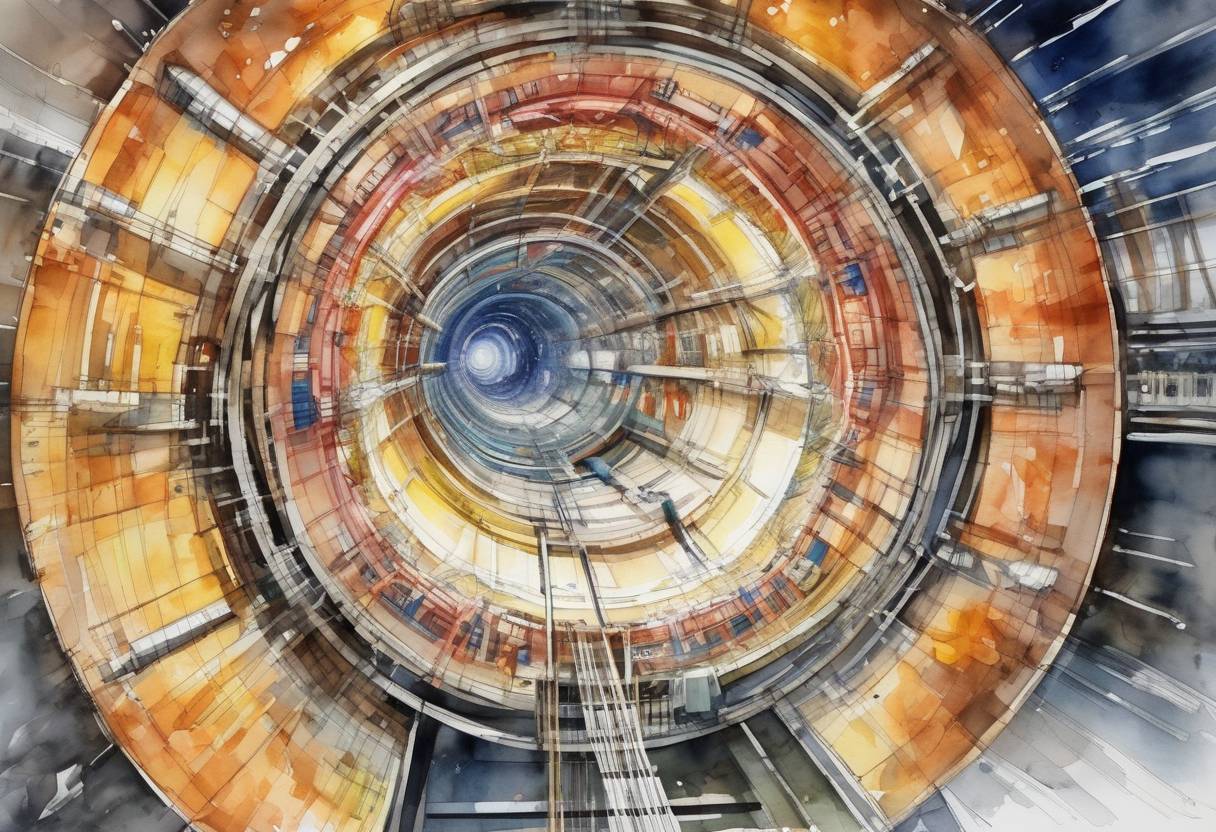
On March 30, 2010, the Large Hadron Collider (LHC) at CERN achieved its first high-energy collisions, marking a pivotal moment in the field of particle physics. This event was the culmination of years of planning, construction, and testing, and it represented a significant milestone in the quest to understand the fundamental components of the universe.
The LHC is the world’s largest and most powerful particle accelerator, located at CERN (the European Organization for Nuclear Research) near Geneva, Switzerland. It was designed to explore some of the most profound questions in physics, including the origins of mass, the nature of dark matter, and the conditions of the early universe.
On March 30, 2010, the LHC successfully collided protons at an unprecedented energy level of 7 tera-electronvolts (TeV), which was three times higher than any previous collider had achieved. This event was a crucial test of the LHC’s capabilities and a major step forward in particle physics research.
The LHC’s first high-energy collisions opened new avenues for research in particle physics. It enabled scientists to probe deeper into the structure of matter and the forces that govern the universe. The data collected from these experiments has continued to enhance our understanding of fundamental physics and has inspired further developments in technology and international scientific collaboration.
Following this milestone, the LHC has undergone several upgrades to increase its energy and luminosity, allowing for even more precise and varied experiments. The insights gained from the LHC continue to shape the future of particle physics and our comprehension of the universe.
In summary, the successful high-energy collisions at the LHC on March 30, 2010, marked a turning point in scientific exploration, setting the stage for numerous discoveries and advancements in the years that followed.
Source: home.cern